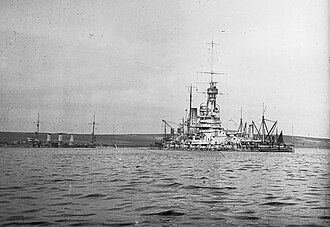
SMS Baden: The Last German Battleship of the Imperial Navy
SMS Baden was one of the most powerful battleships completed by the Imperial German Navy during the First World War and the only Bayern-class battleship, apart from her sister SMS Bayern, to enter active service. Launched in 1915 and commissioned in March 1917, Baden represented the culmination of German dreadnought battleship design during the First World War. Armed with eight powerful 38 cm guns, protected by heavy armor, and capable of more than 21 knots, she was intended to serve as a central unit of the German High Seas Fleet. Yet history gave the ship very little opportunity to demonstrate her combat power. By the time Baden entered service, the decisive Battle of Jutland had already taken place, and the strategic situation in the North Sea increasingly favored caution rather than another major fleet confrontation. Baden consequently spent much of her short career training, conducting limited operations, and serving as the flagship of the High Seas Fleet rather than fighting a major surface battle. After Germany’s defeat in 1918, she was interned at Scapa Flow with the German fleet. When Rear Admiral Ludwig von Reuter ordered the fleet scuttled on June 21, 1919, Baden became the only major German capital ship that the British succeeded in preventing from sinking. She was subsequently salvaged, extensively examined by the Royal Navy, and finally destroyed as a gunnery target in 1921. Her unusual postwar fate made Baden particularly valuable to British naval intelligence and helped preserve her place in naval history.
The Birth of the Bayern-Class Battleships
Germany’s final dreadnought generation
The Bayern class was developed during an important stage in the evolution of German battleship design. The Imperial German Navy had spent years competing with Britain in an increasingly expensive naval arms race, and each new generation of dreadnoughts attempted to improve upon the previous one through heavier guns, better protection, greater speed, and more sophisticated fire-control arrangements. Baden was ordered in 1912 under the provisional name Ersatz Wörth, meaning that she was intended to replace the older battleship Wörth. Her keel was laid down at the Schichau-Werke shipyard in Danzig on December 20, 1913, but the outbreak of the First World War disrupted the construction schedule. The ship was finally launched on October 30, 1915, and after an extended fitting-out and trial period, she was commissioned on March 14, 1917.
Baden was the second and final Bayern-class battleship completed. Her sister Bayern entered service earlier, while Sachsen and Württemberg remained incomplete when the war ended. This meant that Baden became the last battleship actually completed for the Imperial German Navy during the First World War. In terms of design, she represented the point at which German naval architects had moved decisively toward heavier main batteries while retaining the strong protection and underwater defense for which German capital ships were known. Her eight 38 cm guns were especially significant because they represented a major increase in caliber compared with earlier German dreadnoughts.
Design and Construction of SMS Baden
A large and heavily protected battleship
At approximately 180 meters in length and 30 meters in beam, Baden was an imposing vessel by the standards of her period. Her designed displacement was approximately 28,530 metric tons, while her full combat displacement could rise to roughly 32,200 tons. This made her larger than preceding German battleships and one of the most substantial vessels constructed by the Imperial Navy. Her dimensions reflected the demands of carrying heavy artillery, extensive armor, large machinery spaces, ammunition magazines, fuel, crew accommodations, and the equipment required for sustained fleet operations.
Protection was one of Baden’s most important characteristics. Her main armored belt reached approximately 170 mm in some sections and was considerably heavier around vital areas, while the main gun turrets, conning tower, and other critical structures received substantial armor protection. The forward conning tower had armor as thick as 400 mm, while the turret faces and other portions of the main battery were also heavily protected. This reflected the German approach to battleship design, which generally placed considerable emphasis on keeping the ship operational after sustaining damage. The result was a vessel intended not merely to carry powerful weapons but to survive the punishment that came with fighting other heavily armed capital ships.
A modern propulsion system for its era
Baden’s propulsion system consisted of three sets of Schichau steam turbines driving three propeller shafts. Steam was generated by fourteen water-tube boilers, including both coal-fired and oil-burning units. The machinery was rated at approximately 35,000 horsepower, although the ship produced substantially more power during trials. Her designed speed was approximately 21 knots, while trials demonstrated that she could reach roughly 22 knots under favorable conditions.
Her propulsion gave Baden a useful combination of speed and endurance. A battleship did not need the extreme speed of a battlecruiser, but it needed enough performance to maneuver with the fleet and maintain tactical flexibility. Baden could cruise at approximately 12 knots for a range of around 5,000 nautical miles, according to commonly published specifications. This was sufficient for operations in the North Sea and surrounding waters, where the German High Seas Fleet was primarily concentrated.
The Eight 38 cm Main Guns
The defining weapon of Baden
The most impressive aspect of Baden’s armament was her battery of eight 38 cm SK L/45 guns. These weapons were mounted in four twin turrets, with two turrets forward and two aft. The arrangement allowed the ship to concentrate a formidable broadside against an opposing vessel while maintaining a relatively compact main-battery layout. The 38 cm caliber was substantially more powerful than the 30.5 cm guns carried by many earlier German dreadnoughts and brought German battleship armament closer to the heavy weapons being introduced by contemporary foreign navies.
The arrangement of the turrets was also carefully designed to maximize firing arcs. The forward and aft pairs were arranged in superfiring positions, meaning that one turret in each pair was elevated above the other. This allowed the higher turret to fire over the lower turret and gave the ship greater flexibility when engaging targets ahead or astern. The layout also helped concentrate the main battery along the centerline rather than distributing the guns into numerous side-mounted positions.
Baden’s secondary battery consisted of sixteen 15 cm SK L/45 guns. These weapons were intended for use against lighter surface targets and provided an additional layer of offensive capability. The ship also carried 8.8 cm guns for anti-torpedo-boat and anti-aircraft duties, while five 60 cm underwater torpedo tubes provided another weapon for close-range engagements. The combination of heavy main guns, secondary artillery, smaller weapons, and torpedoes gave Baden the comprehensive armament expected of a major battleship of the era.
Commissioning During the First World War
Entering service after Jutland
Baden’s timing was unfortunate from the perspective of combat opportunity. She was commissioned on March 14, 1917, approximately nine months after the Battle of Jutland, the largest surface engagement of the First World War. At Jutland, Germany’s High Seas Fleet and Britain’s Grand Fleet had fought the most important battleship action of the war. Although the German fleet inflicted serious losses on the British, it did not achieve the strategic breakthrough Germany needed, and the Royal Navy retained control of the broader naval situation.
When Baden entered service, therefore, Germany’s battleship fleet faced a difficult strategic environment. Sending the entire High Seas Fleet into a major engagement against the numerically superior British Grand Fleet carried enormous risks. Germany’s ships were valuable assets, and losing them could have left the country even more vulnerable. Consequently, Baden’s early career consisted largely of training and limited fleet movements rather than the dramatic battles for which her heavy guns had been designed.
Despite her limited combat activity, Baden immediately received an important role. She became the flagship of the High Seas Fleet, replacing the older battleship Friedrich der Große. This meant that the ship became the command platform for the senior leadership of Germany’s principal battle fleet. Her flagship configuration included accommodations and facilities required for senior commanders, making her not simply a fighting vessel but also a floating headquarters.
Service as High Seas Fleet Flagship
A powerful ship with little opportunity to fight
Baden’s service as flagship placed her at the center of German naval planning during the final stages of the war. Yet the gap between a battleship’s potential and its actual wartime employment was striking. The ship had been designed to fight in a major fleet action, but the strategic circumstances of 1917 and 1918 made such an engagement increasingly difficult to justify.
In August 1917, Baden transported Kaiser Wilhelm II during a visit to the fortified island of Helgoland. She was accompanied by other German warships, and the operation demonstrated her role as both a symbol of national naval power and a command ship. During the return journey toward Cuxhaven, Baden struck the seabed, although the incident did not cause serious damage and she continued her service.
The ship also participated in the general training and readiness activities of the High Seas Fleet. However, German naval operations increasingly focused on submarine warfare, coastal defense, and carefully controlled surface sorties rather than a decisive battleship confrontation. Baden therefore became an example of an uncomfortable reality of naval warfare: a ship can be among the most powerful weapons in a nation’s arsenal while spending most of its operational life waiting for an opportunity that never arrives.
The Final German Fleet Operations
The war reaches its final stage
By 1918, Germany’s strategic position had deteriorated severely. The High Seas Fleet remained a formidable force, but Germany’s overall military situation was becoming increasingly desperate. In October 1918, German naval commanders considered a final major fleet operation against the British Grand Fleet. The proposed action was intended to inflict damage and restore some measure of German naval prestige, but many sailors recognized that the operation could result in enormous casualties with little prospect of changing the outcome of the war.
The planned operation contributed to unrest within the fleet and ultimately became associated with the wider German naval mutiny that helped trigger the revolutionary events of November 1918. Baden, like other major German ships, became caught up in the political collapse of the German Empire. The war ended before the High Seas Fleet could carry out the intended final battle.
The armistice transformed Baden from an active flagship into an interned warship. Under the terms imposed on Germany, major elements of the German fleet were required to surrender and remain under Allied supervision. Baden was among the ships sent to Scapa Flow, the great British naval anchorage in the Orkney Islands.
Scapa Flow and the Attempted Scuttling
The dramatic end of the High Seas Fleet
The internment of the German fleet at Scapa Flow created an extraordinary situation. Dozens of German warships were effectively immobilized while the future of the vessels was being determined through the peace negotiations. German crews remained aboard their ships, but the vessels were closely watched by British forces.
On June 21, 1919, Rear Admiral Ludwig von Reuter gave the order for the German ships to be scuttled. The Germans opened valves and otherwise took measures to sink their vessels rather than allow them to be distributed among the victorious Allied powers. One after another, ships began settling into the waters of Scapa Flow.
Baden was also deliberately scuttled, but her fate differed from that of most of the other major German ships. British sailors succeeded in boarding her and preventing her from sinking completely. The ship was taken into shallow water and beached, making her the only German battleship at Scapa Flow that the British successfully saved from the scuttling operation.
This was an extraordinary twist in Baden’s story. A battleship that had never fired her main guns in wartime combat was now effectively captured intact. The British had the opportunity to inspect one of Germany’s newest and most advanced dreadnoughts from the inside, providing valuable information about German construction techniques, armor arrangements, machinery, fire control, and other aspects of naval technology.
Baden as a Royal Navy Test Ship
From enemy flagship to experimental target
After being salvaged and refloated, Baden was taken to Britain for detailed examination. The Royal Navy had a strong interest in studying the vessel because she represented the culmination of German battleship development during the First World War. British naval personnel could inspect the construction methods and compare the ship directly with their own dreadnought designs.
This examination was especially important because the German and British navies had developed different approaches to battleship protection, compartmentation, fire control, underwater defense, and machinery. Baden provided an unusually valuable opportunity to study those choices on a complete, modern capital ship.
Her usefulness did not end with technical examination. After the British had extracted the information they needed, Baden was selected for gunnery trials. She became a target for British weapons testing, allowing naval officers to study how a heavily armored German battleship responded to shellfire.
In February 1921, HMS Terror fired upon Baden during an earlier phase of testing, and later that year HMS Erebus conducted additional bombardment. Despite extensive damage, the ship proved surprisingly resilient. She was eventually sunk on August 16, 1921, off the Isle of Wight area after further testing. Her final destruction marked the end of the last completed German battleship of the Imperial Navy.
The Historical Importance of SMS Baden
The culmination of Imperial German battleship design
Baden’s significance comes partly from what she represented. She was not merely another dreadnought; she was the final completed expression of a German battleship-building program that had developed rapidly over the preceding decade. From the early Nassau-class dreadnoughts to the König and Bayern classes, German naval designers progressively increased gun caliber, protection, speed, and technical sophistication.
The Bayern-class represented the peak of that evolution during the First World War. Baden combined eight 38 cm guns with substantial armor and a capable propulsion system, making her one of the most powerful battleships ever constructed by Germany. Yet the war demonstrated that naval power could not be measured solely by a ship’s specifications. Strategy, geography, logistics, industrial capacity, fuel, intelligence, and fleet numbers all influenced the practical value of a battleship.
Baden also illustrates the changing nature of naval warfare. By the end of the First World War, submarines, mines, aircraft, and long-range artillery were increasingly important. Battleships remained formidable, but their strategic role was being reconsidered. Baden entered service just as the era of the unrestricted battleship duel was beginning to give way to a more complex form of naval warfare.
Technical Specifications of SMS Baden
The following table summarizes commonly published specifications for SMS Baden. Figures can vary slightly between sources depending on whether standard, designed, or full-load displacement is being quoted.
| Specification | SMS Baden |
|---|---|
| Country | German Empire |
| Navy | Imperial German Navy (Kaiserliche Marine) |
| Ship type | Dreadnought battleship |
| Class | Bayern class |
| Builder | Schichau-Werke, Danzig |
| Ordered as | Ersatz Wörth |
| Laid down | December 20, 1913 |
| Launched | October 30, 1915 |
| Commissioned | March 14, 1917 |
| Length | 180 m (590 ft 7 in) |
| Beam | 30 m (98 ft 5 in) |
| Draft | Approximately 9.3–9.4 m |
| Designed displacement | Approximately 28,530 metric tons |
| Full-load displacement | Approximately 32,200 metric tons |
| Propulsion | 3 × steam turbine sets |
| Propeller shafts | 3 |
| Boilers | 14 water-tube boilers |
| Installed power | Approximately 35,000 PS |
| Maximum trial power | Approximately 56,000 PS |
| Design speed | 21 knots |
| Maximum speed | Approximately 22.1 knots |
| Range | Approximately 5,000 nautical miles at 12 knots |
| Main armament | 8 × 38 cm SK L/45 guns |
| Main turrets | 4 × twin turrets |
| Secondary armament | 16 × 15 cm SK L/45 guns |
| Anti-aircraft / light guns | 8.8 cm weapons, configuration varied |
| Torpedo armament | 5 × 60 cm underwater torpedo tubes |
| Main belt armor | Up to approximately 170 mm in specified sections |
| Conning tower armor | Up to 400 mm |
| Turret armor | Up to approximately 350 mm on faces/sides |
| Crew | 42 officers and approximately 1,129 enlisted personnel |
| Wartime role | High Seas Fleet flagship |
| Major combat action | None |
| Interned | Scapa Flow, 1918–1919 |
| Scuttling attempt | June 21, 1919 |
| Final fate | Sunk as a Royal Navy gunnery target |
| Final sinking | August 16, 1921 |
Conclusion
SMS Baden was a remarkable battleship whose history was defined as much by what she did not do as by what she was capable of doing. Built as the most advanced completed member of Germany’s final First World War battleship generation, she carried eight powerful 38 cm guns, heavy armor, sophisticated machinery, and the speed and endurance necessary to operate with the High Seas Fleet. Yet she entered service after the Battle of Jutland, when the German and British navies had little incentive to repeat such a massive confrontation. As a result, Baden never fired her main battery in anger.
Her appointment as the High Seas Fleet flagship nevertheless gave her considerable importance. She became a symbol of German naval power during the final stages of the Imperial era and was present as the German fleet moved toward the collapse of 1918. Her subsequent internment at Scapa Flow and the dramatic scuttling of the German fleet transformed her from a symbol of German power into an object of British study.
The British decision to save Baden from sinking was particularly significant. Unlike most of the German capital ships at Scapa Flow, she survived intact enough to be examined extensively. Her machinery, armor, internal arrangements, weapons, and construction techniques could be inspected by the Royal Navy, providing valuable technical knowledge about one of Germany’s newest battleships. Afterward, her use as a gunnery target offered another opportunity to examine how a heavily protected capital ship responded to modern naval fire.
In the end, Baden’s story is a fitting conclusion to the Imperial German battleship era. She embodied the technological ambition of a navy that had spent decades trying to challenge Britain’s command of the seas, but she entered service when Germany’s strategic position was already deteriorating. She was powerful enough to be a serious threat, yet circumstances prevented her from proving herself in battle. Her survival at Scapa Flow, subsequent examination by the Royal Navy, and eventual destruction as a target gave her an unusual afterlife that few other battleships enjoyed.
Today, SMS Baden remains an important example of late Imperial German naval engineering and a fascinating reminder that the history of a warship cannot be measured only by the battles she fought. Baden never participated in a great fleet engagement, but she became a flagship, an interned prize, a source of intelligence, and finally a target used to test the weapons of the navy that had once been her principal adversary. As the last German battleship completed during the First World War, she stands as one of the clearest symbols of the end of an era in European naval history.
