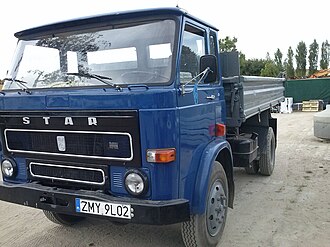
Star 28: The Polish Diesel Truck That Bridged Two Generations
The Star 28 is one of the most interesting trucks in the history of Polish automotive engineering because it was never originally intended to become a long-running success. Designed as a transitional model while engineers and the Starachowice factory prepared the much more ambitious Star 200, the Star 28 entered production in 1968 and remained in manufacture until 1989. What was supposed to be a temporary solution therefore became a familiar part of Polish roads for more than two decades. It was a medium-duty diesel truck, practical and relatively modern for its time, and it introduced a new cabin and several important technical improvements while retaining enough proven components from earlier Star models to make production possible.
The Star 28 also deserves attention because it represented an important moment in the development of Polish commercial vehicles. Its predecessor family, represented by the Star 25 and diesel Star 27, was beginning to show its age, while the planned Star 200 was delayed by technical, industrial and economic difficulties. The Star 28 consequently became the bridge between generations. It combined an improved chassis and reinforced drivetrain with a new cabin developed in cooperation with the French company Chausson. For Polish drivers accustomed to relatively austere truck cabs, this represented a significant improvement in working conditions. Adjustable seating, heating, ventilation, steering-wheel adjustment and better visibility made the Star 28 feel considerably more contemporary than the trucks it replaced.
The Origins of the Star 28
A Truck Created Because the Star 200 Was Delayed
The history of the Star 28 cannot be separated from the history of the Star 200. The future Star 200 was already being developed in the mid-1960s, with prototypes appearing around 1964–1966. However, bringing such a new vehicle into full production required major investment, new manufacturing capabilities and a reliable supply chain. In the centrally planned economy of the Polish People’s Republic, obtaining the necessary resources was not always straightforward. As a result, the factory needed a vehicle that could be produced immediately while the next generation was being prepared.
The answer was the Star 28 for diesel users and the mechanically related Star 29 for petrol users. Both models appeared in 1968 and shared most of their construction. The key distinction was their power unit: the Star 28 used the S530A1 diesel engine producing around 100 hp, while the Star 29 used the S47A petrol engine producing around 105 hp. The Star 29 was particularly significant because it became the final Star production model to use a petrol engine.
Calling the Star 28 a simple facelift would therefore be misleading. Although it retained selected components and engineering solutions from the Star 25 and Star 27, important systems were modernized or strengthened. The gearbox received reinforced gears, the rear axle was strengthened and the new cabin was designed with the forthcoming Star 200 family in mind. In effect, the factory was gradually introducing Star 200 technology while continuing to manufacture a vehicle that could be built with the industrial resources already available.
The New Cabin
A Major Improvement for Polish Truck Drivers
One of the most obvious differences between the Star 28 and earlier Star trucks was its cabin. Developed with the involvement of Chausson, the new cab gave the vehicle a considerably more modern appearance and improved the driver’s working environment. The panoramic windscreen provided better visibility, while the cabin was better insulated and equipped with heating and ventilation. Adjustable seating and steering-wheel positioning were also important improvements at a time when truck drivers could spend many hours behind the wheel.
Contemporary drivers reportedly appreciated the new cabin. During a technical rally in 1968, drivers highlighted its comfortable suspension, improved cabin, visibility and working environment. The truck’s appearance also represented a major stylistic change: compared with the rounded and more old-fashioned forms of its predecessors, the Star 28 looked unmistakably like a product from a new generation.
The cabin’s design was not merely cosmetic. The Star 28 was intended to be a working tool, and improvements to the driver’s environment could directly influence productivity and fatigue. Nevertheless, the truck retained several characteristics that would quickly seem old-fashioned by later European standards. Steering assistance was initially absent, and operating the clutch and brakes could require considerable physical effort. The gearbox was also only partially synchronized, meaning that driving the truck smoothly required experience.
The S530A1 Diesel Engine
Why the Diesel Star Was Important
The defining feature of the Star 28 was its diesel engine. The S530A1 was a six-cylinder inline diesel with a displacement of 6,230 cm³ and an output of approximately 100 hp at 2,600 rpm. It developed around 323 Nm of torque at 1,800 rpm, figures that suited a medium-duty truck intended primarily for practical transport rather than speed.
The diesel engine gave the Star 28 an important advantage over petrol-powered commercial vehicles in everyday fleet use. Fuel economy was becoming increasingly important, especially for companies and state institutions operating trucks over significant distances. Contemporary technical data places representative fuel consumption at approximately 21 litres per 100 km, although real-world results naturally depended on load, body type, terrain, maintenance and driving conditions.
The S530A1 was not an especially powerful engine by today’s standards, but the Star 28 belonged to a different technological era. Around 100 hp was sufficient for a five-tonne-class truck operating mainly on improved roads. Its job was to move cargo reliably rather than rapidly. The combination of a six-cylinder diesel and a five-speed manual gearbox gave the driver enough flexibility to manage varying loads and road conditions.
A Five-Tonne Workhorse
Designed for Road Transport
The Star 28 was principally a road-going medium-duty truck rather than an off-road vehicle like the Star 66 or Star 660. Its basic configuration was intended for improved road surfaces, and the standard vehicle had a payload of approximately five tonnes. Contemporary comparative data gives the Star 28 a gross vehicle weight of around 9,280 kg, with an empty weight in the neighborhood of four tonnes depending on configuration.
Its wheelbase was approximately 3,400 mm in the standard version, while the truck measured about 6,455 mm in length and 2,380 mm in width. These dimensions made it a substantial commercial vehicle while remaining considerably smaller than heavy tractor-trailer combinations. Its relatively compact proportions were useful for domestic distribution, construction work and municipal applications.
The standard five-speed manual transmission reflected the engineering philosophy of the period. There was no automatic transmission, electronic engine management or advanced driver-assistance equipment. The driver was directly involved in controlling the vehicle, and skill behind the wheel mattered considerably. The Star 28 was therefore both a machine and a working environment in which the experience of the driver remained an important part of vehicle performance.
Star 28 in Everyday Polish Transport
The Truck Behind the Scenes
The Star 28 became a common sight in Polish transport because it could be adapted to a remarkable variety of tasks. The basic chassis could support conventional cargo bodies, tipper bodies, cranes and specialist equipment. Variants included the C28 tractor unit, Ż28 crane chassis and BW28 tipper configuration. Special-purpose bodies were also developed for particular industries and public services.
This versatility was essential in the Polish economy of the 1970s and 1980s. A truck did not necessarily belong to a private company with a fleet of specialized vehicles. State enterprises, municipal organizations, construction companies and agricultural institutions often needed one platform that could perform several roles. The Star 28 answered this requirement by providing a sturdy chassis that could be fitted with different bodies according to the operator’s needs.
Its working life could therefore look very different from one example to another. One Star 28 might spend its days transporting general cargo between warehouses, while another could operate as a tipper on a construction site. A crane-equipped example might serve an industrial company, and a specialized version could become part of a municipal fleet. The common denominator was the robust chassis and diesel-powered drivetrain.
The Star 28 and the Star 29
Two Engines, One Basic Truck
The Star 28 and Star 29 were visually almost indistinguishable. Their principal difference was what was under the engine cover. The Star 28 used the 6.23-litre S530A1 diesel, while the Star 29 employed the 4.68-litre S47A petrol engine. The petrol engine produced slightly more power at approximately 105 hp, but the diesel’s lower-speed torque and potentially lower fuel consumption made the Star 28 particularly attractive for commercial operators.
The two models also shared the same basic cabin, transmission concept, steering system and braking architecture. This commonality simplified manufacturing and allowed FSC to produce two variants without creating two completely separate truck designs.
The Star 29 nevertheless has a place of its own in Polish automotive history because it was the final petrol-powered Star produced by the factory. As diesel engines became increasingly important in commercial transport, the Star 28’s configuration pointed toward the future. Later Star generations would rely much more heavily on diesel power.
Production Difficulties and Unexpected Longevity
The “Temporary” Truck That Stayed for Decades
The Star 28 was originally expected to be replaced relatively quickly. The Star 200 was supposed to become the factory’s new generation of medium-duty truck, and initial expectations suggested that the transitional 28/29 models might disappear during the early 1970s. Instead, delays in the Star 200 program, factory modernization and supplier readiness kept the older design in production much longer than anticipated.
This is one of the most fascinating aspects of the Star 28 story. A model created as an interim solution ultimately became one of the longest-lived trucks in the Star range. The diesel Star 28 remained in production until 1989, more than twenty years after its introduction. The Star 29 had a shorter production life, ending in the early 1980s.
The extended production period also meant that the Star 28 evolved gradually. Components and production methods changed over time, and later vehicles incorporated improvements that were not necessarily present on the earliest examples. Consequently, the term “Star 28” covers a family of vehicles rather than a perfectly uniform specification.
The Star 28 in Specialist Roles
Cranes, Tippers and Special Bodies
The versatility of the Star 28 was particularly evident in specialist versions. The Ż28 crane chassis allowed mobile cranes to be constructed on the truck platform, giving industrial and construction companies a useful combination of mobility and lifting capability. The BW28 provided a basis for tipper bodies, making it suitable for transporting loose construction and agricultural materials.
There were also specialist and municipal conversions. Such vehicles could be fitted with bodies designed for sanitation, maintenance, rescue or other public-service work. The ability to manufacture different bodies on the same chassis helped maximize the usefulness of the Star platform.
This adaptability also extended beyond factory-built variants. Polish companies and institutions frequently modified commercial vehicles to meet local requirements, meaning that surviving Star 28s can sometimes be found in unusual configurations. For historians and collectors, these vehicles can be particularly interesting because they illustrate how Polish organizations solved practical transport problems with the resources available to them.
The Star 28 in the Polish Military
Although the Star 28 was primarily a road transport vehicle, it also found limited military use. Historical sources record 117 Star 28 vehicles delivered to the Polish People’s Army, compared with 8,939 examples of the petrol-powered Star 29. This relatively small number reflects the fact that the military had other Star models better suited to demanding off-road operations.
The Star 28’s strengths were better matched to road logistics than battlefield mobility. Its five-tonne payload and diesel engine made it useful for transport duties, while its conventional configuration simplified maintenance. Nevertheless, compared with the purpose-built 6×6 Star 660 and later Star 266, it was not intended to be the primary military off-road truck.
Strengths and Weaknesses
What Made the Star 28 Successful?
The Star 28’s greatest strengths were its useful payload, improved cabin, diesel engine and mechanical simplicity. It represented a significant step forward from the Star 25 and 27 while remaining sufficiently familiar for FSC to manufacture and service. Its five-tonne payload put it in an important category for Polish commercial transport, and its chassis could accommodate many different body types.
The cabin was another major advantage. For drivers accustomed to earlier Polish trucks, the improved seating, ventilation, heating and visibility made a meaningful difference. Contemporary reports from the 1968 technical rally were positive about the cabin and ride comfort, suggesting that FSC had succeeded in addressing several practical complaints associated with previous models.
Where the Design Showed Its Age
The Star 28 was not without shortcomings. The absence of power steering made maneuvering tiring, especially when the vehicle was loaded. The clutch and brake controls required significant physical effort, while the partially synchronized gearbox demanded experience. Noise was another issue, particularly with the diesel engine.
Fuel consumption was also high by modern standards, even though the diesel Star was more economical than many petrol-powered trucks. A figure around 21 litres per 100 km may sound enormous today, but it must be judged against the technology and operating conditions of the 1960s and 1970s. The truck’s modest power, conventional drivetrain and heavy construction naturally resulted in substantial fuel use.
The Star 28 Today
A Rare Reminder of Polish Trucking History
Today, a surviving Star 28 is considerably more unusual than it once was. Thousands of these trucks worked for decades and were eventually scrapped when their maintenance costs exceeded their practical value. Surviving examples therefore attract the attention of collectors, museums and enthusiasts interested in the history of Polish transport.
A restored Star 28 can be particularly impressive because its design captures the transition from older Polish truck engineering to the modernized approach that eventually produced the Star 200. Its angular cabin, relatively large proportions and unmistakable diesel character make it easy to identify even among other classic Star models.
The truck is also valuable as a historical artifact because it represents ordinary working life. Unlike a prestigious passenger car, a Star 28 was purchased primarily because someone needed to move goods. It served factories, construction sites, transport companies and public institutions. Its story is therefore closely connected with the everyday infrastructure of Poland during the final decades of the communist era.
Technical Specifications of the Star 28
Because the Star 28 was manufactured for more than twenty years and existed in several body configurations, exact specifications can differ according to model year and application. The following table presents representative figures for the standard Star 28 and commonly cited factory data.
| Specification | Star 28 |
|---|---|
| Manufacturer | FSC Star, Starachowice, Poland |
| Production period | 1968–1989 |
| Vehicle class | Medium-duty truck |
| Primary role | Road transport |
| Predecessors | Star 25 / Star 27 |
| Successor | Star 200 |
| Engine | S530A1 diesel |
| Engine configuration | Inline 6-cylinder |
| Displacement | 6,230 cm³ |
| Maximum power | 100 hp at 2,600 rpm |
| Maximum torque | Approximately 323 Nm at 1,800 rpm |
| Transmission | 5-speed manual |
| Drive | Rear-wheel drive |
| Wheelbase | Approximately 3,400 mm |
| Length | Approximately 6,455 mm |
| Width | Approximately 2,380 mm |
| Height | Approximately 2,330–3,000 mm, depending on body |
| Empty weight | Approximately 4,000–4,200 kg |
| Gross vehicle weight | Approximately 9,280 kg |
| Typical payload | Approximately 5,000 kg |
| Maximum speed | Approximately 81 km/h |
| Typical fuel consumption | Approximately 21 l/100 km |
| Cab | Two-door cab-over-engine design |
| Seating | 2 |
| Specialist versions | Tractor, tipper, crane and special-purpose chassis |
Conclusion
The Star 28 is a fascinating example of how necessity can shape automotive history. It was conceived as a transitional truck, intended to keep FSC competitive while the company prepared the Star 200, yet delays and industrial limitations transformed that temporary solution into a vehicle with a production career lasting more than two decades. Its combination of a six-cylinder diesel engine, five-tonne payload, improved cabin and adaptable chassis made it a practical tool for Polish transport during a period of enormous economic and technological change.
Its importance lies not in being the fastest or most technologically sophisticated Polish truck, but in how effectively it connected two generations. The Star 28 took proven ideas from the Star 25 and 27, introduced a modern cabin and strengthened mechanical systems, and gradually incorporated elements that would lead toward the Star 200. It was therefore both an old-fashioned working truck and a preview of the future.
For enthusiasts today, that transitional character is exactly what makes the Star 28 so appealing. It captures a moment when Polish truck manufacturing was moving toward more modern designs while still operating within the practical and economic limitations of the era. Every surviving example tells a story of the factories, drivers, mechanics and businesses that depended on these machines. The Star 28 may have been born as a stopgap, but its long service life ensured that it became an important chapter in the history of Polish automotive engineering.
