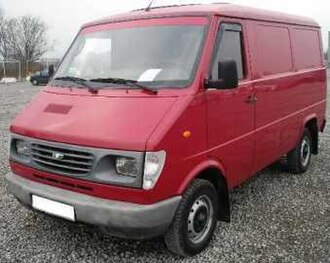
FSC Lublin: The Polish Van That Carried a New Era
The FSC Lublin is one of the most important Polish commercial vehicles of the post-communist era, yet it is often overshadowed by the older and more famous Żuk. Produced in Lublin from the early 1990s into the 21st century, the Lublin represented a major change in the philosophy of Polish light commercial vehicles. Where the Żuk had evolved from a design rooted in the late 1950s, the Lublin was created for a rapidly changing market in which customers expected greater payload capacity, improved comfort, diesel engines, more body configurations and better suitability for long-distance work. It was not a perfect vehicle, but it was an important bridge between Poland’s socialist industrial past and the competitive automotive market that emerged after 1989.
The history of the Lublin is closely connected with the Fabryka Samochodów Ciężarowych in Lublin, the same manufacturer that had produced the Żuk for almost four decades. By the beginning of the 1990s, however, the limitations of the Żuk were impossible to ignore. European manufacturers were offering increasingly sophisticated vans, while Polish businesses suddenly had access to imported vehicles that were more comfortable, economical and technologically advanced. FSC therefore needed a successor that could remain affordable and relatively simple while offering a much more contemporary platform. The result was the Lublin, a vehicle that would become a familiar sight on Polish roads throughout the 1990s and 2000s.
From the Żuk to the Lublin
Why FSC Needed a New Commercial Vehicle
The Żuk had been extraordinarily successful, but its basic architecture dated back to the 1950s. Its engine, chassis, cabin and overall driving characteristics reflected an era when Polish commercial transport had very different requirements. By the late 1980s, operators increasingly expected better ergonomics, improved carrying capacity, diesel power and more efficient use of fuel. A modern replacement was therefore not simply desirable; it was essential for the survival of FSC as a commercial-vehicle manufacturer.
The political and economic transformation of Poland made the challenge even more urgent. After 1989, the domestic market opened rapidly to Western products. Used Mercedes-Benz, Volkswagen, Ford, Iveco and other European vans began appearing in large numbers, giving customers a much wider choice. A Polish vehicle could no longer rely on a shortage of alternatives. It had to compete on price, operating costs, practicality and serviceability.
The Lublin was FSC’s answer. The first production vehicles appeared in 1993, giving the company a new light commercial platform intended to replace the Żuk. The Lublin was larger, more modern and considerably more suited to professional transport than its predecessor. It retained a relatively straightforward mechanical character, however, which helped keep operating and maintenance costs within reach of Polish businesses.
The Lublin 33
The First Generation
The earliest Lublin models are commonly associated with the Lublin 33 designation. They were available in several configurations and were designed around a conventional front-engine, rear-wheel-drive layout. This arrangement made sense for a commercial vehicle expected to carry substantial loads, particularly on poor roads or when fitted with specialized bodies.
Compared with the Żuk, the Lublin offered a much more substantial impression. The cab was larger and better suited to working journeys, while the vehicle’s chassis was designed from the beginning for commercial applications rather than being adapted from a passenger-car platform. Its appearance was distinctly utilitarian, but the squared-off body provided a practical cargo area and allowed numerous derivatives to be developed.
One of the most important changes was the availability of diesel engines. Diesel power was increasingly desirable for commercial users because fuel economy mattered greatly to businesses covering large distances. Early Lublins could use naturally aspirated diesel engines, while later versions gained more powerful and refined power units. The evolution of the engine range became an important part of the vehicle’s development.
A Vehicle Designed for Many Roles
Like the Żuk, the Lublin was never simply one vehicle. Its basic chassis became the foundation for panel vans, pickups, flatbeds, crew-cab vehicles, minibuses and specialized bodies. This flexibility was critical because the Polish market contained thousands of small businesses, tradespeople, municipalities, farms and service companies that required vehicles adapted to specific tasks.
A panel van could serve as a delivery vehicle for a local business, while a flatbed could transport construction materials. A crew-cab version could carry workers and tools, and minibuses could be used for passenger transport. Specialist companies could install refrigerated bodies, mobile workshops, tow equipment or other conversions. This ability to transform the basic Lublin into many different kinds of working vehicle helped extend its commercial life.
Development Through the 1990s
New Engines and Improved Equipment
The Lublin did not remain unchanged after its introduction. The vehicle underwent a series of technical and cosmetic improvements intended to keep it competitive in a rapidly evolving market. Engine choices changed, equipment improved and later models benefited from redesigned components.
Diesel engines were especially important. The Lublin’s target customers generally cared less about performance than about reliability, fuel consumption and the ability to operate under load. Engines from manufacturers including Andoria became closely associated with later Polish commercial vehicles, giving the Lublin a distinctly domestic technical identity.
Over time, turbocharged diesel versions also appeared, improving performance and making the Lublin more suitable for highway travel. This was significant because commercial transport in Poland was changing rapidly. Small companies increasingly delivered goods between towns and cities, and a vehicle designed primarily for short local trips needed to become more capable of sustained road travel.
The Lublin II
The Lublin II represented a further stage in the model’s development. Introduced toward the end of the 1990s, it incorporated various improvements intended to address shortcomings of the earlier versions. Styling was updated, while the cabin and mechanical components received attention. The basic concept remained familiar, but the vehicle was increasingly positioned as a serious competitor to imported light commercial vehicles.
The Lublin II also illustrates the challenges facing Polish manufacturers during this period. Engineering a completely new commercial vehicle required substantial investment, while the domestic market was already flooded with established European products. FSC and its successors therefore had to balance modernization with the need to keep production costs under control.
The Lublin III and the Daewoo Connection
A New Chapter After Privatization
One of the most complicated chapters in the Lublin story began when the factory became connected with Daewoo. The Polish automotive industry was undergoing enormous structural changes, and partnerships with foreign companies appeared to offer a way to obtain capital, technology and access to international markets.
The Lublin was consequently developed further under changing ownership arrangements. The later Lublin 3 benefited from additional modernization, including revised engines, updated interiors and changes intended to make the vehicle more competitive. Yet the relationship with Daewoo could not completely solve the underlying economic problems facing the manufacturer.
The financial collapse of Daewoo at the beginning of the 2000s had major consequences for its Polish operations. The Lublin factory entered a difficult period, but the vehicle itself continued to find buyers. The story did not end immediately with Daewoo’s collapse because the production operation passed through further ownership changes.
Andoria Diesel Power
Why the Diesel Engine Mattered
One of the defining characteristics of the Lublin was its association with Polish diesel-engine production. The Andoria plant in Andrychów had decades of experience producing diesel engines, and its units became important components of the domestic commercial-vehicle industry.
The naturally aspirated and turbocharged diesel engines used in various Lublin models gave the vehicle a useful combination of relatively simple construction and acceptable economy. The exact output depended on the engine and model year, but later turbocharged versions could produce substantially more power than the earliest naturally aspirated units.
For operators, the attraction was straightforward. A commercial vehicle spends much of its life working, and fuel consumption becomes a major part of ownership costs. Diesel engines were therefore particularly appropriate for a van that might carry heavy loads every day. Their strong low-speed torque was also useful when starting with a loaded vehicle or operating on inclines.
The Lublin as a Working Vehicle
Construction and Agriculture
The Lublin became particularly familiar among small businesses and tradespeople. Its relatively simple construction made it suitable for owners who needed a vehicle that could be repaired without the specialized equipment associated with more sophisticated foreign models. Independent workshops could service the mechanical systems, and parts availability was generally better than for many obscure imported vehicles.
Construction companies appreciated the availability of open-bed versions. Builders could transport timber, bricks, tools and other materials without needing a larger truck. Agricultural users likewise found the chassis adaptable to different tasks, especially where a relatively compact commercial vehicle was preferable to a full-size lorry.
Delivery and Passenger Transport
The panel van configuration was equally important. During the rapid expansion of private enterprise in Poland during the 1990s, thousands of small businesses needed affordable transport. Shops, wholesalers, repair companies and distributors required vehicles capable of moving goods around increasingly busy cities and across regional roads.
The Lublin was also offered in passenger-oriented configurations. Minibus versions provided an inexpensive way of transporting workers or passengers, while crew-cab derivatives combined seating with a useful cargo area. In this respect, the Lublin continued the practical philosophy established by the Żuk while bringing it into a new economic era.
Strengths and Weaknesses
What Made the Lublin Attractive
The strongest argument for the Lublin was its practicality. It offered a relatively large commercial platform at a price that could be more accessible than many Western alternatives, especially on the used market. Its rear-wheel-drive layout, sturdy chassis and wide selection of body styles made it suitable for demanding applications.
Another advantage was mechanical simplicity. Although later Lublins became considerably more sophisticated than the earliest models, the vehicle generally remained understandable to independent mechanics. This mattered in an era when many small Polish companies could not afford expensive dealership maintenance.
The Lublin also had a strong domestic identity. For owners who wanted a working vehicle built in Poland, supported by Polish suppliers and familiar to local mechanics, it was a natural choice. The use of Andoria engines reinforced this character.
Where the Lublin Fell Short
The Lublin’s greatest problem was the pace of development in the European commercial-vehicle market. Competitors were improving rapidly, particularly in cabin ergonomics, corrosion protection, safety, suspension comfort, engine refinement and overall manufacturing quality.
Noise was another criticism of many older diesel-powered examples. Compared with modern vans, the Lublin could feel agricultural and tiring on long journeys. Its cabin insulation, steering and suspension were designed according to much older standards, and the driving experience could be demanding when the vehicle was heavily loaded.
Rust also became a serious issue. Commercial vehicles tend to suffer from hard use, and many Lublins spent their lives outdoors or on construction sites. Poor body condition is therefore common among surviving examples, making a well-preserved or professionally restored vehicle particularly interesting to enthusiasts.
The End of the Lublin
The final phase of production took place under new ownership arrangements after the collapse of Daewoo’s Polish operations. The factory and its assets changed hands, while the vehicle continued to be manufactured and marketed under the Lublin name. Production ultimately ended in the mid-2000s, with commonly cited dates placing the final examples around 2007.
By this point, the competitive environment had changed beyond recognition. Poland had become integrated into the European automotive market, and modern vans from manufacturers such as Volkswagen, Mercedes-Benz, Ford, Fiat and Renault were widely available. These vehicles offered better engines, comfort, safety, emissions performance and manufacturing quality.
The Lublin had fulfilled its historical role, however. It had carried the Polish commercial-vehicle industry from the final years of the socialist economy into the realities of the market economy. In doing so, it became an important link between two completely different eras of Polish automotive history.
FSC Lublin as a Modern Classic
Today, the Lublin is increasingly interesting to enthusiasts who appreciate unusual commercial vehicles. Unlike a classic sports car, its appeal comes from authenticity and history rather than performance. A Lublin parked at a classic-vehicle gathering immediately evokes the atmosphere of Polish towns and industrial areas during the 1990s and early 2000s.
The most interesting surviving examples are often those that retain original bodywork, engines and interiors. Former fire-service vehicles, unusual specialist conversions and well-preserved minibuses can be especially attractive because they represent particular chapters in the Lublin’s working life.
The Lublin is also an excellent reminder that automotive history is not limited to glamorous passenger cars. Commercial vehicles shape economies just as profoundly as cars do. They deliver food, transport tools, carry workers, support emergency services and enable small businesses to operate. The Lublin performed all of these roles during one of the most transformative periods in modern Polish history.
Technical Specifications
Because the Lublin was produced in numerous generations, body styles and engine configurations, specifications vary considerably. The figures below represent typical values for representative versions rather than one universal specification.
| Specification | FSC Lublin – representative values |
|---|---|
| Manufacturer | Fabryka Samochodów Ciężarowych, Lublin |
| Production period | 1993–approximately 2007 |
| Vehicle class | Light commercial vehicle |
| Layout | Front engine, rear-wheel drive |
| Body styles | Panel van, pickup, flatbed, crew cab, minibus, specialist |
| Typical engine type | Four-cylinder diesel |
| Notable engine supplier | Andoria |
| Engine displacement | Approximately 2.4–2.5 litres, depending on version |
| Typical power range | Approximately 70–100+ hp, depending on engine |
| Transmission | Manual |
| Representative wheelbase | Approximately 2.9–3.5 m, depending on chassis |
| Overall length | Approximately 4.8–5.5 m, depending on version |
| Overall width | Approximately 2.0 m |
| Payload | Roughly 1.0–1.5 tonnes, depending on configuration |
| Drive wheels | Rear |
| Main successor to Żuk | Yes |
| Production location | Lublin, Poland |
| Notable generations | Lublin 33, Lublin II, Lublin III |
| Principal market | Poland and selected export markets |
Conclusion
The FSC Lublin deserves to be remembered as much more than an old Polish delivery van. It was a product of a country undergoing extraordinary economic and political change, and its development mirrors that transformation. Born as the successor to the venerable Żuk, the Lublin introduced a more substantial commercial platform just as Poland was opening itself to international competition. It had to remain affordable and repairable while facing increasingly sophisticated foreign rivals, and for many years it succeeded in doing exactly that.
Its legacy lies in its usefulness. The Lublin carried parcels, construction materials, agricultural equipment, workers, passengers and specialist equipment across Poland. It served small companies that were just beginning to flourish after the economic transformation, and it remained a familiar sight long after the automotive industry had moved toward increasingly modern designs. Although it ultimately could not compete with the refinement and efficiency of newer European vans, it played a valuable role in the history of Polish transport.
For enthusiasts today, the Lublin offers something that many modern commercial vehicles cannot: character. Its diesel engine, functional cabin, solid chassis and unmistakably utilitarian appearance represent an era when a commercial vehicle was expected to work hard, remain understandable to its owner and keep going despite difficult conditions. The FSC Lublin may never have been the most advanced van in Europe, but as a piece of Polish industrial and social history, it remains a remarkably important vehicle.
