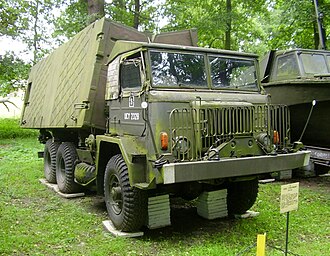
Star 660: The Polish 6×6 Truck That Became an Off-Road Legend
The Star 660 occupies a special place in the history of Polish automotive engineering. Built by Fabryka Samochodów Ciężarowych “Star” in Starachowice, this rugged 6×6 truck was designed primarily as a military and off-road vehicle, but its usefulness extended far beyond the armed forces. Produced from 1965 to 1983, the Star 660 became one of the most recognizable heavy-duty Polish vehicles of the Cold War period. It was used to transport soldiers and equipment, carry specialist bodies, operate as a fire engine, support engineering units, carry radio equipment and perform countless other tasks. Even after its successor, the Star 266, entered production in 1973, the older 660 remained in manufacture for another decade, demonstrating just how valuable its straightforward and adaptable design remained.
The Star 660 was essentially a major modernization of the Star 66, which had been produced since 1958. Experience gained from operating the earlier truck, particularly military feedback, convinced Polish engineers that the vehicle needed greater reliability, better off-road capability and improved suitability for specialist applications. The result was not a completely new truck but a carefully developed evolution that retained the successful 6×6 concept while introducing a stronger chassis, revised running gear and improved systems. Its combination of three driven axles, a reduction gearbox, leaf-spring suspension and relatively simple mechanical construction made it particularly well suited to environments where roads were poor or nonexistent.
The Origins of the Star 660
Developing the Star 66
The Star 66 itself had been created during the early 1950s in response to the Polish requirement for a medium-duty off-road truck. By the early 1960s, however, the limitations and operational experience of the Star 66 provided a clear basis for further development. Engineers from the Automotive Industry Design Office in Warsaw and FSC Star’s own design office worked on modernization proposals, with the results being presented in 1962. Because of financial and production limitations at the Starachowice factory, the improvements were introduced in stages rather than all at once.
This approach explains the existence of the Star 660M1 and later 660M2. The first modernized version entered production in 1965, while the more extensively revised M2 appeared in 1968. The basic philosophy remained unchanged: create a dependable 6×6 truck capable of transporting personnel and cargo across difficult terrain while also serving as a platform for military and civilian equipment.
The design was deliberately conventional. A strong welded longitudinal frame formed the foundation of the vehicle, while rigid axles and leaf springs provided the durability required for off-road service. The front axle was suspended on semi-elliptical leaf springs, while the middle and rear axles used inverted semi-elliptical springs and reaction rods. The drive axles were equipped with pneumatically controlled differential locks, giving the vehicle additional traction when conditions became difficult.
Star 660M1: The First Production Version
A Rugged 6×6 Layout
The Star 660M1 was powered by the Polish S47 petrol engine, a six-cylinder inline unit with a displacement of 4,680 cm³. It produced approximately 105 hp, which may appear modest by modern standards, but the engine was designed to provide reliable operation in a vehicle intended for demanding terrain rather than high-speed road travel. The power unit was connected to a five-speed manual gearbox and a two-speed reduction gearbox, allowing the driver to select low gearing when additional tractive effort was required.
The gearbox was non-synchronized, a characteristic that required more driver involvement than modern transmissions. Experienced operators learned to use engine speed and double-declutching techniques to make smooth gear changes. This mechanical simplicity was appropriate for the period, particularly in military service, where ease of field repair and durability could be more important than driving convenience.
The transfer system also incorporated a power take-off, allowing engine power to be transferred to external equipment. This feature was crucial because the Star 660 was never intended to be merely a cargo carrier. Its chassis could power or support cranes, specialist equipment, engineering machinery and other systems, making it a versatile platform rather than a single-purpose truck.
The Star 660M2
Improvements for Difficult Conditions
In 1968, the Star 660 received another important modernization, creating the 660M2. At first glance, the changes were relatively modest, but many addressed practical problems encountered during operation. The cab received a metal-and-canvas roof structure that improved thermal and acoustic insulation, while changes were made to the engine cover and gear lever.
One particularly interesting improvement involved the electrical system. Components were shielded so that the vehicle could continue operating after being completely flooded. This was an important military capability because the Star 660 could be expected to cross deep water obstacles or even be dragged along the bottom of a water crossing. The truck’s design therefore reflected a very different set of priorities from those of ordinary road vehicles. It was not simply expected to survive rain and puddles; it was engineered to continue functioning in conditions that would disable most conventional trucks.
The braking system was also improved, including increased pump capacity and equipment for controlling trailer brakes. These details demonstrate the philosophy behind the modernization: rather than replacing the entire vehicle, engineers strengthened and refined the systems that mattered most during demanding operation.
The Diesel-Powered Star 660D
More Torque and Better Economy
The Star 660 family was not limited to petrol power. In 1968, the Star 660D entered production with the S530A six-cylinder diesel engine. This unit had a displacement of 6,230 cm³ and produced approximately 100 hp. From 1970, an even more powerful S359 diesel engine was introduced, featuring direct fuel injection, 6,840 cm³ displacement and approximately 150 hp.
The arrival of diesel power was significant. Heavy vehicles benefit from the high low-speed torque of diesel engines, particularly when carrying substantial loads or climbing difficult terrain. Diesel fuel economy was also attractive for military and industrial operators that accumulated large numbers of operating hours.
The 150-hp S359-equipped versions represented a considerable increase in available power compared with the original 105-hp petrol engine. Nevertheless, the Star 660 remained fundamentally a slow, robust off-road truck rather than a high-speed highway vehicle. Its strengths were traction, load-carrying ability and durability rather than acceleration or cruising comfort.
A Truck Built for Many Missions
Military Transport
The Star 660 became an important transport vehicle for the Polish People’s Army. According to available historical records, 13,760 Star 660 vehicles were delivered to the Polish Army. Its military service included ordinary cargo transport as well as a wide variety of specialist applications.
The standard cargo body could transport personnel, supplies and equipment, but the same chassis could also carry fuel or water tanks, engineering equipment and communications systems. Specialist bodies included radio stations, repair and workshop bodies, radio-relay equipment and engineering systems. This versatility made the Star 660 particularly valuable because a common basic chassis could support an entire family of military vehicles.
The truck was also used with equipment associated with pontoon bridges. AP-64 and BP-64 bodies were employed to transport bridge and pontoon components, while the SMT-1 accompanying bridge system represented another example of the Star 660 being integrated into military engineering operations.
Fire Engines and Civilian Applications
Although military service is central to the Star 660’s identity, the truck also became a platform for civilian applications. Fire engines were among the best-known specialist versions, including vehicles equipped with GBM 2/8 firefighting bodies. Its 6×6 drivetrain made the Star 660 especially useful for reaching locations where conventional fire engines might struggle.
The chassis was also suitable for cranes and excavators. Hydraulic and mechanical specialist bodies transformed the basic truck into mobile industrial equipment, allowing a single vehicle platform to perform tasks that otherwise required several different types of machinery.
This adaptability explains why the Star 660 remained useful for so long. Even when newer trucks became available, an existing 660 could be rebuilt, fitted with a new body or reassigned to a different role.
The Star 660 and the Star 266
Why Production Continued
The Star 266 entered production in 1973 as the successor to the Star 660, offering a more modern design and improved capabilities. Yet FSC Star did not immediately discontinue the older model. Instead, Star 660 production continued until 1983.
This ten-year overlap is revealing. The Star 660 was already an older design by the 1970s, but its established production system, familiar mechanics and broad range of applications kept it relevant. Military organizations and civilian operators could continue using an established vehicle whose capabilities were well understood.
The Star 266 eventually became the more important Polish military off-road truck, but the 660 remained a recognizable part of the transition between two generations of Polish truck engineering.
The Famous Star 660 Papamobile
A Unique Chapter in the Truck’s History
One of the most unusual Star 660 stories is connected with Pope John Paul II’s first pilgrimage to Poland in 1979. A special vehicle was requested for the Pope, and engineers at the Industrial Automotive Institute in Warsaw decided to use a Star 660 chassis. Two vehicles were constructed in a remarkably short period of approximately a month and a half, ensuring that a backup would be available if the first vehicle developed a problem.
The resulting vehicle was dramatically different from a normal cargo truck. It featured an open passenger gondola and was designed to allow the Pope to be visible to large crowds. The chassis retained the Star 660’s 6×6 drivetrain and 105-hp petrol engine. According to technical descriptions of the reconstructed vehicle, the gondola accommodated 17 people, including the centrally positioned papal seat, in addition to two people in the cab.
After the pilgrimage, the original body was dismantled and destroyed under the political circumstances of the time, while the chassis and cab returned to FSC Starachowice. The chassis was subsequently sold and remained in agricultural use for many years. Enthusiasts later located the original chassis and reconstructed the famous vehicle. The replica was completed in 2008 and is now preserved as a significant piece of Polish automotive and cultural history.
Driving and Engineering Character
What Makes the Star 660 Special?
The Star 660’s appeal today comes largely from the relationship between its mechanical simplicity and extraordinary operating capability. A modern truck may have vastly greater engine power, advanced traction-control systems, automatic transmissions and electronically controlled suspension, but the Star 660 achieved impressive off-road performance using fundamentally mechanical solutions.
Its 6×6 drivetrain was the key. All three axles could contribute to propulsion, while the reduction gearbox gave the driver control over very low-speed movement. Leaf springs were simple, strong and well suited to heavy loads. Differential locks provided additional traction when wheels began to lose grip. These components worked together without requiring sophisticated electronic control systems.
The result was a vehicle that could be demanding to drive but highly rewarding for an experienced operator. The steering, clutch, gearbox and brakes required physical effort, and the non-synchronized transmission demanded skill. The truck’s relatively low maximum speed also encouraged deliberate driving rather than fast road travel.
The Star 660 as a Historic Vehicle
Today, surviving Star 660s are increasingly appreciated by collectors, military-vehicle enthusiasts and museums. Their rarity, distinctive appearance and historical significance make them particularly interesting examples of Polish engineering from the Cold War period.
Restoring one can be a considerable undertaking. Many vehicles spent decades working in difficult environments, and corrosion, worn mechanical components and missing specialist equipment can make restoration complicated. Nevertheless, the truck’s straightforward mechanical construction can also make restoration more achievable than with a modern vehicle dependent on electronic control units and proprietary diagnostic systems.
A preserved Star 660 is more than an old truck. It represents Polish industrial capacity during the Cold War, the engineering requirements of the Polish military and the ability of Starachowice engineers to create a versatile platform from relatively conventional technology.
Technical Specifications of the Star 660
The figures below describe the Star 660 family, with particular emphasis on the commonly documented 660M2. Because the model was produced in several versions and with different engines, specifications can vary according to production year and configuration.
| Specification | Star 660 / 660M2 |
|---|---|
| Manufacturer | FSC Star, Starachowice |
| Production | 1965–1983 |
| Vehicle type | Medium-duty off-road truck |
| Drive configuration | 6×6 |
| Predecessor | Star 66 |
| Successor | Star 266 |
| Standard engine | S47 petrol, inline 6 |
| Petrol displacement | 4,680 cm³ |
| Petrol power | 105 hp (77.3 kW) |
| Diesel engine | S530A, inline 6 |
| Diesel displacement | 6,230 cm³ |
| S530A power | 100 hp (73.6 kW) |
| Later diesel | S359, inline 6 |
| S359 displacement | 6,840 cm³ |
| S359 power | 150 hp (110 kW) |
| Transmission | 5-speed manual |
| Gearbox type | Non-synchronized |
| Transfer/reduction gearbox | 2-speed |
| Typical length | 6.53 m |
| Typical width | 2.40 m |
| Typical height | 2.88 m |
| Kerb weight, 660M2 | Approximately 5,650 kg |
| Payload, road | Approximately 4,000 kg |
| Payload, off-road | Approximately 2,500 kg |
| Maximum speed | Approximately 50 km/h for typical 660M2 configuration |
| Suspension | Leaf springs with rigid axles |
| Differential locks | Pneumatically controlled |
| Main applications | Military transport, engineering, firefighting, communications, specialist equipment |
The technical figures highlight why the Star 660 should not be judged by modern standards. Its maximum speed of roughly 50 km/h in a representative 660M2 configuration appears extremely low today, but speed was not its purpose. The truck was designed to deliver useful loads across terrain where road-going commercial vehicles might not be able to travel at all. Its combination of approximately four tonnes of road payload, 6×6 traction and a two-speed reduction gearbox made it a specialized tool rather than simply a heavy truck.
Conclusion
The Star 660 is one of the defining vehicles of Polish post-war truck engineering. Developed as a modernization of the Star 66, it combined a strong chassis, three driven axles, simple mechanical systems and exceptional versatility. Production lasted from 1965 to 1983, and even the arrival of the newer Star 266 did not immediately make it obsolete. Its ability to carry cargo, transport personnel, support engineering operations, serve as a fire engine or provide a platform for communications equipment made it useful across an enormous range of applications.
Its story also extends beyond military and industrial history. The specially constructed Star 660 used as a Papamobile in 1979 gave the vehicle an extraordinary place in Polish cultural memory, while surviving examples today provide enthusiasts with a tangible connection to the engineering realities of the Cold War era. The truck may be slow, noisy and physically demanding by modern standards, but those very characteristics are part of its identity.
Above all, the Star 660 demonstrates what good engineering can achieve without electronic sophistication. Its designers relied on mechanical traction, robust materials, simple systems and a flexible chassis. The result was a truck capable of doing serious work under conditions that would challenge much newer vehicles. For that reason, the Star 660 remains not only an important Polish classic but also a fascinating example of purposeful, durable and adaptable automotive engineering.
