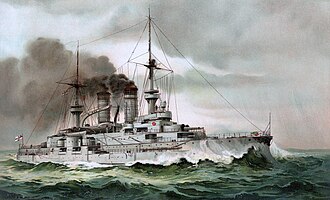
SMS Zähringen: The Long and Unusual Career of a German Pre-Dreadnought Battleship
The German Imperial Navy’s pre-dreadnought battleship SMS Zähringen occupied an unusual place in naval history. Launched at a time when Germany was rapidly expanding its fleet, she represented the transition between the battleships of the nineteenth century and the radically more powerful dreadnoughts that would transform naval warfare after 1906. Yet Zähringen’s significance lies not only in her original role as a capital ship. Unlike many of her contemporaries, she survived the First World War, avoided the wholesale scrapping that followed Germany’s defeat, was converted into a radio-controlled target ship, and ultimately remained afloat in one form or another until the closing months of the Second World War. Her career therefore stretched across more than four decades and several dramatically different eras of German naval history.
Origins and Construction of SMS Zähringen
SMS Zähringen was the third ship of the Wittelsbach class, a group of five pre-dreadnought battleships built for the Kaiserliche Marine during the final years of the nineteenth and opening years of the twentieth centuries. The class consisted of Wittelsbach, Wettin, Zähringen, Schwaben, and Mecklenburg. These ships were part of the expansion of the German fleet that accelerated after Alfred von Tirpitz became State Secretary of the Imperial Navy Office and the German government adopted the Naval Law of 1898. The Wittelsbachs were closely related to the preceding Kaiser Friedrich III class and were intended to provide the German fleet with a modern force of battleships capable of operating in the North Sea and Baltic approaches.
Zähringen was ordered under the contract name “E” and built by Germaniawerft in Kiel, one of the major shipyards contributing to Germany’s rapidly expanding naval-industrial capacity. Her keel was laid down on 21 November 1899, and the completed hull was launched on 12 June 1901. The ship entered service on 25 October 1902, marking the beginning of a career that would ultimately outlast both the German Empire and the Weimar Republic.
The ship was named after the House of Zähringen, a historic German princely dynasty associated particularly with southwestern Germany. As with many vessels of the Imperial German Navy, the name connected the modern fleet with Germany’s older dynastic and territorial history.
Design and Armament
Zähringen was a substantial ship by the standards of the early twentieth century, measuring approximately 126.8 meters in overall length and 22.8 meters in beam. Her full-load displacement was roughly 12,800 metric tons. Three vertical triple-expansion steam engines drove three propeller shafts, with steam supplied by twelve coal-fired cylindrical boilers. The machinery developed approximately 14,000 horsepower and gave the battleship a maximum speed of about 18 knots. Her range was approximately 5,000 nautical miles at 10 knots, allowing her to undertake extended fleet operations without constant replenishment.
Her principal weapon system consisted of four 24 cm SK L/40 guns, mounted in two twin turrets, one forward and one aft. Although these weapons were significantly smaller than the 30.5 cm and larger guns that would become standard on later dreadnoughts, they represented a formidable armament for a battleship commissioned in 1902. The main battery was supplemented by eighteen 15 cm SK L/40 guns, giving Zähringen a powerful secondary battery for engaging cruisers, destroyers, and other targets at shorter ranges. Twelve 8.8 cm quick-firing guns provided additional protection against smaller vessels. Six 45 cm torpedo tubes completed the original offensive armament.
Protection was based on Krupp armor, with the central portion of the armored belt reaching approximately 225 mm in thickness. The main gun turrets were protected by armor up to 250 mm thick, while the armored deck was approximately 50 mm thick. This reflected the prevailing pre-dreadnought philosophy: a battleship was expected to absorb substantial punishment while protecting its machinery, ammunition magazines, and vital command spaces behind heavy armor.
A Ship Designed for the Pre-Dreadnought Era
Zähringen’s design makes most sense when viewed against the naval technology of its time. Before HMS Dreadnought entered service in 1906, battleships generally combined a relatively small number of heavy guns with a much larger collection of medium-caliber weapons. The Wittelsbach class followed this pattern. Its four 24 cm guns formed the main battery, while eighteen 15 cm weapons supplied a substantial volume of secondary fire.
This arrangement became increasingly obsolete after Dreadnought introduced the “all-big-gun” battleship concept. Ships such as Zähringen were not suddenly useless, but their relative combat value declined dramatically because newer battleships could engage at greater distances and concentrate much heavier shellfire. The German Navy therefore found itself possessing a sizeable force of ships that were still expensive, seaworthy, and heavily armed, but increasingly unsuitable for a fleet action against the newest British and German dreadnoughts.
Service Before the First World War
After completing trials and training, Zähringen joined the I Squadron of the German High Seas Fleet, where much of her prewar existence consisted of fleet exercises, maneuvers, and routine service in the North and Baltic Seas. The fleet was becoming an important instrument of German foreign policy as well as a military force, and naval exercises were designed to improve tactical coordination while demonstrating the growing strength of the Kaiserliche Marine.
Her peacetime career included visits abroad as well as domestic exercises. In July 1904, for example, the ship visited England, followed later that month by a visit to Norway. Zähringen also participated in the regular annual cycle of German fleet maneuvers and reportedly won the I Squadron’s Kaiserschießpreis, an award associated with gunnery performance, in 1905.
By 1910, however, the rise of the dreadnought had fundamentally changed the position of the Wittelsbach class. Zähringen was decommissioned on 20 September 1910 and placed in the reserve. Her temporary return to service in 1912 demonstrated that Germany still had uses for older battleships, particularly for training and exercises, but her collision with the torpedo boat G 171 during fleet maneuvers on 4 September 1912 illustrated that even routine service could be hazardous. G 171 sank in the collision.
Zähringen During the First World War
The outbreak of the First World War changed Zähringen’s status once again. She was recommissioned on 1 August 1914 and assigned to the German fleet’s IV Squadron. Although the ship was no longer a first-line battleship by contemporary standards, she could still perform useful duties in areas where the risk from the newest enemy battleships was limited.
Much of her wartime activity was associated with the Baltic Sea. In August 1914, Zähringen participated in operations connected with the German response to the cruiser Magdeburg after that vessel became stranded. She subsequently took part in Baltic operations, including the German campaign associated with the Battle of the Gulf of Riga in August 1915. Nevertheless, she did not achieve the kind of dramatic surface combat for which the great battleships of the period are remembered. Her principal value was as part of the supporting fleet structure rather than as a centerpiece of a major battle.
As the war continued, the limitations of the older battleships became increasingly obvious. By 1916, the Wittelsbach-class ships had largely been removed from active fleet operations. Zähringen’s later wartime employment included training-related duties, and she eventually ceased to be a frontline combatant. This was a common fate for pre-dreadnoughts: rather than risk them unnecessarily against modern battleships and submarines, navies increasingly used them for secondary duties.
From Obsolete Battleship to Target Ship
The most remarkable part of Zähringen’s story began after the First World War. Germany’s defeat and the restrictions imposed on its navy meant that there was little future for an old pre-dreadnought battleship as an operational combat vessel. Many of her sister ships were scrapped in the early 1920s, but Zähringen escaped that fate.
Instead, she was retained for training-related purposes and subsequently selected for conversion into a radio-controlled target ship. Sources differ slightly on the precise chronology of the conversion, but the transformation was undertaken during the mid-to-late 1920s, with Zähringen entering her new role in 1928. The conversion stripped away much of the equipment associated with her former identity as a battleship. Her superstructure was heavily reduced, and only selected structures were retained. Her machinery and propulsion arrangements were also modified for remote-controlled operation.
The concept was highly practical. Instead of simply scrapping an obsolete hull, the German Navy could use Zähringen to train crews against a moving target that behaved much more like an actual warship than a stationary practice target. Her radio-control equipment allowed her to be operated without a full crew aboard, making live-fire exercises considerably more realistic while reducing the danger to personnel.
To improve buoyancy and survivability in her new role, large internal spaces were modified and filled in part with buoyant material. The ship was therefore transformed from a heavily armed battleship into something that looked increasingly unlike the vessel launched in 1901.
Zähringen in the Second World War
Zähringen’s second life continued into the era of Nazi Germany and the Kriegsmarine. As a target vessel, she provided a useful training platform during the interwar years and into the Second World War. Her survival was extraordinary: a ship conceived during the reign of Kaiser Wilhelm II was still being used by a German navy more than forty years after her launch.
Her final chapter came in the collapsing stages of the Second World War. On 18 December 1944, Zähringen was damaged and burned out during an Allied air attack on Gotenhafen, the German name for the Baltic port of Gdynia. No longer capable of serving effectively as a target ship, her wreck was subsequently moved and ultimately scuttled near the harbor entrance in 1945. The remains were finally broken up between 1949 and 1950.
The circumstances of her end give the ship an almost symbolic quality. Zähringen had begun her existence as an embodiment of Imperial Germany’s ambitions to build a modern battle fleet. She survived the First World War and the destruction of that empire, then entered service in a completely different naval environment. By the end of her life she was no longer a battleship at all, but an obsolete hull serving as a training instrument before becoming a wartime wreck.
Why SMS Zähringen Matters
Zähringen is not remembered because she fought in one of the great decisive naval battles of the First World War. Her importance is more subtle. She illustrates the extraordinary speed of technological change in naval warfare during the first half of the twentieth century.
When Zähringen was designed, four 24 cm guns and a substantial secondary battery made her a powerful capital ship. Within only a few years, however, the emergence of dreadnought battleships had transformed the definition of naval power. Ships that had represented the cutting edge of technology became second-line vessels almost overnight.
Her career also demonstrates the value of adaptability. Rather than being immediately scrapped, Zähringen found new purposes as a reserve vessel, training ship, and eventually a sophisticated remotely controlled target. Her survival allowed a battleship conceived in the age of coal, armor belts, and mixed-caliber batteries to enter an era dominated by radio control, air power, submarines, and modern dreadnoughts.
In that respect, SMS Zähringen was much more than an old battleship. She was a surviving thread connecting several generations of German naval history. Her career began during the dramatic naval expansion of Imperial Germany, continued through the First World War and the difficult interwar years, and ended amid the destruction of the Second World War. Few ships of her generation experienced such a remarkable transformation.
Technical Specifications of SMS Zähringen
| Specification | Details |
|---|---|
| Ship name | SMS Zähringen |
| Type | Pre-dreadnought battleship; later radio-controlled target ship |
| Class | Wittelsbach class |
| Builder | Germaniawerft, Kiel |
| Keel laid down | 21 November 1899 |
| Launched | 12 June 1901 |
| Commissioned | 25 October 1902 |
| Length | 126.8 m |
| Beam | 22.8 m |
| Draft | Approximately 7.95 m |
| Full-load displacement | Approximately 12,800 metric tons |
| Propulsion | 3 vertical triple-expansion steam engines |
| Boilers | 12 cylindrical, coal-fired boilers |
| Shafts | 3 |
| Power | Approximately 14,000 PS |
| Maximum speed | Approximately 18 knots |
| Range | Approximately 5,000 nautical miles at 10 knots |
| Main armament | 4 × 24 cm SK L/40 guns |
| Secondary armament | 18 × 15 cm SK L/40 guns |
| Light guns | 12 × 8.8 cm SK L/30 guns |
| Torpedo armament | 6 × 45 cm torpedo tubes |
| Main belt armor | Up to approximately 225 mm |
| Turret armor | Up to approximately 250 mm |
| Deck armor | Approximately 50 mm |
| Original crew | Approximately 30 officers and 650 enlisted personnel |
| Target-ship conversion | Mid-to-late 1920s |
| Final wartime fate | Damaged and burned in 1944; scuttled in 1945 |
| Final disposal | Broken up in 1949–1950 |
The technical figures above are based primarily on contemporary-style naval data compiled by historical references; minor variations occur between sources, particularly in displacement, draft, horsepower, crew size, and the exact chronology of her postwar conversion.
SMS Zähringen ultimately represents one of the most interesting survival stories among Germany’s pre-dreadnought battleships. Built for a rapidly expanding Imperial fleet, rendered obsolete by the dreadnought revolution, and then reinvented as a remotely controlled target, she survived long enough to witness the disappearance of the world for which she had originally been built. Her career is therefore a useful reminder that naval history is not simply a story of battles and weapons, but also of technological obsolescence, adaptation, and the extraordinary longevity of ships that refuse to disappear.
