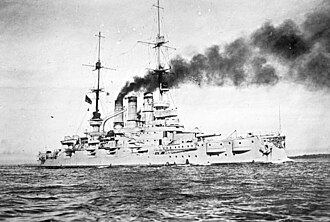
SMS Pommern: The German Pre-Dreadnought Battleship Lost at Jutland
SMS Pommern was one of the final pre-dreadnought battleships constructed for the Imperial German Navy and the third vessel of the Deutschland class. Launched in December 1905 and commissioned in August 1907, she was a substantial warship by the standards of her own time, combining four 28 cm main guns with a powerful secondary battery, heavy Krupp armor, and triple-expansion steam machinery. Yet Pommern entered service at precisely the moment when battleship design was undergoing a revolution. The arrival of HMS Dreadnought in 1906 rendered ships of her type obsolete almost immediately, transforming Pommern from a new capital ship into a second-line battleship before she had truly established herself.
Unlike several of her sisters, however, Pommern did not survive the First World War. Her career ended dramatically during the Battle of Jutland on the night of 31 May–1 June 1916, when she was struck by torpedoes from British destroyers. A catastrophic internal explosion destroyed the ship and killed her entire crew. German naval records and modern historical studies generally give the death toll at approximately 839–844 men, making Pommern one of the most devastating German losses of the battle.
Her relatively short career nevertheless offers an unusually revealing glimpse into the final years of the pre-dreadnought battleship. Pommern was conceived as part of Germany’s effort to build a powerful battle fleet, trained for major fleet warfare, participated in operations during the opening years of the First World War, and ultimately met the very fate that the rapid development of naval weapons had made increasingly likely for aging capital ships.
The Origins of SMS Pommern
Germany’s Naval Expansion
The construction of Pommern must be understood within the extraordinary naval expansion undertaken by Imperial Germany during the reign of Kaiser Wilhelm II. At the beginning of the twentieth century, Germany was seeking to establish itself as a major maritime power, and Admiral Alfred von Tirpitz became the principal architect of a fleet designed to challenge the dominance of established naval powers.
The Deutschland class represented the final stage of this pre-dreadnought building program. The five ships—Deutschland, Hannover, Pommern, Schlesien, and Schleswig-Holstein—were based on the preceding Braunschweig class. Their designers retained the basic concept of a heavily protected battleship armed with a small number of large guns and a substantial intermediate battery, but increased protection and made a number of incremental improvements. German naval sources describe the class as slightly better protected than the Braunschweigs, although this came with some loss of maneuverability.
Pommern was ordered under the contract name “O” and constructed by AG Vulcan at Stettin, a major German shipbuilding center located in what is now Szczecin, Poland. Her keel was laid on 22 March 1904. The ship was launched on 2 December 1905, after a delay caused by insufficient water levels in the harbor, and was commissioned on 6 August 1907. Her construction cost approximately 24.6 million marks.
The name Pommern referred to Pomerania, the historic region along Germany’s Baltic coast. The choice was consistent with the practice of naming many German battleships after states, provinces, cities, or other geographical entities associated with the German Empire.
Design and Construction
Dimensions and Machinery
Pommern measured 127.6 meters in overall length, with a beam of 22.2 meters. Sources give a maximum draft of approximately 7.7 to 8.25 meters, depending on how the measurement is recorded. Her designed displacement was about 13,191 metric tons, while maximum displacement reached approximately 14,218 tons. She carried a crew of roughly 735–749 officers and enlisted personnel during her wartime service.
The battleship was propelled by three vertical three-cylinder triple-expansion steam engines driving three propellers. Twelve Schulz-Thornycroft boilers supplied steam to the engines. The machinery produced approximately 17,696 horsepower, or about 13,015 kW, and gave the ship a designed maximum speed of around 18 knots. Pommern was also notable for her economy, with a range commonly given as approximately 5,830 nautical miles at 10 knots.
Coal was the primary fuel, as was standard for German battleships of the period. The propulsion system was technologically mature rather than revolutionary. Triple-expansion engines had been used extensively in warships before the appearance of steam turbines, and they provided reliable power, although they were eventually surpassed in efficiency and performance by turbine machinery.
For Pommern, the machinery was sufficient to make her a relatively fast pre-dreadnought. Some accounts credit her with exceeding her designed speed during trials. Nevertheless, speed alone could not compensate for the fundamental difference between a ship armed with four 28 cm guns and the new generation of dreadnoughts carrying numerous weapons of 30.5 cm or larger caliber.
Heavy Armor Protection
Protection was one of the principal strengths of the Deutschland class. Pommern was equipped with Krupp cemented armor, and her main waterline belt reached approximately 240 mm in its thickest central sections. The armor protected the machinery spaces, magazines, and other vital areas that were essential to the ship’s survival.
The main gun turrets were protected by armor reaching approximately 280 mm, while the armored deck was about 40 mm thick in its principal sections. Other parts of the ship, including the casemates and command tower, received substantial protection as well. German technical data records a particularly wide range of armor thicknesses across the ship, from relatively thin sections to as much as 300 mm in portions of the conning tower.
This armor scheme reflected the pre-dreadnought understanding of naval combat. Designers expected battleships to exchange fire at relatively close or moderate ranges, making thick vertical armor crucial. The central armored citadel was intended to preserve the ship’s machinery and magazines even after sustaining repeated hits.
The irony of Pommern’s eventual fate was that armor could offer little protection against a catastrophic underwater explosion that penetrated the ship’s internal spaces.
The Armament of SMS Pommern
Four 28 cm Main Guns
The principal offensive weapons aboard Pommern were four 28 cm SK L/40 guns mounted in two twin turrets. One turret stood forward and the other aft, giving the ship a conventional arrangement that allowed her to fire a powerful broadside while retaining substantial firepower toward the bow and stern.
The 28 cm gun was a formidable weapon when the Deutschland class was conceived. It was capable of engaging enemy capital ships and represented a substantial improvement over the 24 cm guns carried by several earlier German battleships.
Yet the main battery also illustrates why Pommern became obsolete so rapidly. Four heavy guns represented only a small fraction of the firepower available aboard the new dreadnoughts. In a long-range engagement, a dreadnought could deliver considerably more heavy shells and could generally make more effective use of salvo fire.
Secondary and Light Artillery
Supporting the main battery were fourteen 17 cm SK L/40 guns, largely mounted in casemates. These weapons provided a substantial intermediate battery for engaging cruisers and other targets that did not require the use of the main guns. Twenty 8.8 cm quick-firing guns provided defense against torpedo boats and other light vessels. Six 45 cm torpedo tubes completed the original offensive armament.
This combination of weapon types was characteristic of the pre-dreadnought era. Battleship designers believed that the different calibers gave a capital ship flexibility in combat. Heavy guns were intended for battleships, medium guns for cruisers and other warships, and quick-firing weapons for small, fast attackers.
The system was logical within the technological environment of the early 1900s. It was the appearance of accurate long-range fire control and all-big-gun battleships that made the mixed battery increasingly obsolete.
The Dreadnought Revolution
A Battleship Outdated Almost Immediately
The greatest misfortune of Pommern was the timing of her construction. She was launched in December 1905 and commissioned in August 1907, but HMS Dreadnought had already been launched in 1906 and commissioned before Pommern entered service.
Dreadnought carried ten 30.5 cm guns and used steam turbines, creating an entirely new category of battleship. Instead of relying on four heavy guns supplemented by numerous medium weapons, the new design emphasized a much larger battery of heavy artillery. This dramatically increased the weight of fire that could be delivered at long range.
The effect on Pommern and her sisters was immediate. They were still capable warships, but they were no longer first-line battleships in the emerging dreadnought competition. Germany itself responded by constructing the Nassau class, its first dreadnought battleships, followed by increasingly powerful classes.
The Deutschland-class ships consequently became second-line units. Their continued existence was nevertheless valuable because Germany had relatively few modern dreadnoughts at the beginning of the First World War, while the Royal Navy possessed a much larger fleet.
Prewar Service
Training With the High Seas Fleet
During the years before 1914, Pommern participated in the regular training and exercises of the High Seas Fleet. These exercises were fundamental to German naval preparation. A fleet was not simply a collection of individual ships; it required crews and commanders capable of maneuvering large formations under difficult conditions.
Battleship crews practiced gunnery, navigation, signaling, formation keeping, damage control, and tactical maneuvers. Fleet exercises also allowed German officers to develop procedures for coordinating battleships with cruisers, torpedo boats, destroyers, and other vessels.
Pommern therefore spent her early career performing a role for which she remained well suited: training sailors and contributing to the fleet’s numerical strength. Her robust armor and reliable machinery made her useful even though newer ships were already assuming the leading position.
The peacetime years also allowed the crew to become familiar with a vessel that required a large number of sailors and extensive engineering support. Battleships of this period were floating industrial complexes, combining huge steam machinery, ammunition magazines, electrical systems, pumps, workshops, living spaces, and communications equipment.
SMS Pommern During the First World War
The Opening of the Conflict
When the First World War began in August 1914, Pommern and the other Deutschland-class ships were assigned to the II Battle Squadron of the High Seas Fleet. Their role was increasingly defensive and supportive, but they remained available for major fleet operations. German naval commanders could not afford to leave heavily armed ships unused while Britain possessed overwhelming numerical superiority at sea.
The old battleships took part in operations designed to protect German forces, support battlecruiser sorties, and potentially bring portions of the British Grand Fleet into battle under favorable circumstances.
One of the major early operations was the German raid on the British east coast in December 1914. Pommern participated in the broader fleet movement associated with the bombardments of Scarborough, Hartlepool, and Whitby. The operation sought to draw British forces into a position where German battlecruisers and battleships could engage them, but the anticipated decisive confrontation did not occur.
The experience demonstrated both the strategic possibilities and limitations of the German fleet. Germany could conduct offensive sorties into the North Sea, but the risk of encountering the much larger British Grand Fleet remained enormous.
The Battle of Jutland
Germany’s Greatest Fleet Engagement
The defining event in Pommern’s career came in May and June 1916, when the German High Seas Fleet sailed into the North Sea in an operation that eventually produced the Battle of Jutland.
The battle began on 31 May when German and British scouting forces encountered each other. Battlecruisers fought a series of engagements before the main fleets gradually approached one another. The older German battleships of the II Battle Squadron occupied a difficult position within the German formation. They possessed respectable firepower and heavy armor, but they were slower and less heavily armed than the modern dreadnoughts around them.
Pommern did fire during the battle and briefly engaged British forces, but the decisive event in her story occurred later, during the chaotic night fighting.
The Fatal Torpedo Attack
During the night of 31 May–1 June, German and British destroyers fought a series of confused engagements as the German fleet attempted to return home. Visibility was poor, formations were difficult to maintain, and identification of friendly and enemy ships became extremely challenging.
In the early hours of 1 June, British destroyers attacked the German line. Pommern was struck by one or possibly two torpedoes fired by the British destroyer HMS Onslaught, according to historical accounts. The torpedoes caused a catastrophic explosion that detonated ammunition within the ship. The resulting blast tore the battleship apart and destroyed her almost instantly.
The loss was particularly severe because Pommern was carrying a large crew. There were no survivors from the ship, and modern sources generally give the death toll as approximately 839–844 men. The Jutland Battle Memorial records 844 fatalities, while German naval-history sources give 839 casualties.
The destruction of Pommern was one of the clearest demonstrations at Jutland of the danger posed by torpedoes and ammunition explosions. Her thick armor, which might have protected her effectively against many gunfire hits, could not save the ship once the underwater attack triggered a devastating internal explosion.
The Significance of Pommern’s Loss
The End of a Pre-Dreadnought Battleship
Pommern was the only Deutschland-class battleship lost during the First World War. Her sisters survived the conflict and some remained in German service for decades afterward. Her destruction therefore occupies a special place in the history of the class.
Her fate also illustrated the declining usefulness of pre-dreadnoughts in modern fleet combat. The ship had been designed around the expectation that armor and gunfire would determine battleship engagements. At Jutland, however, underwater weapons, long-range artillery, rapid maneuvering, and increasingly sophisticated fire control had transformed naval warfare.
It would be misleading to describe Pommern as simply a helpless obsolete ship. She was still heavily armed and armored and could contribute to a fleet operation. But her presence in the battle reflected Germany’s shortage of modern capital ships rather than the continuing superiority of the pre-dreadnought concept.
A Symbol of the Jutland Night Battle
The circumstances of Pommern’s destruction have given her a lasting place in accounts of Jutland. The daytime battle is often remembered for the dramatic clashes between battlecruisers and dreadnoughts, but the night phase was equally dangerous. Confused destroyer actions demonstrated that even the most powerful capital ships remained vulnerable to smaller vessels carrying torpedoes.
Pommern was not defeated by a prolonged artillery duel. She was destroyed suddenly in the darkness, her ammunition exploding after the torpedo attack. The contrast between the ship’s immense size and the relatively small weapons that ultimately destroyed her is one of the most striking aspects of her history.
The Wreck of SMS Pommern
An Underwater Grave
The wreck of Pommern remained on the seabed after the battle, representing the final resting place of hundreds of German sailors. Her loss was so catastrophic that there were no survivors to provide personal accounts of the sinking.
In the decades following the First World War, the wreck remained a reminder of the scale of the Battle of Jutland. Some material from the wreck was recovered in 1957, but the site largely remained associated with the men who died aboard the ship.
The wreck’s condition also reflects the long-term fate of many First World War warships. Underwater corrosion, salvage activity, fishing operations, and natural deterioration gradually alter submerged vessels. What remains of Pommern today is therefore not simply a technological artifact but also a maritime memorial.
The Historical Legacy of SMS Pommern
A Product of a Changing Navy
The history of Pommern encapsulates the dramatic transition between two generations of naval warfare. She was a sophisticated battleship when her design was conceived, yet she belonged to a technological category that was already disappearing by the time she entered service.
Her construction was part of Germany’s attempt to establish a powerful battle fleet, and her service with the High Seas Fleet reflected the strategic ambitions of the Kaiserreich. But the emergence of the dreadnought transformed the battleship competition and forced Germany to build an entirely new generation of capital ships.
Pommern nevertheless remained useful because naval wars are rarely fought exclusively with the newest equipment. Older ships can provide additional numbers, guard important waters, escort lighter forces, and reinforce fleet operations. Her service during the first two years of the First World War demonstrates precisely this practical value.
Remembering the Ship and Her Crew
The most important aspect of Pommern’s legacy is ultimately not her technical specifications but the people aboard her. More than eight hundred sailors died when she disappeared during the night fighting at Jutland. Unlike many naval losses, there was no group of survivors who could recount the final moments of the ship. Her destruction was sudden and catastrophic.
For that reason, Pommern remains more than an example of pre-dreadnought technology. She is also a war grave and a reminder of the human cost hidden behind statistics about displacement, armor thickness, gun caliber, and speed.
Technical Specifications of SMS Pommern
| Specification | Details |
|---|---|
| Ship name | SMS Pommern |
| Type | Pre-dreadnought battleship |
| Class | Deutschland class |
| Builder | AG Vulcan, Stettin |
| Contract name | “O” |
| Laid down | 22 March 1904 |
| Launched | 2 December 1905 |
| Commissioned | 6 August 1907 |
| Construction cost | Approximately 24.6 million marks |
| Length overall | 127.6 m |
| Length at waterline | Approximately 125.9 m |
| Beam | 22.2 m |
| Maximum draft | Approximately 7.7–8.25 m |
| Designed displacement | 13,191 metric tons |
| Full-load displacement | Approximately 14,218 metric tons |
| Propulsion | 3 × three-cylinder triple-expansion steam engines |
| Boilers | 12 × Schulz-Thornycroft boilers |
| Propeller shafts | 3 |
| Power | Approximately 17,696 PS / 13,015 kW |
| Maximum speed | Approximately 18 knots |
| Range | Approximately 5,830 nautical miles at 10 knots |
| Crew | Approximately 735–749; wartime sources give higher casualty totals |
| Main armament | 4 × 28 cm SK L/40 guns |
| Secondary armament | 14 × 17 cm SK L/40 guns |
| Light armament | 20 × 8.8 cm guns |
| Torpedo armament | 6 × 45 cm submerged torpedo tubes |
| Main belt armor | Up to approximately 240 mm |
| Deck armor | Approximately 40 mm, with thicker protective sections |
| Turret armor | Up to approximately 280 mm |
| Casemate armor | Approximately 170 mm |
| Primary wartime formation | II Battle Squadron, High Seas Fleet |
| Major battle | Battle of Jutland, 31 May–1 June 1916 |
| Fate | Torpedoed and sunk during the night action at Jutland |
| Casualties | Approximately 839–844 killed; no survivors |
Published specifications differ slightly in areas such as draft, range, horsepower, crew strength, and the precise arrangement of armor. The figures above combine commonly cited German naval and Jutland reference data.
Conclusion
SMS Pommern was a battleship born into an era that was already disappearing. Conceived as part of Germany’s ambitious naval expansion, she embodied the mature pre-dreadnought design philosophy: heavy armor, a four-gun main battery, a substantial secondary armament, and reliable triple-expansion machinery. When her keel was laid in 1904, she represented serious naval power; when she entered service in 1907, the appearance of HMS Dreadnought had already transformed the battleship world.
Nevertheless, Pommern remained an active participant in Germany’s naval war. She served with the High Seas Fleet, supported operations in the North Sea, and ultimately took part in the Battle of Jutland. Her final hours demonstrated the extraordinary danger of naval combat in the early twentieth century. During the confused night fighting of 1 June 1916, British destroyers launched a torpedo attack that caused a catastrophic ammunition explosion, destroying Pommern and killing her entire crew.
Her fate also illustrates the limitations of judging historic warships solely by their specifications. Pommern was certainly obsolete compared with the dreadnoughts of her time, but she was still a heavily armored warship with powerful artillery and considerable strategic value. Her loss was not the result of simply being an old ship; it was the result of the complex and unpredictable nature of fleet warfare, where a torpedo launched by a relatively small destroyer could destroy a battleship costing millions of marks.
Today, SMS Pommern is remembered both as the only Deutschland-class battleship lost in the First World War and as one of the most dramatic German losses at Jutland. Her wreck marks the final resting place of more than eight hundred sailors, while her career illustrates the extraordinary speed with which naval technology changed between the construction of her keel and her destruction twelve years later. In that sense, Pommern stands as a powerful symbol of the transitional period between the traditional battleship and the modern dreadnought—and of the human cost of that transformation.
