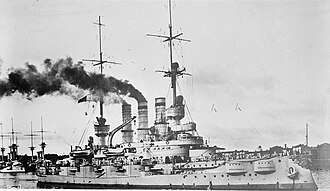
SMS Schlesien: From Imperial Battleship to World War II Veteran
SMS Schlesien was one of the last pre-dreadnought battleships built for the Imperial German Navy and one of the most remarkable survivors of the German naval wars of the first half of the twentieth century. A member of the Deutschland class, she was laid down at the Schichau shipyard in Danzig in 1904, launched on 28 May 1906, and commissioned on 5 May 1908. By the standards of her own design era, Schlesien was a formidable capital ship, carrying four 28 cm guns, fourteen 17 cm secondary weapons, heavy armor, and triple-expansion steam engines capable of driving her at roughly 18.5 knots. Yet the appearance of HMS Dreadnought in 1906 transformed the naval balance so quickly that Schlesien was effectively obsolete almost as soon as she entered service.
What makes Schlesien particularly fascinating is that obsolescence did not end her usefulness. She served through the First World War, participated in the Battle of Jutland in 1916, survived the collapse of Imperial Germany, and was retained by the small Reichsmarine under the restrictions of the Treaty of Versailles. During the interwar period she was modernized and used as a training and fleet ship, and after the establishment of the Kriegsmarine she became one of the few elderly German battleships to see service during the Second World War. Her career finally ended in May 1945, when she was deliberately scuttled at Swinemünde as Soviet forces approached.
The story of Schlesien therefore stretches across an extraordinary period of naval history. She began life as a symbol of Kaiser Wilhelm II’s ambitious battle fleet, became an outdated but useful wartime veteran, survived the political upheaval of 1918, and eventually served a Germany that was fighting another world war. Few warships demonstrate so clearly how a vessel designed for one generation of naval warfare could be repeatedly adapted to changing circumstances.
The Origins of SMS Schlesien
Germany’s Final Pre-Dreadnought Battleship Class
The Deutschland class was the final class of traditional pre-dreadnought battleships constructed by Germany. The five ships—Deutschland, Hannover, Pommern, Schlesien, and Schleswig-Holstein—were derived from the preceding Braunschweig class and represented an incremental development rather than a radical redesign. Their armor protection was improved, while their armament retained the general arrangement of four heavy guns supplemented by a large number of medium-caliber weapons. The ships were somewhat less maneuverable than their predecessors, but they offered substantial protection and firepower for the naval environment in which they had been designed.
The class was ordered under the naval construction program associated with Admiral Alfred von Tirpitz, whose fleet laws provided the institutional and financial framework for the rapid expansion of the Imperial German Navy. The intention was to create a battle fleet powerful enough to make a potential enemy hesitate before attempting to destroy Germany’s naval forces. The Deutschland class was consequently part of a much larger strategic project: Germany was not merely purchasing individual battleships but constructing the infrastructure, personnel, tactics, and industrial capacity required to operate a modern fleet.
Schlesien was ordered from F. Schichau of Danzig. Her keel was laid in 1904, she was launched on 28 May 1906, and she entered service on 5 May 1908. Her construction cost approximately 24.9 million marks according to commonly cited records. She was named after Silesia, the historic Central European region that was an important part of Prussia and the German Empire.
Her launch occurred at an unfortunate moment for the pre-dreadnought battleship concept. In December 1906, HMS Dreadnought entered British service. The British ship’s revolutionary combination of numerous heavy guns and turbine propulsion effectively reset the definition of a modern battleship. By the time Schlesien joined the fleet in 1908, Germany was already pursuing its own generation of dreadnoughts.
Design and Construction
Hull and Dimensions
Schlesien measured approximately 127.6 meters in overall length, with a beam of 22.2 meters and a draft of about 8.2 meters. Her designed displacement was approximately 13,191 metric tons, increasing to around 14,218 tons at maximum loading. Her crew numbered roughly 742 to 802 personnel depending on the period and configuration of the ship.
These dimensions made Schlesien a substantial ship, but she was relatively compact when compared with the much larger dreadnoughts that followed. Her designers were attempting to balance firepower, armor, propulsion, and displacement within the limitations of the German naval building program. Like other battleships of the period, she had extensive internal subdivision intended to limit flooding and protect vital machinery and magazines.
The hull’s relatively narrow beam compared with later capital ships also reflected the priorities of the era. Naval architects needed to produce a vessel that could achieve reasonable speed while carrying enough armor and ammunition to withstand enemy fire. The result was a heavily protected battleship whose proportions were characteristic of the final generation of pre-dreadnought designs.
Triple-Expansion Machinery
The propulsion system consisted of three vertical three-cylinder triple-expansion steam engines, each driving its own propeller shaft. Twelve coal-fired marine boilers supplied steam, and the machinery developed approximately 18,923 horsepower according to technical references. This gave Schlesien a maximum speed of about 18.5 knots and a range of approximately 4,800 nautical miles at 10 knots.
Triple-expansion engines were mature and dependable technology by the time Schlesien was constructed. They worked by expanding steam through multiple cylinders of increasing size, extracting energy at several stages before exhausting the steam. The system had served naval and commercial shipping effectively for decades.
The problem was that turbine propulsion was developing rapidly. HMS Dreadnought demonstrated the tactical benefits of turbines, particularly for achieving high speed. Consequently, Schlesien’s propulsion system was already representative of a passing generation. It was reliable, however, and remained perfectly adequate for the ship’s later roles.
Armor Protection
Built to Survive Gunfire
Armor was one of Schlesien’s greatest strengths. Her main armored belt reached approximately 240 mm at its thickest portions, while the heavy gun turrets were protected by armor up to approximately 280 mm. The forward command tower was protected by as much as 300 mm of armor, while the deck armor and internal protective structures varied according to location.
This protection reflected the prevailing pre-dreadnought assumption that battleships would primarily defeat one another through artillery exchanges. A heavily armored central citadel protected the machinery and ammunition spaces, while thick turret and conning-tower armor protected the ship’s weapons and command personnel.
The armor also helped explain why Schlesien remained useful after becoming technologically obsolete. Although she could not match a modern dreadnought in long-range firepower, she was still a difficult target for lighter warships. Her protection made her suitable for coastal defense, training, patrol, and other roles in which the risk of encountering the enemy’s newest battleships was limited.
The Armament of SMS Schlesien
Main Battery
The principal battery consisted of four 28 cm SK L/40 guns, mounted in two twin turrets, one forward and one aft. These were powerful weapons when the Deutschland class was designed and gave Schlesien the ability to engage enemy battleships at substantial ranges.
The basic weakness was the number of guns. Four heavy weapons could produce a respectable broadside, but the new dreadnoughts carried many more guns of similar or larger caliber. This difference dramatically affected the amount of shellfire that could be delivered during an engagement.
The main guns nevertheless remained useful throughout Schlesien’s career. Their presence gave the elderly ship a level of striking power that smaller cruisers and auxiliary vessels could not match, and the guns were retained through much of her later service.
Secondary Battery and Torpedoes
The original secondary armament comprised fourteen 17 cm guns, while twenty 8.8 cm quick-firing weapons provided additional defense against torpedo boats and other small vessels. Six 45 cm torpedo tubes completed the original armament.
The secondary battery was typical of the pre-dreadnought era. Naval designers expected a battleship to face several categories of targets, and the mixed-caliber arrangement allowed commanders to select appropriate weapons according to range and target size.
As Schlesien aged, however, her secondary and anti-aircraft weapons were repeatedly modified. During the interwar and Second World War periods, some of the original guns were removed and replaced by more modern weapons, including anti-aircraft artillery. This evolution demonstrates how the ship’s role changed from a conventional battleship into a multipurpose naval platform.
The Dreadnought Revolution
Obsolete Before the First World War
The most important event in Schlesien’s early career was not something she participated in, but something that happened to naval technology. HMS Dreadnought rendered the traditional pre-dreadnought battleship obsolete by introducing an all-big-gun arrangement and turbine propulsion. The Deutschland-class ships, including Schlesien, suddenly occupied an uncomfortable position: they were modern enough to be expensive and heavily armed but too old in concept to compete with the latest dreadnoughts.
Germany reacted by building its own dreadnoughts, beginning with the Nassau class. The High Seas Fleet consequently developed into a mixture of older pre-dreadnoughts and increasingly powerful modern battleships.
This technological transition is essential to understanding Schlesien’s later career. She was not retained because German commanders believed she could defeat a modern battleship in a conventional duel. Rather, she remained useful because a fleet needed ships for many tasks, and Germany had a finite number of capital ships available.
SMS Schlesien in the First World War
Early War Operations
At the outbreak of the First World War in 1914, Schlesien served with the High Seas Fleet and initially performed guard duties in the German Bight. She subsequently participated in the fleet operation supporting the German battlecruisers during the bombardment of Scarborough, Hartlepool, and Whitby on 15–16 December 1914.
The operation was intended to use German battlecruisers to attack the British coast while the High Seas Fleet remained nearby to support them. German commanders hoped that British forces would respond in a way that allowed a portion of the Royal Navy to be isolated and defeated.
Instead, the operation demonstrated the dangers of operating near the vastly larger British Grand Fleet. German and British forces came relatively close to one another, but Admiral Friedrich von Ingenohl withdrew after receiving reports that suggested a much larger British force might be present.
For Schlesien, the operation was important because it demonstrated that even an obsolete battleship could contribute to the protective screen of a major fleet sortie. Her role, however, was increasingly secondary to that of the modern dreadnoughts.
From Fleet Battleship to Support Vessel
During 1915 and early 1916, Schlesien participated in several fleet advances and training operations. By March 1916, she had also been used as a target ship for U-boat training, an indication of the extent to which the German Navy recognized the limitations of the old battleships.
In April 1916 she again joined the High Seas Fleet in support of the battlecruisers during the raid on the English coast around Yarmouth and Lowestoft. The operation was cut short after a German battlecruiser struck a mine and the weather and visibility made further operations difficult.
These duties reveal an important feature of naval warfare: a ship did not need to be the newest or most powerful unit in the fleet to have operational value. Schlesien could provide additional guns, act as a training platform, perform guard duty, and reinforce formations without being relied upon to engage the enemy’s most modern battleships directly.
The Battle of Jutland
Joining the German Battle Line
The climax of Schlesien’s First World War career was the Battle of Jutland, fought on 31 May and 1 June 1916. The five Deutschland-class battleships all participated, despite their obsolescence. They formed the II Battle Squadron and occupied the rear of the German battle line.
Schlesien was positioned as the second ship in the IV Division of II Battle Squadron and was near the rear of the German formation. Her sister Schleswig-Holstein followed her. This positioning reduced their exposure compared with the modern dreadnoughts in the center of the fleet, but it also reflected their limited tactical usefulness in a battle dominated by newer ships.
During the battle, British destroyers made repeated attacks against the German fleet, some of which threatened Schlesien. Nevertheless, the German fleet successfully fought its way through the British destroyer screen and reached the waters near Horns Reef during the early hours of 1 June. Schlesien survived the engagement without suffering the catastrophic fate that overtook her sister Pommern.
The Lesson of Jutland
Jutland effectively confirmed that the old pre-dreadnoughts had no meaningful place in a modern fleet battle. Their speed, armament, and fire-control capabilities were inadequate compared with the dreadnoughts. The Deutschland-class ships were therefore increasingly confined to secondary duties after the battle.
This was a critical turning point in Schlesien’s history. She had survived the largest fleet battle of the First World War, but survival did not mean she would return to her former position. After Jutland, she was used increasingly for picket and training duties near the Elbe and as a target ship for submarine exercises. (Wikipedie)
Surviving the First World War
The Post-Jutland Years
The German Navy’s experience at Jutland convinced commanders that the old battleships were too vulnerable for major fleet engagements. Schlesien and her surviving sisters consequently spent much of the later war away from the main battle line. Her duties included coastal defense, training, and submarine-related exercises.
When the war ended in November 1918, Schlesien was among the German capital ships that survived the conflict. Her survival would prove extremely significant because the Treaty of Versailles imposed severe limitations on Germany’s navy.
The treaty permitted Germany to retain only a small number of old battleships. Because Schlesien was already an elderly pre-dreadnought, she fell within the category of vessels that could be retained. This allowed her to become part of the Reichsmarine, the naval force of the Weimar Republic.
Service in the Reichsmarine
An Unlikely Second Career
The interwar years gave Schlesien a remarkable second life. Although she was technologically outdated, she became valuable as a training ship and fleet unit for a navy that was itself severely restricted.
The Reichsmarine had to preserve naval expertise with a very small number of vessels. Older ships such as Schlesien could therefore provide training opportunities that would otherwise have been unavailable. Officers and sailors could learn navigation, engineering, gunnery, signaling, and fleet procedures aboard a genuine capital ship.
During the 1920s and 1930s, Schlesien and other surviving German battleships also undertook extended cruises. These voyages gave crews experience in long-distance navigation and demonstrated the Reichsmarine’s limited ability to operate beyond German coastal waters.
Her armament and machinery were modified over time. Some of the original secondary weapons were removed, and new anti-aircraft guns were added as aircraft became increasingly important to naval warfare. These modifications could not turn Schlesien into a modern battleship, but they made her more useful in the roles that Germany could realistically assign to her.
SMS Schlesien in the Second World War
From Training Ship to Combat Support
After the creation of the Kriegsmarine in 1935, Schlesien continued to serve despite her age. Germany’s naval expansion was focused on modern warships, but the elderly pre-dreadnought remained useful for training and auxiliary duties.
When the Second World War began in 1939, Schlesien was no longer a credible opponent for modern battleships. Nevertheless, she could perform coastal defense, artillery support, training, and other tasks. Her heavy armor and large-caliber guns still gave her a useful capability against shore targets and smaller vessels.
The transformation in her armament illustrates the changing nature of warfare. The ship that had originally carried twenty 8.8 cm guns as defense against torpedo boats was later fitted with anti-aircraft weapons designed to defend against aircraft. Technical references record modifications that included 10.5 cm anti-aircraft guns and increasing numbers of 3.7 cm and 2 cm weapons.
Thus, Schlesien became something very different from the battleship launched in 1906. She retained her four 28 cm main guns, but much of her supporting armament was adapted to the realities of twentieth-century warfare.
The Final Years of SMS Schlesien
The Baltic and the End of the War
In the final stages of the Second World War, Schlesien operated in the Baltic. By this point the German naval situation was desperate. The Kriegsmarine was increasingly involved in supporting ground forces, evacuating personnel, transporting supplies, and providing artillery support as the Red Army advanced toward the Baltic coast.
Schlesien’s heavy guns could still be useful for shore bombardment, and her elderly hull continued to serve despite its age. This was a striking reversal of her original purpose. The ship had been designed to fight enemy battleships at sea, but her most valuable contribution late in her life was increasingly connected with supporting operations on land and in coastal waters.
In May 1945, as Germany’s military collapse approached its final stage, Schlesien was at Swinemünde, then a major German naval base in Pomerania. On 4 May she was scuttled after being damaged, with the exact circumstances of her final destruction described somewhat differently in historical accounts. German naval references give her final fate as being blown up at Swinemünde on 4 May 1945.
Her career had lasted almost thirty-seven years.
The Legacy of SMS Schlesien
A Warship Spanning Four Decades
Few German battleships illustrate technological change as dramatically as Schlesien. She entered service with the Kaiserliche Marine when the pre-dreadnought battleship represented the pinnacle of naval power. Eight years later she was already an obsolete second-line unit. She then survived the First World War, became part of the restricted Reichsmarine, was modified during the interwar period, and eventually served during the Second World War.
The ship’s longevity was not evidence that her original design remained competitive. Instead, it demonstrated the adaptability of naval organizations. A vessel that could no longer perform her original mission could still provide training, coastal defense, transport, artillery support, or a platform for new weapons.
The Deutschland class as a whole illustrates this principle. Of the five ships, Pommern was lost at Jutland, while several of the survivors remained in German service because their age made them permissible under the postwar naval restrictions. Schlesien and Schleswig-Holstein went further than their sisters, remaining useful enough to see service in the Second World War.
From Imperial Symbol to War Grave
There is also a symbolic dimension to Schlesien’s career. She was built during Germany’s imperial naval expansion and named after a major historic region of the German state. She survived the collapse of that empire and continued serving under two different German republican and authoritarian naval organizations.
By the time she was scuttled in 1945, the world of German battleship construction that had produced her had vanished completely. Aircraft carriers, submarines, radar, naval aviation, and fast modern battleships had transformed naval warfare. Yet Schlesien was still afloat, a physical survivor from an earlier technological age.
Her final resting place consequently represents more than the loss of an old battleship. It marks the end of a career that had begun during the reign of Kaiser Wilhelm II and continued almost to the end of the Third Reich.
Technical Specifications of SMS Schlesien
| Specification | Details |
|---|---|
| Ship name | SMS Schlesien |
| Type | Pre-dreadnought battleship |
| Class | Deutschland class |
| Builder | F. Schichau, Danzig |
| Construction number | 751 / 571 in differing references |
| Laid down | 1904–1905 |
| Launched | 28 May 1906 |
| Commissioned | 5 May 1908 |
| Construction cost | Approximately 24.9 million marks |
| Length overall | 127.6 m |
| Length at waterline | 125.9 m |
| Beam | 22.2 m |
| Draft | Approximately 8.2 m |
| Designed displacement | 13,191 metric tons |
| Maximum displacement | 14,218 metric tons |
| Propulsion | 3 × three-cylinder triple-expansion steam engines |
| Boilers | 12 × marine water-tube boilers |
| Propeller shafts | 3 |
| Power | Approximately 18,923 shp |
| Maximum speed | Approximately 18.5 knots |
| Range | Approximately 4,800 nautical miles at 10 knots |
| Original crew | Approximately 742–802 |
| Main armament | 4 × 28 cm SK L/40 guns |
| Original secondary armament | 14 × 17 cm SK L/40 guns |
| Original light armament | 20 × 8.8 cm guns |
| Torpedo armament | 6 × 45 cm torpedo tubes |
| Maximum belt armor | Approximately 240 mm |
| Deck armor | Approximately 40 mm, with thicker sloped sections |
| Turret armor | Up to approximately 280 mm |
| Command tower armor | Up to approximately 300 mm |
| World War I formation | II Battle Squadron, High Seas Fleet |
| Major World War I battle | Battle of Jutland, 31 May–1 June 1916 |
| Interwar operator | Reichsmarine |
| Later operator | Kriegsmarine |
| Final location | Swinemünde |
| Final fate | Scuttled/blown up, 4 May 1945 |
Figures can vary between references because the ship underwent substantial modifications during her long career. The table primarily describes her original configuration, with later-service details noted where appropriate.
Conclusion
SMS Schlesien was far more than an obsolete pre-dreadnought battleship. Her career represents a remarkable journey through one of the most turbulent periods in naval history. Constructed as part of Imperial Germany’s effort to build a world-class battle fleet, she entered service in 1908 carrying the conventional armament and protection of the pre-dreadnought era. Almost immediately, however, HMS Dreadnought transformed the naval landscape and left Schlesien behind technologically.
Yet technological obsolescence did not make her irrelevant. During the First World War she performed guard duties, supported German fleet operations, and participated in the Battle of Jutland. Unlike her sister Pommern, she survived the battle and continued serving in increasingly secondary roles. After 1918, her age became an unexpected advantage because it allowed Germany to retain her under the naval restrictions imposed by the Treaty of Versailles. She subsequently became part of the Reichsmarine and was adapted to the needs of a much smaller German navy.
The Second World War extended her extraordinary career even further. By then Schlesien could no longer compete with modern battleships, but her guns, armor, and large hull still made her useful for training, coastal operations, and artillery support. Her anti-aircraft armament was repeatedly modified as the threat posed by aircraft grew, demonstrating the effort made to extract practical value from an aging warship.
Her final destruction at Swinemünde in May 1945 brought an end to nearly four decades of service. Schlesien had witnessed the transformation from the Kaiserliche Marine’s pre-dreadnought fleet to the dreadnought era, survived the First World War and the fall of the German Empire, served the interwar Reichsmarine, and then fought in the final stages of another world war. Few ships better illustrate the extraordinary longevity that an adaptable warship could achieve—even after the technology that created it had long since disappeared.
