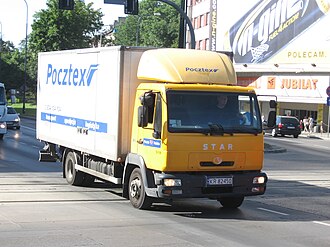
Star S2000: The Polish Truck That Entered the MAN Era
The Star S2000 represents one of the most important stages in the long history of Poland’s Star truck manufacturer. Developed at a time when the European commercial-vehicle industry was undergoing rapid consolidation and modernization, the S2000 family brought together the manufacturing heritage of Starachowice with technology and design associated with MAN. Rather than being a single truck in the traditional sense, the S2000 was a family of medium- and heavier-duty vehicles covering several weight and power classes. Models such as the Star 8.117, 10.157, 12.157, 12.227, 13.227, 14.227 and 15.227 demonstrated how extensively the Star range had evolved by the end of the 1990s. The trucks were closely related to the MAN L2000 concept, making the S2000 an especially interesting chapter in Polish commercial-vehicle history.
The Origins of the Star S2000
A New Direction for Star
The story of the S2000 begins with the changing fortunes of Fabryka Samochodów Ciężarowych Star, better known simply as Star. For decades, Starachowice had been one of Poland’s most important centers of truck production, and Star vehicles had become familiar throughout the country in transportation, construction, agriculture, municipal services and the armed forces. By the 1990s, however, the company’s traditional product range faced increasing competition from Western European manufacturers. Modern trucks were becoming more comfortable, cleaner, safer and more technologically advanced, while manufacturers themselves were becoming increasingly international.
Star’s cooperation with MAN marked a major change. Instead of attempting to develop an entirely new generation of trucks independently, the company gained access to components and engineering concepts that were already proven in the wider European market. The resulting S2000 family consequently combined Star’s production capabilities with the MAN L2000 platform and related technology. This was a pragmatic response to the economic and technological realities of the period, and it allowed the Star name to remain visible on a substantially more modern class of truck.
Why the MAN Connection Mattered
The relationship with MAN is one of the defining characteristics of the S2000. The family was not simply a cosmetic redesign of an older Star truck. Its cab architecture, engines and various drivetrain components reflected the growing technical relationship between the two companies. This gave the vehicles a noticeably more contemporary appearance and helped them meet the expectations of operators who increasingly compared Polish trucks directly with products from Germany and other Western European manufacturers.
The connection also created an interesting identity for the trucks. They remained Stars, built in the historical Star manufacturing environment and marketed under the Star name, but they shared much of their technical character with MAN’s medium-duty products. In retrospect, the S2000 can therefore be seen as a bridge between two eras: the era of the independent Polish Star and the era in which MAN’s influence became dominant.
The S2000 Model Family
Several Weight and Power Classes
One of the most useful ways to understand the Star S2000 is to treat it as a family rather than a single specification. Historical documentation lists multiple variants, including the 8.117, 10.157, 12.157, 12.227, 13.227, 14.227 and 15.227. The numbers generally indicate the approximate gross-weight or vehicle class and engine power, although individual designations and specifications varied across the range.
This approach made the S2000 more commercially useful because Star could offer customers a coherent range instead of a single truck aimed at one narrow market. Smaller variants could serve distribution and municipal roles, while larger versions offered greater payload capacity and were suitable for specialized bodies. The different power levels also allowed customers to select a vehicle appropriate to their operating requirements without abandoning the basic architecture of the S2000 family.
The Star 12.157 is particularly well known because of its use as a fire-engine chassis, while the more powerful 12.227, 13.227, 14.227 and 15.227 versions extended the range toward heavier applications. The result was a family capable of covering a significant portion of the medium-duty market at a time when Star was attempting to reposition itself within a rapidly changing European industry.
The Star 12.157
The 12.157 is arguably one of the best-known S2000 variants. It combined a gross vehicle weight of approximately 12 tonnes with an engine output of around 157 horsepower. Surviving vehicles document the use of MAN diesel technology, a six-speed manual transmission and a 4×2 chassis configuration. These characteristics made the truck a practical platform for general transportation as well as specialist applications.
Its popularity with Polish fire services is especially significant. Numerous Star 12.157 chassis were fitted with firefighting bodies, including vehicles carrying approximately 2,500 litres of water and 250 litres of foam concentrate. Some configurations accommodated crews of six and incorporated high-capacity pumps, turning the medium-duty chassis into a fully equipped emergency-response vehicle.
The continued survival of these trucks also demonstrates the strength of the basic design. Many remained in service for years after production ended, and some were subsequently transferred from professional fire services to volunteer brigades. For enthusiasts, these preserved or still-working fire engines are among the most visible reminders of the S2000 generation.
Engines and Mechanical Technology
MAN Diesel Engines
The S2000 family’s use of MAN engines was a major departure from the more traditional Star power units of earlier generations. Depending on the specific variant, the trucks used different MAN diesel engines corresponding to their power and weight classes. The 12.157, for example, is associated with the MAN D0824 LFL09 engine family and produced approximately 157 horsepower.
The engine selection was significant because it brought Star customers into a broader European ecosystem of commercial-vehicle components. MAN’s engines were already designed for demanding truck applications and could offer the combination of torque, fuel efficiency and durability expected from a modern medium-duty vehicle. At the same time, the use of an established engine design reduced the development risk associated with creating an entirely new Star powerplant.
For the operator, the practical advantage was straightforward: the S2000 was intended to be a working truck, and its drivetrain was designed accordingly. These were not performance vehicles. Their purpose was to deliver dependable propulsion while carrying substantial loads, operating specialized equipment and covering long working lives.
ZF Gearboxes and Conventional Drivetrains
The S2000 generation also benefited from internationally sourced transmission technology. Six-speed ZF manual gearboxes are documented on models such as the Star 12.157, providing a conventional but effective drivetrain for medium-duty operation.
A six-speed manual transmission suited the operating conditions of the era particularly well. Drivers could select a low gear for heavy starts and gradients and use higher ratios for economical road travel. The manual gearbox also avoided some of the complexity associated with later automated transmissions, which can be advantageous when maintaining an older truck today.
The drivetrain philosophy was therefore relatively straightforward: a turbocharged diesel engine, manual transmission, conventional rear-wheel drive and a chassis capable of accepting numerous body types. That simplicity was part of the S2000’s appeal and contributed to its usefulness in applications where reliability and ease of servicing were more important than sophisticated electronic integration.
Chassis and Vehicle Configuration
A Flexible Commercial Platform
One of the strongest features of the S2000 family was its adaptability. A truck chassis is valuable only if it can support the body and equipment required by its customer, and Star’s partnership with MAN produced a platform that could accommodate a wide variety of configurations. Depending on the model, S2000 vehicles could serve as cargo trucks, municipal vehicles, emergency vehicles and other specialized platforms.
The 12.157 provides a particularly clear example. With a gross vehicle weight of approximately 12,000 kg and a 4×2 configuration, it occupied a useful middle ground between lighter delivery vehicles and larger heavy trucks. Its two-axle layout kept the vehicle relatively maneuverable while still providing considerable capacity for equipment and payload.
Wheelbase and body dimensions naturally varied according to the particular version and conversion. This was especially important for specialist bodybuilders, which could adapt the chassis for firefighting equipment, recovery bodies or other applications. As a result, two S2000 trucks with identical model badges could look very different depending on their intended role.
Braking and Running Gear
The S2000 generation also reflected the modernization of Star’s chassis technology. Historical descriptions of the 12.157 identify disc brakes and a hypoid final drive, demonstrating that the truck incorporated components and design approaches consistent with contemporary European commercial vehicles.
For a medium-duty truck operating at approximately 12 tonnes, braking performance is particularly important. Emergency vehicles provide an obvious example because they can carry substantial equipment and may have to accelerate and brake repeatedly under demanding conditions. A modernized braking system therefore improved not only everyday drivability but also the suitability of the chassis for specialist applications.
The S2000 was still fundamentally a conventional truck, however. It lacked the extensive electronic systems found in current commercial vehicles, and that makes surviving examples comparatively straightforward to understand from a mechanical perspective. For restorers and enthusiasts, this combination of relatively modern European components and older mechanical architecture is one of the family’s most attractive characteristics.
The Cab: Star Meets MAN
A Distinctive L2000-Based Design
The cab is probably the most obvious visual expression of the S2000’s MAN connection. The family was based on the MAN L2000, giving the trucks a distinctly European appearance that was markedly different from earlier Star products.
This design change had practical importance as well as aesthetic significance. Cab-over-engine trucks place the driver above the front axle and engine compartment, making compact dimensions possible while maximizing usable cargo space. The MAN-influenced cab offered a more contemporary working environment, with improved visibility and ergonomics compared with many older Polish truck designs.
For fleet operators, this modernization was important. Drivers spend long periods inside commercial vehicles, so cab design has a direct effect on fatigue and productivity. The S2000’s cab helped bring Star closer to the standards established by Western European competitors and made the trucks more attractive to operators seeking something more contemporary than traditional Star models.
Specialist Crew Cabs
The flexibility of the cab architecture is particularly visible in emergency-service conversions. Some Star 12.157 fire engines used four-door crew cabs with seating for six firefighters, typically arranged as one driver, one front passenger and four rear crew members.
Such configurations transformed the basic truck into an integrated response vehicle. Instead of simply transporting cargo, the S2000 could carry an entire emergency crew together with water, firefighting equipment, pumps, breathing apparatus and rescue tools. This is an excellent illustration of why a versatile commercial chassis can remain useful for decades even after it disappears from ordinary freight fleets.
The S2000 in Fire and Rescue Service
Why Fire Brigades Chose the Platform
The S2000’s success in the fire-service sector deserves special attention because it helped preserve the trucks long after their production era. Polish fire departments and specialist bodybuilders used Star chassis to create vehicles capable of carrying significant quantities of water and equipment while remaining compact enough for everyday station and road use.
A typical Star 12.157 fire engine could carry around 2,500 litres of water and 250 litres of foam concentrate, while some Stolarczyk-bodied examples were equipped with pumps capable of delivering approximately 1,600 litres per minute or more at 8 bar. Higher-pressure outputs were also available depending on the individual installation.
The truck’s approximately 12-tonne gross-weight class was well suited to this role. A fire engine must balance equipment capacity with maneuverability, and a two-axle chassis is often more practical in towns and cities than a much larger heavy vehicle. The S2000 consequently provided a useful platform for stations that required substantial capability without the size and cost of a heavier truck.
A Second Life in Volunteer Brigades
Another reason the S2000 remains visible today is the practice of transferring older fire-service vehicles to volunteer fire brigades. Some Star 12.157 vehicles served first with professional fire services and later continued their careers with volunteer organizations.
This secondary life is particularly valuable from a historical perspective. Many commercial trucks disappear once their economic service life ends, but emergency vehicles often remain operational because the equipment can still perform its intended function. Consequently, an S2000 fire engine can survive for decades in a condition that allows enthusiasts to experience the truck not merely as a museum object but as a working piece of automotive history.
The Importance of the Star S2000
A Bridge Between Two Manufacturers
The greatest historical importance of the Star S2000 lies in its transitional character. It belongs to neither the purely traditional Star era nor the fully MAN-dominated period that followed. Instead, it demonstrates how the Star brand adapted to a changing European market by incorporating outside technology into its own truck production.
The result was a vehicle family that carried a Polish name but increasingly international engineering. The MAN engine technology, L2000-derived cab and ZF transmission are obvious examples, but the broader significance is the way these elements allowed Star to modernize without abandoning its manufacturing identity overnight.
Why Enthusiasts Still Remember It
For truck enthusiasts, the S2000 has a particular charm because it combines familiar Polish heritage with recognizable German commercial-vehicle engineering. It is easy to appreciate the distinctive Star badge and Starachowice history while simultaneously recognizing the influence of MAN’s L2000 generation.
Surviving examples also offer a fascinating look at the state of European truck design around the turn of the millennium. They are old enough to feel mechanically straightforward but modern enough to incorporate technologies that were becoming standard throughout Western Europe. This makes them useful reference points for understanding how commercial vehicles evolved during the transition from traditional mechanical trucks to today’s electronically controlled machines.
Technical Specifications
Because the Star S2000 was a family of vehicles rather than one single specification, exact figures vary according to model, chassis and body configuration. The table below therefore focuses on the principal characteristics of the S2000 family and uses the well-documented 12.157 as a representative example.
| Specification | Star S2000 / Representative 12.157 |
|---|---|
| Manufacturer | FSC Star / Star |
| Model family | Star S2000 |
| Production era | Late 1990s–early 2000s |
| Technical basis | MAN L2000-related architecture |
| Known variants | 8.117, 10.157, 12.157, 12.227, 13.227, 14.227, 15.227 |
| Representative model | Star 12.157 |
| Vehicle class | Medium-duty truck |
| Gross vehicle weight, 12.157 | Approx. 12,000 kg |
| Engine manufacturer | MAN |
| Representative engine | MAN D0824 LFL09 family |
| Engine configuration | 4-cylinder diesel |
| Representative power | Approx. 157 hp / 115–116 kW |
| Transmission | 6-speed manual |
| Transmission manufacturer | ZF |
| Drive configuration | Commonly 4×2 |
| Number of axles | 2 on typical 12.157 |
| Final drive | Hypoid |
| Brakes | Disc brakes on documented 12.157 specifications |
| Cab | MAN L2000-influenced |
| Typical fire-engine water capacity | Approx. 2,500 litres |
| Typical foam capacity | Approx. 250 litres |
| Typical crew capacity in fire-engine conversion | 6 |
| Common fire-service bodybuilder | Stolarczyk |
| Major applications | Freight, municipal work, emergency services, specialist bodies |
Conclusion
The Star S2000 is one of the clearest symbols of the transformation that took place within Polish truck manufacturing at the end of the twentieth century. Its importance does not come from a single groundbreaking technical feature, but from the way it brought together several worlds: Star’s decades of experience in Polish truck production, MAN’s modern European commercial-vehicle engineering and the increasingly international component industry represented by companies such as ZF.
The family offered a broad range of models, from lighter variants such as the 8.117 through progressively larger and more powerful trucks including the 12.157, 12.227, 13.227, 14.227 and 15.227. This breadth allowed Star to compete across several commercial segments while moving away from the engineering philosophy of its older generations. The MAN L2000 relationship gave the vehicles a modern cab and technical foundation, while MAN diesel engines and ZF transmissions provided familiar European components.
Among the family, the 12.157 has earned a particularly durable legacy. Its approximately 12-tonne chassis, 157-horsepower MAN diesel and 4×2 configuration proved well suited to specialist applications, most notably fire engines. Stolarczyk-bodied examples carrying water, foam, pumps and crews became an important part of Polish emergency-service fleets, and many continued operating long after the original production period.
Ultimately, the Star S2000 should be remembered as a bridge between eras. It was one of the last major truck families to carry the Star name while simultaneously pointing toward the MAN-dominated future of the Starachowice plant. For historians, it records a crucial period of industrial change; for truck enthusiasts, it combines the character of a Polish classic with the engineering influence of one of Europe’s major commercial-vehicle manufacturers. That unusual combination is precisely what makes the Star S2000 such a compelling truck to study and preserve today.
