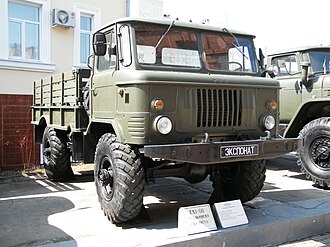
GAZ-66: The Legendary Soviet 4×4 Truck Built for the Toughest Roads
The GAZ-66 is one of the most famous all-terrain trucks ever produced in the Soviet Union. Developed at the Gorky Automobile Plant as a compact but highly capable four-wheel-drive transport vehicle, it became a familiar sight across the Soviet military, agricultural, industrial and civil sectors. Production officially began in July 1964 and continued until 1999, with the GAZ History Museum recording a remarkable 964,979 trucks built during the model’s production life. From the beginning, the GAZ-66 was designed around a simple but demanding objective: provide a relatively compact truck with enough payload capacity, traction and mechanical strength to travel through terrain that would stop conventional road vehicles.
Unlike the larger Soviet trucks intended primarily for highways and established roads, the GAZ-66 was conceived as a genuine off-road working machine. Its 4×4 drivetrain, compact wheelbase, high ground clearance, portal-like axle design, low-range transfer case and central tire-inflation system gave it exceptional mobility. A V8 petrol engine supplied the power, while a short cab-over layout kept the vehicle compact and improved weight distribution. The result was a truck that could climb steep slopes, cross muddy ground, negotiate deep ruts and ford substantial water obstacles while carrying a useful load. It was not fast, comfortable or economical by modern standards, but it was exceptionally effective at the job for which it had been designed.
The Origins of the GAZ-66
Developing a New Generation of Soviet Off-Road Trucks
The roots of the GAZ-66 can be traced to the Soviet Union’s postwar requirement for increasingly capable military and civilian transport vehicles. GAZ had already produced successful four-wheel-drive trucks such as the GAZ-63, which entered production in 1948 and remained in production until 1968. The GAZ-63 demonstrated the value of four-wheel drive for Soviet operating conditions, but by the late 1950s the automotive industry was looking toward a more compact and modern design.
The Soviet Union presented unusually difficult transportation challenges. Vast distances, seasonal mud, snow, poorly maintained roads and undeveloped rural routes meant that trucks often had to operate far beyond paved highways. A vehicle intended for military logistics could not simply be optimized for good roads. It needed to continue moving when the surface disappeared altogether.
The GAZ-66 was developed with exactly these conditions in mind. Instead of simply increasing the size of an existing truck, engineers created a vehicle with a cab-over-engine layout, four-wheel drive and a chassis designed specifically for off-road operation. Its relatively short wheelbase was especially important because it reduced the distance between the axles, helping the truck crest steep terrain and negotiate uneven ground without grounding its frame.
Production Begins in 1964
The first GAZ-66 entered serial production on 1 July 1964. The GAZ History Museum identifies this date as the beginning of production and notes that the model was subsequently designated GAZ-66-11 from 1984. Production finally ended in 1999, by which point nearly one million examples had been produced.
The truck quickly established itself as one of GAZ’s most important specialist vehicles. Its capabilities were recognized almost immediately: in 1966, the GAZ-66 received a gold medal from the Soviet Chamber of Commerce, and in 1967 it received another gold medal at the Leipzig Trade Fair. In 1969, it was awarded the Soviet State Quality Badge, which was subsequently confirmed several more times.
These awards were significant because the GAZ-66 was not merely a domestic utility truck. It represented Soviet engineering on an international stage and demonstrated that the USSR could produce a compact off-road vehicle with capabilities competitive with other military and commercial trucks of the period.
The Design Philosophy of the GAZ-66
A Cab-Over Layout
One of the first things that distinguishes the GAZ-66 from many older Soviet trucks is its cab-over-engine configuration. Instead of placing a long bonnet in front of the driver, the cab sits directly above and slightly ahead of the engine compartment. This allowed GAZ to achieve a surprisingly short overall vehicle length while retaining a useful cargo platform.
The compact design was particularly advantageous in rough terrain. A shorter vehicle is easier to maneuver between trees, rocks and other obstacles, while the reduced wheelbase makes it easier to negotiate sharp changes in elevation. The GAZ-66’s wheelbase was approximately 3,300 mm, while its overall length was around 5.7–5.8 metres, depending on the specific version and body arrangement.
The cab itself was designed to be practical rather than luxurious. It accommodated the driver and one passenger, with controls laid out for straightforward operation. Access to the engine was also an important consideration. Because the engine was located beneath the cab, the entire cab could be tilted forward to provide access for maintenance.
This arrangement made the GAZ-66 considerably more compact than a conventional bonneted truck carrying a similar load. It also gave the driver a commanding view of the terrain immediately ahead, which was useful when navigating difficult tracks.
A High Ground Clearance
Ground clearance was another defining feature. The GAZ-66 had approximately 315 mm of clearance, a substantial figure even among off-road vehicles.
High clearance allowed the truck to pass over rocks, deep ruts and other obstacles without allowing the differential housings or frame to become trapped. It also complemented the short wheelbase and relatively large wheels, creating a vehicle capable of moving through terrain that would be inaccessible to ordinary road trucks.
The high clearance came with an obvious compromise: climbing into the cab required more effort than entering a low commercial vehicle. For military crews and professional drivers, however, this was a small price to pay for mobility.
The GAZ-66’s V8 Engine
The ZMZ-66 Powerplant
At the heart of the GAZ-66 was the ZMZ-66 V8 petrol engine, a heavy-duty development of the engine family used in other GAZ trucks. The engine displaced approximately 4.254 litres and produced around 120 horsepower at 3,200 rpm in the commonly documented GAZ-66-11 configuration. Maximum torque was approximately 284–285 Nm, available around 2,000–2,200 rpm.
The V8 was not designed for high-speed performance. Instead, it delivered the low- and mid-range torque required to move a loaded truck over difficult terrain. The engine used a conventional carburetor and OHV valve arrangement, keeping the design relatively simple and serviceable.
The use of a V8 was particularly interesting because the GAZ-66 was a relatively compact truck. The engine gave it a useful power-to-weight ratio without requiring a very large and heavy powerplant. It could therefore combine compact dimensions with sufficient power for demanding terrain.
The Price of Power
The engine’s main disadvantage was fuel consumption. The GAZ-66 was powered by petrol at a time when diesel engines were increasingly attractive for heavy commercial vehicles, and its off-road drivetrain generated additional mechanical losses. Published specifications commonly give fuel consumption around 31.5 litres per 100 kilometres under standardized conditions, although actual consumption could be considerably higher in difficult terrain.
The large fuel capacity helped compensate for this weakness. A typical GAZ-66 configuration had two fuel tanks with a combined capacity of approximately 210 litres, allowing the truck to operate over long distances without frequent refueling.
For military and remote-area operators, range and reliability were more important than fuel economy. Carrying additional fuel was considered preferable to designing a less capable drivetrain simply to reduce consumption.
Four-Wheel Drive and Off-Road Mobility
Permanent Capability Where It Matters
The defining characteristic of the GAZ-66 was its 4×4 drivetrain. Both axles were driven, giving the truck traction at all four wheels and allowing it to continue moving when one axle encountered poor grip.
The drivetrain incorporated a two-speed transfer case, providing high and low ranges. Low gearing allowed the engine’s torque to be multiplied at the wheels, making it possible to crawl slowly through difficult terrain while maintaining control and reducing the need to abuse the clutch.
This was especially important when climbing steep slopes or crossing obstacles. The GAZ-66 was capable of climbing gradients in the region of 31–37 degrees when loaded, depending on conditions and configuration.
The combination of low-range gearing, four-wheel drive and high ground clearance gave the truck an extraordinary ability to maintain forward momentum. Drivers could select an appropriate low gear, engage the necessary drivetrain settings and allow the engine to work steadily rather than relying on speed to cross an obstacle.
Central Tire Inflation
Perhaps the most technically impressive feature of the GAZ-66 was its central tire-inflation system. Introduced into production during the 1960s, the system allowed the driver to adjust tire pressure from the cab while the vehicle was moving or stationary.
This was an extremely useful feature for off-road operation. Lower tire pressure increases the contact patch between tire and ground, allowing the vehicle to spread its weight over a larger area. On soft mud, sand or snow, this can significantly reduce the tendency of the tires to sink.
Once the truck returned to a firmer surface, the driver could increase pressure again. The system therefore allowed the same vehicle to adapt to changing terrain without requiring the driver to stop and manually adjust every tire.
For a military truck operating across unpredictable terrain, this represented a major tactical advantage. It also reduced the likelihood of becoming immobilized simply because road conditions changed.
Suspension and Chassis
Leaf Springs and Solid Axles
The GAZ-66 used solid axles suspended by leaf springs, a conventional arrangement for a heavy-duty vehicle of its era.
Modern off-road vehicles frequently use more sophisticated suspension systems, but solid axles have important advantages in demanding environments. They are mechanically robust, relatively easy to repair and provide substantial axle articulation when properly designed.
The GAZ-66’s suspension was therefore well suited to the realities of military service. It did not need to provide sports-car handling or passenger-car comfort. It needed to keep the tires in contact with the ground and withstand repeated impacts.
The chassis itself was built around a strong frame capable of supporting the cargo body and specialist equipment. This made the GAZ-66 an adaptable platform rather than simply a single-purpose transport truck.
Braking and Steering
The braking system used mechanically straightforward drum brakes with hydraulic control and servo assistance. The steering system was equipped with hydraulic assistance on later configurations, reducing the physical effort required to maneuver the relatively large tires.
This combination was appropriate for the vehicle’s operating environment. Off-road driving can place enormous demands on steering components, particularly when the front wheels encounter deep ruts or rocks. Power assistance made the truck considerably easier to control.
Payload and Performance
A Two-Tonne Off-Road Truck
The GAZ-66 was generally rated to carry approximately 2,000 kg, while also being capable of towing a trailer of roughly similar mass under appropriate conditions.
That payload might seem modest compared with larger Soviet trucks, but the GAZ-66’s purpose was fundamentally different. It was not designed to maximize cargo volume on highways. Its purpose was to deliver that load to locations where a larger road truck might never arrive.
This distinction is crucial when evaluating the vehicle. A truck carrying two tonnes through a muddy forest road can be more useful than a truck carrying twice as much but requiring a paved route.
The GAZ-66’s maximum road speed was approximately 90 km/h, although real-world operating speeds depended heavily on load, road quality and terrain.
Water Crossings
The vehicle was also designed to handle substantial water crossings. Published specifications give a fording depth of approximately one metre.
This capability was particularly valuable for military logistics and remote-area operations. Rivers, flooded tracks and seasonal streams could represent major obstacles to conventional vehicles, but the GAZ-66 was designed with sufficient clearance and drivetrain protection to negotiate significant water depths.
The truck’s ability to combine water-crossing capability with steep approach and departure angles further contributed to its reputation as a vehicle that could go almost anywhere.
The GAZ-66 in Military Service
A Natural Military Platform
The GAZ-66 became one of the Soviet Union’s most important military transport trucks. Its compact dimensions, 4×4 drivetrain and useful payload made it ideal for carrying personnel, ammunition, communications equipment and supplies.
The truck was particularly valuable because it could transport military equipment into areas where larger trucks would struggle. Its cargo platform could be fitted with a canvas-covered body, while numerous specialist bodies were developed for communications, command, medical and engineering applications.
Military versions could also be equipped for specific environmental conditions, including cold climates. The basic platform’s adaptability meant that armies did not need a completely different vehicle for every specialized logistical task.
Airborne and Specialist Applications
The GAZ-66 was also associated with Soviet airborne forces. Its relatively compact size and weight made it more suitable for airborne logistics than many larger trucks, while its off-road capability allowed it to operate after landing away from established roads.
Specialized variants were developed for communications and military command functions, including vehicles carrying radio equipment and other mission-specific systems. In this role, the GAZ-66 became more than a cargo truck: it was effectively a mobile platform capable of bringing specialist equipment into remote areas.
This versatility explains why the model remained in service for so many decades. Military organizations could continue using the chassis while changing the equipment mounted on it.
Civilian Life of the GAZ-66
Agriculture and Forestry
Although its military reputation is perhaps the strongest, the GAZ-66 was equally valuable in civilian work. Agriculture, forestry, geological exploration, construction and utility services all benefited from its off-road ability.
A farm might use a GAZ-66 to move supplies along muddy tracks, while forestry workers could use it to reach remote areas where ordinary trucks could not operate. Geological and survey teams could similarly use the truck as a mobile base for operations far from paved roads.
The central tire-inflation system was particularly useful for these applications because working conditions could change rapidly. A truck leaving a hard-surfaced road might encounter sand, mud or wet grass only a few kilometres later.
Specialist Bodies
The GAZ-66 chassis was adapted for an enormous variety of bodies. Tankers, workshops, ambulances, fire-fighting vehicles, mobile communications units and utility trucks all used the platform.
This versatility was one of the vehicle’s greatest strengths. Instead of designing a separate chassis for every task, operators could take a common GAZ-66 foundation and install the appropriate superstructure.
The result was a huge family of visually different vehicles that shared the same basic mechanical DNA.
The GAZ-66 in Extreme Terrain
Why Its Reputation Became Legendary
The GAZ-66’s reputation for exceptional off-road ability is not based solely on nostalgia. Its engineering provides a clear explanation for its performance. The truck combined 4×4 drive, low-range gearing, high ground clearance, short wheelbase, large tires, solid axles and central tire inflation in one relatively compact package.
Each feature reinforced the others. The short wheelbase helped the truck negotiate terrain; high clearance reduced the risk of grounding; four-wheel drive maintained traction; low gearing provided controlled torque; and adjustable tire pressure allowed the driver to adapt the truck to different surfaces.
The result was a vehicle capable of progressing through conditions that would make an ordinary truck effectively useless.
The GAZ-66 was not necessarily the fastest or most comfortable off-road truck, but its design placed extraordinary emphasis on maintaining mobility. In a remote location, that characteristic could be much more important than speed.
The GAZ-66-11 and Later Development
Keeping the Design Relevant
In 1984, the GAZ-66 became the GAZ-66-11, reflecting a later stage of development and modernization. The basic architecture remained recognizable, but numerous improvements were introduced during the model’s long production life.
The ability to update rather than completely replace the truck was economically important. By the 1980s, the GAZ-66 had an enormous installed base, an established spare-parts network and generations of drivers and mechanics familiar with its operation.
Keeping the basic design in production allowed Soviet industry to continue supplying proven off-road trucks without the expense of creating an entirely new production system.
Production finally ended in 1999, bringing a 35-year production career to a close. Nearly 965,000 trucks had been produced.
Technical Specifications of the GAZ-66
The following figures represent the commonly documented specifications of the GAZ-66-11 and closely related standard configurations. Exact figures can vary between production years and specialist versions.
| Specification | GAZ-66 |
|---|---|
| Manufacturer | Gorky Automobile Plant (GAZ) |
| Country of origin | Soviet Union |
| Production | 1964–1999 |
| Later designation | GAZ-66-11, from 1984 |
| Vehicle type | Medium-duty 4×4 off-road truck |
| Drive configuration | 4×4 |
| Engine | ZMZ-66-06 V8 petrol |
| Engine type | 4-stroke, water-cooled V8 |
| Displacement | 4,254 cm³ |
| Bore × stroke | 92 × 80 mm |
| Compression ratio | Approx. 7.6:1 |
| Maximum power | Approx. 120 hp at 3,200 rpm |
| Maximum torque | Approx. 284–285 Nm |
| Transmission | 4-speed manual |
| Transfer case | 2-speed |
| Payload | Approx. 2,000 kg |
| Trailer capacity | Approx. 2,000 kg |
| Wheelbase | 3,300 mm |
| Length | Approx. 5,655–5,805 mm |
| Width | Approx. 2,322 mm |
| Height with canvas | Approx. 2,520 mm |
| Ground clearance | Approx. 315 mm |
| Curb weight | Approx. 3,440 kg |
| Maximum speed | Approx. 90 km/h |
| Fuel tanks | 2 × 10⁵ litres |
| Total fuel capacity | Approx. 210 litres |
| Typical fuel consumption | Approx. 31.5 l/100 km |
| Tire size | 12.00-18 |
| Tire pressure system | Central inflation from cab |
| Fording depth | Approx. 1 metre |
| Approach angle | Approx. 41° |
| Departure angle | Approx. 32° |
| Maximum loaded gradient | Approx. 31–37° |
| Suspension | Solid axles with leaf springs |
| Brakes | Hydraulic drum brakes with servo assistance |
| Primary roles | Military transport, agriculture, forestry, utilities |
| Total production | 964,979 |
The specifications illustrate the priorities behind the design particularly well. The GAZ-66 was relatively light for a 4×4 truck of its capabilities, yet it carried approximately two tonnes. Its 120-horsepower V8 was not especially powerful by modern standards, but the low-range transfer case and four-wheel-drive system allowed that power to be used effectively at the wheels. High clearance, a one-metre fording capability and adjustable tire pressure made the truck adaptable to an unusually wide range of surfaces. (Wikipedia)
The Legacy of the GAZ-66
Nearly a Million Trucks
The production figures alone demonstrate the importance of the GAZ-66. With 964,979 examples produced between 1964 and 1999, it became one of the most numerous Soviet 4×4 trucks of its generation.
Its longevity was equally impressive. A truck introduced during the Cold War’s early decades remained in production until the end of the twentieth century. That longevity was possible because the basic concept was fundamentally sound: a compact chassis, a strong engine, simple mechanical systems and exceptional mobility.
The GAZ-66 was not dependent on complex electronics or sophisticated computerized systems. Its mechanical components could be diagnosed and repaired using tools available in ordinary workshops, which was crucial in remote Soviet regions.
A Cult Vehicle Among Enthusiasts
Today, the GAZ-66 has developed a strong following among military-vehicle collectors, off-road enthusiasts and restoration specialists. Its unusual cab-over layout and distinctive proportions make it immediately recognizable, while its mechanical simplicity makes it an appealing restoration project.
More importantly, surviving examples demonstrate just how specialized Soviet off-road engineering could be. The GAZ-66 was created for a world in which roads could disappear, fuel and maintenance facilities could be hundreds of kilometres away and vehicles had to function despite extreme weather.
That environment produced a truck with very different priorities from those of a modern commercial vehicle. Comfort and fuel efficiency were secondary; mobility, repairability and durability came first.
Conclusion
The GAZ-66 deserves its reputation as one of the great Soviet off-road trucks. Introduced in 1964, it combined a compact cab-over design with four-wheel drive, a two-speed transfer case, a 4.25-litre V8 engine, high ground clearance and a central tire-inflation system. These features made it exceptionally capable on mud, snow, sand, steep slopes and rough tracks. The GAZ History Museum records that production continued until 1999 and reached 964,979 vehicles, a testament to the enduring usefulness of the design.
Its success was also recognized during its own lifetime. The GAZ-66 received gold medals at Soviet and international trade events and was awarded the State Quality Badge in 1969, subsequently retaining that distinction through further confirmations. These achievements reflected a vehicle that was particularly well matched to its intended environment.
The truck’s greatest strength was the way its individual engineering features worked together. Four-wheel drive provided traction, low gearing multiplied torque, high ground clearance protected the chassis, short wheelbase improved maneuverability and central tire inflation allowed the driver to adapt to changing terrain. None of these features was revolutionary by itself, but their combination created a highly effective all-terrain package.
The GAZ-66 was also remarkably versatile. It served as a military cargo truck, airborne support vehicle, communications platform, ambulance, workshop, tanker, fire engine and agricultural workhorse. In remote areas, it could function as both transportation and a mobile working platform. Its standardized chassis made it possible to create countless specialist versions without abandoning the proven mechanical foundation.
Perhaps the most important lesson of the GAZ-66 is that successful engineering does not always require technological complexity. The truck’s design was based on relatively simple mechanical principles, but those principles were applied intelligently to the conditions for which the vehicle was intended. The result was a machine that could carry its load through terrain that would defeat many ordinary trucks.
More than half a century after its introduction, the GAZ-66 remains instantly recognizable. Its angular cab, compact proportions, large tires and distinctive V8 sound have become symbols of Soviet off-road engineering. It was never designed to be elegant or luxurious. It was designed to keep going when the road ended—and that straightforward mission is precisely what made the GAZ-66 a legend.
