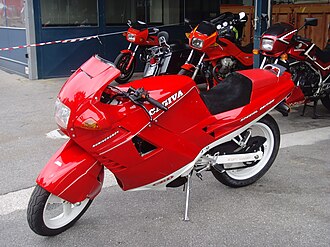
The Cagiva Freccia is one of the motorcycles that best captures the spirit of the Italian 125 cc sportbike era. Produced during the second half of the 1980s and the beginning of the 1990s, the Freccia combined aggressive full-fairing styling with a lightweight two-stroke engine, sophisticated chassis technology and an unmistakably Italian approach to motorcycle design. Although it was a relatively small motorcycle by displacement, the Freccia was never conceived as a basic commuter. It was a genuine miniature sportbike, created at a time when manufacturers were investing heavily in the 125 cc class and young riders could experience engineering and styling remarkably close to those of much larger performance motorcycles. The Freccia family evolved through several important versions, beginning with the C9 and progressing through the C10R, C12R and limited-production C12SP, with each generation bringing meaningful changes to the engine, chassis, suspension, braking and styling.
The Birth of the Cagiva Freccia
A new generation of Italian 125s
The Freccia appeared in 1986 as Cagiva was establishing a much stronger identity in the road-bike market. The original C9 was an ambitious machine for its capacity class, featuring a 125 cc two-stroke single-cylinder engine, six-speed gearbox, full fairing, Marzocchi suspension and disc brakes at both ends. Unlike many inexpensive learner motorcycles, it was designed to look and feel like a serious sporting machine. Period specifications describe the C9 as using a 125 cc two-stroke engine producing a claimed 27 horsepower, with a 28 mm Dell’Orto carburetor and a six-speed transmission. The chassis incorporated a steel frame, Marzocchi telescopic front suspension and a Marzocchi rear monoshock, while Brembo braking equipment reinforced its sporting credentials.
The motorcycle’s styling was equally important. The Freccia emerged during a period when Cagiva was closely associated with some of the most distinctive Italian motorcycle designs, and the bike’s fully enclosed bodywork gave it the visual presence of a much larger sport machine. Moto.it describes the C9 as aesthetically inspired by the Ducati Paso, an especially significant connection because Ducati was part of the wider Cagiva group at the time. The result was a 125 that did not attempt to hide its mechanical purpose: the bodywork, riding position and compact proportions communicated speed even before the engine was started.
The Freccia C9
The beginning of the family
The C9 established the basic formula that would define the Freccia range. Its 124 cc-class two-stroke single was compact and relatively light, but the claimed 27 horsepower figure was impressive for a road-legal 125 of the period. The six-speed gearbox allowed the rider to keep the engine within its relatively narrow high-performance operating range, while the two-stroke power delivery rewarded active use of the transmission. This was part of the charm of performance 125s from this era: rather than relying on abundant low-end torque, they encouraged the rider to work with the engine, selecting gears carefully and allowing the engine to build revs before making the most of its available power.
The C9 also demonstrated that Cagiva understood the importance of the complete motorcycle rather than simply the engine. A full fairing reduced the visual and aerodynamic bulk of the motorcycle, while cast-aluminium wheels, disc brakes and adjustable rear suspension gave the small machine a specification that would have seemed ambitious on many ordinary 125s. The reported dry weight was around 123 kg, giving the Freccia a useful power-to-weight ratio and helping explain why contemporary riders regarded these motorcycles as genuine sporting machines rather than merely stepping stones toward larger bikes.
The C10R: A More Developed Freccia
New styling and mechanical refinement
Cagiva did not leave the Freccia formula untouched for long. The C10R followed the C9 and introduced a revised body design together with mechanical changes intended to improve the motorcycle. Moto.it’s historical overview notes that the C10R changed the exhaust arrangement, revised the steering-head geometry and received a new cylinder assembly. These changes illustrate how quickly the Italian 125 class was evolving: manufacturers were not simply changing colors and decals each year but actively refining the engines and chassis of their small sportbikes.
The C10R also received an anniversary edition during 1988, celebrating ten years of Cagiva motorcycle production. The Anniversary version used a special paint scheme and revised bodywork while retaining the basic mechanical specification of the C10R. This special model is an interesting reminder of how much cultural significance these motorcycles had acquired within the Italian motorcycle industry. The 125 was not treated as an anonymous entry-level product; it was a platform through which manufacturers could express their design language and technological ambitions.
The C12R and the Seven-Speed Revolution
More power and more technology
The C12R represents perhaps the most technically interesting stage of the mainstream Freccia’s development. Introduced around the end of the 1980s and sold from 1989, it brought further changes to the bodywork and chassis while introducing an electronically controlled exhaust valve and, most famously, a seven-speed transmission. Moto.it identifies the C12R’s electronically controlled exhaust valve and seven-speed gearbox as two of its defining developments. The transition from the earlier mechanically controlled exhaust system to electronic control represented the increasingly sophisticated approach manufacturers were taking to two-stroke power delivery.
The seven-speed gearbox may sound extraordinary today, but it made sense for a high-performance 125 two-stroke. With a small displacement engine designed to produce significant power at high rpm, closely spaced ratios could help keep the engine in its effective power band. A period specification for the 1990 C12R lists a 56.0 mm bore, 50.6 mm stroke, 124.6 cc displacement, liquid cooling, Dell’Orto 28 mm carburetion and seven-speed transmission. That specification also records approximately 31.5 horsepower at 10,500 rpm for the C12R SP specification, while other C12R references give figures around 29 horsepower, demonstrating that output depended on version and market.
The braking system also reflected the C12R’s sporting ambitions. Published specifications identify a 298 mm front disc with a four-piston caliper and a 240 mm rear disc, while the suspension used a Marzocchi telescopic fork and rear monoshock. The combination of a lightweight chassis, substantial front brake and high-revving liquid-cooled two-stroke engine made the C12R an unusually serious machine for its displacement.
The C12SP: The Freccia at Its Most Extreme
A limited-production competition-inspired model
The C12SP was the ultimate development of the Freccia concept. Presented at the Milan Motor Show in November 1989, it was produced as a limited series associated with the Italian Sport Production racing category. Rather than simply adding cosmetic equipment, Cagiva made substantial technical changes. Moto.it notes that the C12SP received stiffer suspension settings and a completely new top-end and crank assembly, together with an enormous 37 mm VHSB carburetor.
This specification demonstrates just how far manufacturers were prepared to push the 125 class. A 37 mm carburetor on a 125 cc two-stroke sounds excessive when judged by modern road-bike standards, but the C12SP was created with competition-oriented performance in mind. The objective was to extract as much usable power as possible from a very small engine while maintaining the lightweight and compact character that made the Freccia so effective.
The C12SP also represents the point at which the Freccia’s road-bike identity and racing ambitions came closest together. Its significance is not simply that it was more powerful or more specialized than earlier versions; it shows how the technology developed for small-displacement racing could directly influence production motorcycles. In an era when 125 cc racing was an important part of European motorcycle culture, that connection gave machines such as the Freccia an importance far beyond their engine capacity.
The Engineering Behind the Freccia
Two-stroke technology
At the heart of the Freccia’s personality was its two-stroke single-cylinder engine. A 125 cc two-stroke can produce impressive specific power because it generates a power stroke every revolution rather than every second revolution, although the architecture also brings a narrower power band and a more demanding riding style. Cagiva used exhaust-valve technology to make the engine’s performance more controllable across the rev range. On early Freccias the system was mechanically controlled, while the C12R introduced electronic control.
Liquid cooling became another important part of the later Freccia’s specification. It allowed Cagiva to maintain more consistent engine temperatures under hard use and supported the high specific output expected from the later versions. The C12R’s 124.6 cc engine used a 56.0 × 50.6 mm bore-and-stroke configuration, with compression commonly listed around 13:1 in published specifications. Such numbers help explain the very different character of these engines compared with modern four-stroke 125s.
Chassis and braking
The Freccia’s chassis was equally important to its identity. The original C9 used a steel frame with Marzocchi suspension, and later versions continued to develop this basic architecture. The C12R specification commonly cited for 1990 features a 38 mm telescopic front fork with approximately 130 mm of travel and a rear monoshock, while braking was handled by a large 298 mm front disc and 240 mm rear disc.
The relatively substantial front brake is particularly revealing. A 298 mm disc and four-piston caliper were serious equipment for a 125, and the combination would have given the rider considerable braking capability relative to the motorcycle’s mass. The later Freccia’s approximately 123–125 kg dry weight also meant that the brakes did not have to deal with the inertia of a large motorcycle. This combination of low mass and strong braking was one of the qualities that made lightweight sportbikes so rewarding on technical roads.
Riding Character of the Cagiva Freccia
A motorcycle that rewards commitment
The appeal of the Freccia cannot be understood purely through horsepower figures. A high-performance two-stroke 125 demands a different approach from the rider. Below its effective power range, the engine can feel relatively modest, but as the revs rise and the exhaust-valve system brings the engine into its stronger operating range, acceleration becomes much more energetic. The rider therefore becomes an active participant in the motorcycle’s performance, using the seven-speed gearbox on later models to keep the engine operating where it produces its best power.
This character made the Freccia an ideal product for the sporting culture of its time. Its compact dimensions meant that a rider could learn the fundamentals of cornering, braking, gear selection and throttle control without dealing with the mass and enormous power of a large motorcycle. At the same time, its styling and equipment made it feel like a miniature superbike. The Freccia was therefore not simply transportation for younger riders; it offered an authentic sporting experience in a small package.
The Freccia in the History of Cagiva
More than a 125
The Freccia is important because it appeared during a particularly productive period for Cagiva. The company was expanding its range and developing a distinctive Italian identity, while its relationship with Ducati gave it access to a broader technological and industrial ecosystem. The Freccia’s styling reflected the design trends of the period, but its evolution also demonstrated Cagiva’s willingness to experiment with engine technology, chassis development and racing-derived equipment.
The model’s place in history is strengthened by its relationship with the other famous Cagiva sportbikes that followed. The Freccia belonged to the same broader era that produced increasingly sophisticated Cagiva motorcycles and helped establish the company’s reputation among enthusiasts. Even though its engine was only 125 cc, the Freccia communicated the same basic philosophy: performance should be accompanied by distinctive design, and a small motorcycle could still be technically ambitious.
Cagiva Freccia Technical Specifications
Because the Freccia evolved substantially between the C9, C10R, C12R and C12SP, there is no single specification sheet that accurately represents every motorcycle carrying the name. The table below therefore uses the Cagiva Freccia C12R around 1990 as the principal reference point, with figures that are commonly documented for that version. Some published sources differ slightly in claimed power, weight and component details depending on market and specification.
| Specification | Cagiva Freccia C12R |
|---|---|
| Production period | 1989–1991 |
| Engine | Single-cylinder, 2-stroke |
| Cooling | Liquid-cooled |
| Displacement | 124.6 cc |
| Bore × stroke | 56.0 × 50.6 mm |
| Fuel system | Dell’Orto PHBH 28 mm carburetor |
| Exhaust control | Electronic exhaust-valve system |
| Compression ratio | Approximately 13:1 |
| Maximum power | Approximately 29 hp, depending on version |
| Peak power | Around 10,100–10,500 rpm |
| Maximum torque | Approximately 20 Nm |
| Transmission | 7-speed manual |
| Final drive | Chain |
| Frame | Steel perimeter-type frame |
| Front suspension | Marzocchi telescopic fork |
| Rear suspension | Marzocchi monoshock |
| Front brake | 298 mm disc, four-piston caliper |
| Rear brake | 240 mm disc |
| Front tyre | 100/80-16 |
| Rear tyre | 120/80-17 |
| Fuel capacity | Approximately 16 litres |
| Dry weight | Approximately 123–125 kg |
| Wet weight | Approximately 132 kg |
| Top speed | Approximately 166 km/h, depending on specification and test conditions |
The figures should be understood in their historical context. Contemporary and later reference sources do not always agree on every specification, particularly power output, because the Freccia existed in several versions and specifications varied during its production life. A period Spanish comparison, for example, lists 31.5 hp for the C12R SP specification, while other references quote approximately 29 hp for the standard C12R.
Why the Cagiva Freccia Still Matters
The Cagiva Freccia remains memorable because it represents a motorcycle industry that was willing to make small machines technically fascinating. Modern 125 cc motorcycles are often designed around efficiency, emissions compliance, accessibility and everyday usability, whereas the Freccia came from a period when a 125 could be a miniature laboratory for two-stroke performance. Its seven-speed transmission, exhaust-valve technology, liquid cooling, substantial brakes and lightweight chassis were not there simply to make the specification sheet impressive; they were components of a motorcycle designed to be ridden enthusiastically.
The evolution from C9 to C12R and C12SP also tells an important story about the rapid development of Italian sportbikes in the late 1980s. The first Freccia was already a sophisticated motorcycle, but within only a few years Cagiva had introduced liquid cooling, electronic exhaust-valve control, a seven-speed gearbox and increasingly specialized engine components. That progression mirrors the fierce technical competition taking place throughout the European 125 market.
Ultimately, the Cagiva Freccia deserves recognition as one of the defining Italian small-capacity sportbikes of its era. Its combination of dramatic styling, lightweight construction, two-stroke performance and increasingly sophisticated chassis technology made it far more than an entry-level motorcycle. The C9 established the formula, the C10R refined it, the C12R pushed the technology further and the C12SP brought the concept closer to competition specification. Together, these motorcycles form a fascinating chapter in Cagiva’s history and a reminder of a time when a 125 cc motorcycle could inspire the same sense of excitement and engineering curiosity as a much larger machine.
