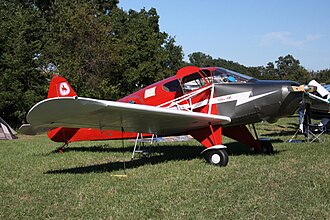
The CallAir Model A occupies an interesting place in the history of American general aviation, representing a period when aircraft manufacturers focused on creating practical, affordable, and versatile machines capable of meeting the needs of pilots, private owners, ranchers, and agricultural operators. Developed by the Call Aircraft Company, the aircraft emerged from the practical experience of the Call family, who understood the challenges of working and traveling across the vast landscapes of the American West. Rather than concentrating exclusively on speed, luxury, or advanced technology, the designers pursued a straightforward objective: build an airplane that could perform useful work, operate from relatively modest airfields, and provide dependable transportation in regions where conventional transport options were often limited. This philosophy helped establish the Model A as an example of the functional, purpose-driven aircraft that contributed significantly to the expansion of postwar American aviation.
Although the name CallAir Model A is frequently used to describe the entire aircraft family, it actually encompasses several related versions developed over a number of years. These included early prototypes, production aircraft with different engines, improved cabin models, and agricultural derivatives that were adapted for specialized operations. The first aircraft in the series was developed around the beginning of the 1940s, but wartime circumstances delayed the start of production until after World War II. When production finally began, the aircraft entered a market in which pilots and businesses were increasingly interested in economical utility airplanes that could perform more than one role. Over time, the original design demonstrated enough flexibility to support a variety of improvements, ultimately establishing a foundation for the agricultural aircraft developments that followed.
The significance of the CallAir Model A therefore extends beyond its individual performance figures. It illustrates how relatively simple engineering, practical construction methods, and a clear understanding of operational requirements could produce an aircraft with a useful service life and an adaptable design. Its history also demonstrates how the needs of rural communities and agricultural businesses helped shape the evolution of light aircraft in the United States. For aviation enthusiasts, historians, and readers interested in classic aircraft, the CallAir Model A offers a valuable example of the relationship between regional aircraft manufacturing, practical engineering, and the development of specialized aviation.
The Origins and Historical Background of the CallAir Model A
A design shaped by the American West
The origins of the CallAir Model A are closely associated with the Call family and their experience in Wyoming, where long distances, varied terrain, and the demands of rural life made practical transportation particularly valuable. In such an environment, an airplane could offer more than a recreational experience; it could provide a means of traveling between communities, visiting remote properties, and reaching locations that were inconvenient to access by road. These conditions encouraged the development of aircraft that emphasized useful carrying capacity, manageable operating characteristics, and construction methods that were appropriate for a small manufacturer rather than a large industrial aviation company.
The Call brothers approached aircraft design with a practical outlook, seeking a balance between affordability, performance, and utility. Their aircraft was intended to be useful in everyday flying rather than limited to specialized sporting activities or high-speed travel. This approach influenced the Model A’s general configuration, which combined a relatively compact fuselage with a low-mounted wing supported by external struts and a conventional tailwheel landing gear arrangement. The design was not intended to compete with larger transport airplanes or sophisticated military aircraft. Instead, it occupied a category in which ease of use, reasonable operating costs, and adaptability were central considerations.
The development process began before the United States entered World War II, and the first aircraft was prepared around 1940–1941, although historical accounts differ in how they identify the initial development and first-flight dates. The early prototype used a Continental A-80 engine before being re-engined and redesignated as the Model A-1. The subsequent development program led to the production Model A-2, which became one of the principal early versions of the family. This progression illustrates how early aircraft programs frequently evolved through engine changes and incremental refinements rather than through a complete redesign of the airframe.
The impact of World War II and the beginning of production
The outbreak of World War II significantly affected the aircraft industry’s priorities, diverting manufacturing resources and engineering attention toward military requirements. For smaller aviation companies such as Call Aircraft Company, these circumstances made it difficult to proceed with a new civilian airplane as originally planned. Although the Model A had been developed before the war, series production did not begin until 1946, when the American general aviation market was entering a new phase of development.
The postwar environment created opportunities for manufacturers that could offer practical aircraft to private pilots, flying clubs, businesses, and rural operators. Thousands of former military pilots had gained flying experience during the war, and civilian aviation attracted growing interest from people who wanted to use aircraft for transportation, recreation, and work. The market was not uniform, however. Some customers wanted inexpensive personal airplanes, while others required machines capable of carrying passengers or equipment into areas with limited aviation infrastructure. The CallAir Model A’s practical configuration made it relevant to this broader market.
The return to civilian production also allowed the company to refine the design through successive versions. Changes in engine selection provided opportunities to improve power, while later derivatives expanded the aircraft’s suitability for particular tasks. This gradual development strategy helped preserve the fundamental character of the original airplane while allowing the manufacturer to respond to changing customer requirements. Rather than treating the Model A as a single, unchanging product, the company developed it into a family of aircraft that shared a common design philosophy.
Airframe Design and Construction
A conventional low-wing monoplane configuration
One of the defining characteristics of the CallAir Model A is its low-wing monoplane layout. Unlike high-wing aircraft, in which the wings are mounted above the fuselage, the Model A places its wings below the cabin. The wings are supported by external struts, creating a configuration that reflects the engineering priorities of its era. The arrangement provided a practical structural solution without requiring the complex internal wing systems or advanced materials associated with more modern aircraft designs.
The aircraft’s appearance is relatively straightforward, with a compact fuselage, a conventional tail assembly, and fixed landing gear. Its design reflects an emphasis on structural practicality rather than aerodynamic styling for its own sake. External bracing, fabric covering, and traditional construction methods were common among light aircraft of the period, particularly those developed by smaller manufacturers. These features allowed designers to build useful airplanes without relying on the manufacturing infrastructure needed for all-metal stressed-skin aircraft.
The low-wing configuration also gave the CallAir a distinctive visual identity among utility aircraft. The external struts and exposed landing gear contribute to its unmistakably vintage appearance, while the relatively narrow fuselage and modest overall dimensions reflect its role as a small general-purpose airplane. Although the design may appear simple compared with contemporary aircraft, its layout represented a considered balance between structural requirements, manufacturing practicality, and the intended operating environment.
Fabric-covered wings and steel-tube fuselage
The CallAir Model A family used mixed construction, combining fabric-covered wooden wings with a fabric-covered welded steel-tube fuselage. This approach was well established in light aircraft manufacturing during the period and allowed manufacturers to combine different materials according to their structural advantages. Wooden wing structures could provide the necessary shape and stiffness without requiring extensive metal-forming facilities, while a welded steel-tube framework could create a strong underlying fuselage structure.
Fabric covering offered a lightweight exterior surface over the supporting framework. However, this type of construction also required appropriate maintenance practices. Fabric condition, structural joints, corrosion protection, and the integrity of the underlying framework all needed attention during inspections and restoration work. As aircraft aged, the quality of previous repairs and the condition of concealed structural components became particularly important in determining their continued airworthiness.
For modern owners and restorers, the construction method is both part of the aircraft’s historical appeal and a practical consideration. A surviving CallAir cannot be evaluated solely by its exterior appearance because fabric surfaces may conceal deterioration or earlier repairs. A proper inspection must consider the underlying structure, covering condition, control systems, landing gear, engine installation, and the aircraft’s documented maintenance history. These requirements are not unique to the CallAir, but they are especially relevant to older aircraft that have spent decades exposed to changing storage and operating conditions.
Fixed tailwheel landing gear
The Model A uses conventional fixed tailwheel landing gear, a configuration that was widespread among light aircraft of its generation. In this arrangement, the main wheels support the forward portion of the aircraft while a smaller wheel or tailwheel supports the rear. Unlike retractable landing gear, the fixed arrangement does not require a complex retraction mechanism, reducing mechanical complexity and simplifying certain maintenance tasks.
Tailwheel aircraft have distinctive ground-handling characteristics. Their center of gravity is positioned behind the main landing gear, meaning that directional control during taxiing, takeoff, and landing requires appropriate pilot technique. Crosswinds, uneven surfaces, and changing ground conditions can influence handling, so tailwheel experience is an important consideration for anyone operating a vintage aircraft of this type.
The fixed landing gear is consistent with the Model A’s practical design philosophy. The aircraft was built for straightforward utility rather than maximum aerodynamic refinement, and the conventional undercarriage supports that objective. Its suitability for any particular runway or operating location must nevertheless be assessed using the aircraft’s approved documentation, current condition, loading, weather conditions, and the pilot’s experience. A historical reputation for utility should not be interpreted as a guarantee that every surviving example can safely operate from every unimproved surface.
Engine Development and Performance
The early Model A-2
The Model A-2 represents one of the most useful reference points for understanding the early production CallAir. It was equipped with a four-cylinder, horizontally opposed, air-cooled Lycoming O-290-series engine, generally identified in period specifications as the O-290-B or O-290-C, producing approximately 125 horsepower at 2,600 rpm. This type of engine was well suited to light aircraft because its horizontally opposed cylinder arrangement provided a relatively compact installation, while air cooling avoided the additional weight and complexity of a liquid-cooling system.
The engine drove a two-bladed fixed-pitch wooden Sensenich propeller, according to the period specifications commonly cited for the A-2. A fixed-pitch propeller is mechanically simpler than a variable-pitch or constant-speed design because its blade angle is not adjusted in flight. This simplicity was appropriate for an aircraft designed around practical operation and manageable maintenance requirements. The engine and propeller combination provided the power necessary for the aircraft’s intended general-aviation role, although its actual performance depended on factors such as aircraft weight, atmospheric conditions, engine condition, and propeller characteristics.
The published figures for the A-2 indicate a maximum speed of approximately 112 mph and a cruise speed of around 102 mph. These numbers should be understood as historical reference values rather than guaranteed performance figures for every aircraft. Differences in measurement conventions, engine condition, loading, altitude, and the specific flight-test configuration can affect reported results. They also explain why historical publications may give slightly different figures for aircraft that appear to be the same model.
Development of the A-3 and A-4
The Model A series evolved as the manufacturer introduced aircraft with different engine installations and refinements. The A-3 used a 125-horsepower Continental C-125-2 engine, offering an alternative to the Lycoming-powered A-2. The continued use of engines in a similar power range indicates that the company was initially refining the aircraft through incremental changes rather than attempting to transform it into an entirely different category of airplane.
The A-4 represented a significant development within the family, incorporating a cabin configuration capable of accommodating two or three people, depending on the specific arrangement and operating limitations. Sources commonly identify the A-4 with a 135-horsepower Lycoming O-290-D2 engine, while some secondary aviation summaries refer to later or revised installations producing approximately 150 horsepower. These differences underline the importance of identifying the precise model and approved engine installation before using a specification as an authoritative technical reference.
The A-4 demonstrated the adaptability of the basic airframe. It retained the recognizable low-wing arrangement and conventional structure while serving customers who needed a practical cabin aircraft. The additional engine power associated with later developments also helped prepare the design for more demanding applications. In particular, the experience gained from operating and refining the cabin models contributed to the development of agricultural derivatives, in which low-level maneuvering, payload arrangements, and specialized equipment became more important than passenger comfort.
The transition toward agricultural aviation
Agricultural aviation became one of the most important directions in the development of the CallAir family. Farming operations can cover large areas, and aerial application offers a way to distribute certain agricultural materials over fields more efficiently than some ground-based methods. Aircraft intended for this work require a different balance of characteristics from conventional private airplanes. Their design and operation must account for specialized equipment, payload, visibility, low-altitude maneuvering, structural demands, and the operational hazards associated with working close to the ground.
The A-5 was developed as an open-cockpit, two-seat agricultural version of the A-4. The change was more substantial than a simple alteration to the exterior appearance because agricultural operations required the aircraft to accommodate specialized equipment and a different working environment. The A-5T Texan followed with a revised fuselage structure, while the A-6 introduced a more powerful Lycoming O-360-A1A engine rated at approximately 180 horsepower. These developments show how the original Model A concept gradually moved away from its early cabin-aircraft role and toward a specialized utility platform.
The A-7 was another agricultural derivative, associated with a Continental W-670-240 engine installation. Only one example is commonly reported as having been converted from an A-6, while a proposed A-7T development did not establish itself as a major production version. Taken together, these variants demonstrate that the CallAir family was not simply a collection of similar-looking aircraft: the differences between versions reflected changing operational needs and engineering decisions.
Flight Characteristics and Operational Utility
A practical approach to speed and range
The published performance of the Model A-2 places it firmly within the category of modestly powered light aircraft. Its maximum speed was approximately 112 mph, with a cited cruise speed of about 102 mph. These figures were not intended to rival those of faster touring aircraft, but they were suitable for the short- and medium-distance journeys for which the airplane was designed. For a rural owner or small business, a relatively uncomplicated aircraft capable of connecting distant communities could be valuable even without exceptional speed.
Period specifications also report a range of approximately 332 miles for the A-2, although other secondary sources give different figures under differing assumptions. Range is particularly sensitive to fuel reserves, engine settings, wind, payload, altitude, and the aircraft’s actual condition. A published maximum or reference range should therefore never be treated as a flight-planning guarantee. Real-world flight planning must use the approved aircraft flight manual or equivalent documentation and account for applicable reserve requirements and operating conditions.
The aircraft’s reported service ceiling of approximately 17,500 feet and rate of climb of around 1,000 feet per minute provide additional context for its performance. These figures describe historical reference conditions and should not be interpreted as universally achievable values. An aircraft operating near its maximum weight, in warm weather, or with an engine that does not produce its original rated power may perform differently. The figures are most useful for understanding the original design’s capabilities and the engineering standards of the era.
Takeoff and landing considerations
For the A-2, historical specifications list a takeoff run of approximately 142 yards and a landing run of about 100 yards. These measurements help illustrate the aircraft’s relatively modest operating scale, but they require careful interpretation because historical publications do not always use identical definitions for takeoff distance, landing distance, ground roll, or total distance over an obstacle. Modern pilots should consult the approved operating data for the particular aircraft rather than rely on a single historical figure.
Takeoff and landing performance depend on numerous variables, including aircraft weight, runway surface, density altitude, wind, slope, temperature, and pilot technique. Grass, gravel, or other unpaved surfaces can introduce additional uncertainty because rolling resistance and surface condition vary considerably. An aircraft’s historical association with practical utility does not remove the need for a runway assessment or a proper performance calculation before flight.
The Model A’s conventional landing gear and relatively straightforward systems fit its intended role, but safe operation still requires appropriate pilot training and knowledge of the aircraft. Vintage aircraft can differ significantly from modern training airplanes in control response, visibility, instrumentation, and ground handling. Consequently, historical performance figures should be used to understand the aircraft rather than as a substitute for training, maintenance, or current operational documentation.
The CallAir Model A in Agricultural Aviation
Why the design suited agricultural work
Agricultural operations helped reveal the versatility of the CallAir airframe. The basic aircraft was developed for practical transportation, but its construction and relatively straightforward configuration provided a foundation for later specialized versions. Agricultural aircraft operate in an environment that demands more than simply carrying a pilot and passenger from one airfield to another. They may need to carry substantial working loads, accommodate equipment, make repeated low-level passes, and operate according to the changing needs of a farm or agricultural contractor.
The A-5 and A-6 reflected this transition. Their open-cockpit or specialized agricultural arrangements distinguished them from conventional cabin models, while their engine and structural developments supported the changing demands of their intended work. The A-6’s approximately 180-horsepower engine represented a meaningful increase over the 125-horsepower installation associated with the A-2. However, the additional power should not be viewed in isolation: agricultural capability also depends on structural limits, approved payload, center-of-gravity restrictions, equipment installation, fuel capacity, and the aircraft’s certification status.
Agricultural aircraft also face demanding maintenance and inspection requirements because their working environment may expose them to dust, chemicals, moisture, vibration, and repeated high-workload cycles. These conditions can affect both the airframe and the powerplant. An aircraft that performs occasional recreational flights may experience a very different operating pattern from one used regularly for aerial application. The CallAir family’s agricultural derivatives therefore illustrate not only the adaptability of the original design but also the importance of designing and maintaining aircraft for their actual operating environment.
The broader importance of purpose-built aircraft
The evolution of the CallAir Model A reflects a wider pattern in aviation history: aircraft that begin as general-purpose machines may become platforms for specialized work when their basic configuration proves suitable for further development. This process has occurred throughout the history of civil aviation, particularly in sectors such as agricultural application, aerial observation, surveying, bush flying, and remote-area transport. Manufacturers often discover that a robust basic airframe can serve several markets if it is adapted carefully to the requirements of each role.
The CallAir’s development also illustrates the distinction between an aircraft’s appearance and its engineering purpose. Two variants may look similar while differing substantially in powerplant, payload arrangements, structural details, equipment, and approved operating limitations. Conversely, a specialized derivative may retain much of the original aircraft’s visual character even when its intended mission has changed considerably. For historians and enthusiasts, understanding these distinctions is essential to appreciating the evolution of the Model A family.
Its agricultural development was also part of a larger transformation in rural aviation. As farms and agricultural businesses increasingly adopted mechanized methods, aircraft became tools that could support particular tasks across large areas. The CallAir was one example of the manufacturers responding to this demand with relatively compact, purpose-oriented designs. Although it was not the only aircraft to serve this market, its progression from a cabin utility airplane to specialized agricultural versions makes it a useful case study in practical aircraft development.
Production History and Later Development
The main Model A variants
The CallAir Model A family expanded through several versions, with changes in engine installation, cabin arrangement, and intended role. The A-2 became an important early production model, followed by the Continental-powered A-3 and the cabin-oriented A-4. The A-5 introduced a dedicated agricultural configuration, while the A-5T Texan and A-6 represented further development of that specialized direction. The A-7 explored another engine arrangement, although it remained a very limited development.
Production figures reported in historical aircraft references vary according to how prototypes, conversions, and individual variants are counted. Commonly cited figures include 16 A-2 aircraft, 15 A-3 aircraft, 65 A-4 aircraft, 74 A-5 aircraft, nine A-5T aircraft, and 34 A-6 aircraft. These numbers should be treated as historical production estimates associated with the respective variants, not as a definitive count of aircraft surviving today. Differences in recordkeeping and the treatment of conversions can complicate comparisons across sources.
The diversity of the variants is important because the Model A should not be understood as a single fixed specification. A reference describing the A-2’s 125-horsepower engine does not automatically apply to the A-4 or A-6, and the seating arrangement of a cabin version does not necessarily describe an agricultural derivative. When researching an individual aircraft, the exact model designation, serial number, engine installation, approved modifications, and maintenance records are more reliable guides than the broad family name alone.
The transition to the CallAir A-9
The next stage of the design’s history came after the original company’s assets were acquired at auction by Intermountain Manufacturing Company in 1962. The subsequent development program produced the CallAir A-9, a related but more extensively developed agricultural aircraft. The A-9 incorporated a more powerful engine and a configuration tailored to the requirements of aerial application, demonstrating how the earlier design philosophy could be carried forward into a more specialized machine.
The A-9 should not be confused with the original Model A-2 or treated as merely another name for the first CallAir. It belongs to the wider lineage of CallAir-related aircraft, but its specifications, capabilities, and structural details differ from those of the earlier cabin aircraft. Later developments under other manufacturers continued this lineage, reflecting the continuing demand for dedicated agricultural airplanes. The broader family therefore represents a progression from a small utility aircraft toward aircraft increasingly optimized for a demanding commercial task.
This transition is particularly significant because it shows that the value of the original design was not limited to its initial production period. The basic idea of a practical, relatively straightforward aircraft capable of supporting useful work continued to influence later development. In this respect, the Model A’s historical importance lies partly in its role as the foundation for a wider family of machines rather than solely in its own production totals or flight performance.
Ownership, Restoration, and the Vintage Aircraft Market
Preserving an aging airframe
Today, a surviving CallAir Model A is primarily of interest as a vintage aircraft, a restoration project, or an example of an earlier era of utility aviation. Its mixed wood, steel-tube, and fabric construction gives it considerable historical character, but it also means that preservation requires specialist knowledge. Owners and prospective buyers must consider the condition of the airframe, the state of the fabric covering, the integrity of the wooden wing structure, the condition of welded joints, and the history of previous repairs and modifications.
The engine deserves equally careful attention. An engine’s published rating describes its original configuration, not necessarily the power available from a particular example after decades of service. Maintenance records, overhaul history, component life limits where applicable, parts availability, and compliance with current airworthiness requirements all influence an aircraft’s practical value. A seemingly attractive restoration candidate can require extensive work if structural deterioration or undocumented repairs are discovered during a detailed inspection.
Authenticity is another consideration for collectors and aviation historians. Over the years, aircraft may have been modified with replacement engines, updated equipment, revised interiors, or alterations associated with a change in operational role. Such changes are not necessarily undesirable, but they should be documented accurately. A carefully restored aircraft that preserves appropriate historical details may have a different appeal from one modified extensively for modern recreational use.
Operating costs and practical limitations
The operating cost of a vintage aircraft cannot be determined from its original fuel capacity or rated horsepower alone. Fuel consumption, insurance, hangarage, maintenance labor, parts availability, engine reserves, inspection requirements, and the aircraft’s actual utilization all contribute to the total cost of ownership. Older aircraft can be economical in some circumstances, but unexpected maintenance needs may outweigh apparent savings, particularly when specialist components or restoration work are involved.
Availability of technical information is also essential. Before acquiring or operating a CallAir, an owner should establish access to the appropriate approved manuals, type-certification documentation, parts information, and applicable maintenance instructions. The exact variant matters because a modification or engine installation that is acceptable for one version may not be approved for another. A qualified aviation maintenance professional familiar with vintage aircraft can help determine the aircraft’s condition and identify the documentation needed for continued operation.
For these reasons, the CallAir Model A is best understood as a historically important aircraft rather than automatically as a low-cost alternative to a modern light airplane. Its value may lie in its heritage, distinctive design, suitability for a particular collector’s interests, or place in agricultural aviation history. Any purchase or restoration decision should be based on the specific airframe, its records, its current condition, and the intended use rather than on general descriptions of the aircraft family.
Why the CallAir Model A Remains Interesting Today
The continuing interest in the CallAir Model A comes from the way it combines a recognizable vintage design with a practical engineering history. Its low-wing configuration, external bracing, fabric-covered structure, and conventional landing gear provide a clear illustration of the construction methods used by many smaller aircraft manufacturers during the mid-twentieth century. At the same time, its gradual evolution through different engines and operational roles shows how a relatively modest design could respond to changing requirements without losing its fundamental identity.
For aviation enthusiasts, the Model A offers an opportunity to explore the history of civilian aircraft manufacturing beyond the better-known mass-produced training and touring airplanes. It highlights the contributions of smaller companies that developed aircraft for specific regional needs, often relying on practical experience and incremental improvement rather than extensive industrial resources. The aircraft’s association with Wyoming and the American West also provides a useful reminder that geography and local economic conditions have often played a major role in shaping aviation design.
Its agricultural derivatives add another dimension to that story. They demonstrate how aircraft design can change when a machine moves from general transportation into a specialized commercial role. Increased engine power, revised cockpit arrangements, structural changes, and equipment installations were not simply cosmetic updates; they reflected the different demands of operating close to the ground while carrying working loads. This evolution connects the CallAir to the wider history of agricultural aviation and the development of purpose-built working aircraft.
Ultimately, the CallAir Model A deserves attention because it represents a practical approach to aviation engineering. It was not designed to establish speed records or introduce revolutionary technology. Instead, it sought to provide a useful airplane for real-world needs, and its later derivatives demonstrated the potential of that approach. The family remains a valuable subject for anyone interested in vintage aircraft, aircraft restoration, American aviation manufacturing, or the historical development of agricultural airplanes.
CallAir Model A: Technical Specifications
The following table summarizes the commonly published specifications of the CallAir A-2, one of the principal early production versions of the Model A family. These figures are historical reference data, commonly associated with period aircraft references such as Jane’s All the World’s Aircraft 1947. They should not be applied indiscriminately to the A-3, A-4, A-5, A-6, A-7, or later A-9, all of which differ in one or more important respects.
| Specification | CallAir A-2 |
|---|---|
| Aircraft category | Light utility aircraft |
| Manufacturer | Call Aircraft Company |
| Country of origin | United States |
| First flight of the original design | Around 1940–1941; published accounts differ |
| Production period | Postwar production; A-2 associated with the 1940s |
| Crew | 1 pilot |
| Passenger capacity | 1 passenger |
| Overall seating capacity | 2 people |
| Configuration | Low-wing monoplane |
| Fuselage construction | Welded steel-tube framework with fabric covering |
| Wing construction | Wood with fabric covering |
| Landing gear | Fixed conventional tailwheel |
| Length | 23 ft 5 in (7.15 m) |
| Wingspan | Approximately 35 ft 10 in (10.91 m) |
| Height | Approximately 6 ft (1.83 m), reported in the tail-up position |
| Wing area | 181.6 sq ft (16.87 m²) |
| Empty weight | 975 lb (442 kg) |
| Maximum gross weight | 1,550 lb (703 kg) |
| Fuel capacity | 30 US gal (approximately 114 L; period references may give different rounded conversions) |
| Engine | 1 × Lycoming O-290-B or O-290-C |
| Engine type | Four-cylinder, horizontally opposed, air-cooled piston engine |
| Rated power | 125 hp (93 kW) at 2,600 rpm |
| Propeller | Two-bladed, fixed-pitch wooden Sensenich |
| Maximum speed | Approximately 112 mph (180 km/h) |
| Cruise speed | Approximately 102 mph (164 km/h) |
| Reported landing speed | Approximately 42 mph (68 km/h) |
| Published range | Approximately 332 miles (534 km) |
| Service ceiling | Approximately 17,500 ft (5,300 m) |
| Rate of climb | Approximately 1,000 ft/min (5.1 m/s) |
| Takeoff run | Approximately 142 yd (130 m) |
| Landing run | Approximately 100 yd (91 m) |
Technical note: Historical references sometimes report different values for range, cruise speed, dimensions, and operating performance. This can reflect differences in the exact aircraft configuration, test conditions, measurement conventions, or the source’s treatment of a particular variant. The table is intended as a historical overview of the A-2, not as an approved operating specification for flight planning or maintenance. For an individual aircraft, the applicable type certificate, approved flight manual or operating limitations, and current maintenance records should take precedence.
Conclusion
The CallAir Model A is an excellent example of how practical engineering and regional requirements shaped American general aviation during the middle of the twentieth century. Developed by the Call Aircraft Company and produced after the interruption of World War II, it combined a conventional low-wing configuration, mixed wood-and-steel-tube construction, fixed tailwheel landing gear, and modest piston-engine power in a straightforward utility airplane. These characteristics made it representative of a generation of aircraft designed around usefulness, maintainability, and reasonable performance rather than technological complexity.
The development of the A-2, A-3, A-4, A-5, A-5T, A-6, and A-7 demonstrates the adaptability of the original design. Changes in engines, cockpit arrangements, and structural details allowed the family to serve different purposes, culminating in agricultural derivatives that helped establish a connection between the original utility airplane and later specialized aircraft. The subsequent development of the CallAir A-9 extended that lineage into a more purpose-built agricultural role.
For modern readers, the CallAir Model A is worth studying not only for its technical specifications but also for what it reveals about the evolution of aviation. It illustrates the influence of local needs on aircraft design, the importance of incremental engineering development, and the ability of a practical airframe concept to evolve as operating requirements change. Whether viewed as a vintage cabin airplane, a milestone in agricultural aviation, or a restoration subject, the CallAir Model A remains a meaningful part of the history of American utility aircraft.
.jpg)