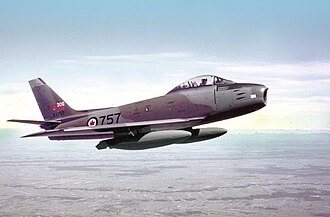
Canadair Sabre: The Canadian-Built Jet Fighter That Helped Define the Cold War
The Canadair Sabre occupies a special place in the history of military aviation because it represents a period when Canada moved from being primarily a purchaser and wartime producer of aircraft to becoming an important manufacturer of advanced jet fighters. Developed under licence from North American Aviation’s celebrated F-86 Sabre, the Canadian-built CL-13 evolved into a formidable combat aircraft that served with the Royal Canadian Air Force (RCAF), supported Canada’s commitment to the North Atlantic Treaty Organization (NATO), and entered service with several foreign air forces. Produced at Canadair’s facilities in Montreal between 1950 and 1958, the aircraft combined the aerodynamic advantages of a swept-wing jet fighter with increasingly powerful Canadian-designed and manufactured engines. Its development reflected the extraordinary pace of aviation technology during the early Cold War, when the transition from propeller-driven fighters to jet aircraft transformed military strategy, pilot training, aircraft design, and the organisation of air forces around the world. More than a thousand Canadian Sabres were produced, and their widespread service helped establish Canadair as a manufacturer capable of building sophisticated combat aircraft to international standards.
The Sabre’s reputation was built on a combination of speed, manoeuvrability, structural strength, and continuous improvement. Its swept wings helped reduce the aerodynamic problems associated with approaching the speed of sound, while successive engine upgrades improved acceleration, climb performance, and high-altitude capability. The early Canadian models remained closely related to American F-86 variants, but later aircraft, especially the Sabre Mk 5 and Mk 6, incorporated Canadian Orenda turbojet engines that gave them a distinctive identity. The Mk 6, equipped with the powerful Orenda 14 and a refined wing arrangement, became particularly well regarded for its manoeuvring performance and was often described as one of the finest dogfighters of its generation. Although the aircraft never became a supersonic fighter in sustained level flight, it could approach or exceed the speed of sound in a dive under suitable conditions, placing it among the aircraft that helped pilots and engineers understand the practical limits of high-speed flight.
The Canadair Sabre was also significant because it connected Canadian industry to the strategic requirements of the Western alliance. Following the establishment of NATO in 1949, Canada committed forces to the defence of Western Europe at a time when the Soviet Union was rapidly expanding its own jet-fighter capabilities. Canadian Sabre squadrons were deployed overseas, operating from bases in Britain, France, and West Germany, where they formed an important part of the alliance’s frontline air defence during the 1950s and early 1960s. The aircraft also served in the air forces of countries including West Germany, South Africa, Colombia, and others, with some aircraft passing between operators as military requirements changed. At home, Sabres trained generations of Canadian fighter pilots and became closely associated with the RCAF’s Golden Hawks aerobatic team. Their polished metal surfaces, swept-wing profile, and distinctive jet-engine sound made them enduring symbols of Canada’s early Cold War aviation history.
The Origins of the Canadair Sabre
The aviation revolution after the Second World War
The Canadair Sabre emerged from a period of rapid technological change. During the Second World War, piston-engine fighters such as the Spitfire, Mustang, and Messerschmitt Bf 109 had demonstrated how advances in engine power, aerodynamics, and weapons could dramatically improve combat performance. By the final years of the conflict, however, jet propulsion had begun to reshape the future of fighter aviation. Early jet aircraft could achieve speeds and climb rates that were difficult for conventional piston-engine designs to match, and military planners increasingly recognised that the next generation of air combat would depend on aircraft capable of operating at much higher speeds and altitudes.
The transition was not straightforward. Early turbojet engines consumed large quantities of fuel, acceleration could be slow compared with that of some piston fighters, and aircraft designers had limited experience with the aerodynamic behaviour of swept wings near the speed of sound. At high subsonic speeds, airflow over a conventional wing could produce shock waves and a sudden increase in drag, potentially causing serious changes in handling. Engineers therefore investigated wing sweep as a way of delaying some of these effects, allowing aircraft to approach transonic speeds more effectively. The result was a new generation of fighters whose appearance differed markedly from the straight-winged jets that had entered service during the closing stages of the war.
North American Aviation developed the F-86 Sabre in the United States as part of this transformation. The aircraft first flew on 1 October 1947 and combined swept-wing aerodynamics with a powerful turbojet engine, a pressurised cockpit, and a design intended for high-speed fighter operations. Its subsequent combat record during the Korean War made it one of the most famous jet fighters of the 1950s. For Canada, the F-86 offered a proven foundation for modernising the RCAF while supporting the country’s industrial and defence requirements. Instead of relying entirely on imported American-built aircraft, Canada could obtain a manufacturing licence and build the fighter domestically, developing expertise in production, engine integration, aircraft testing, and maintenance.
Why Canada selected the F-86 Sabre
Canada’s decision to adopt the Sabre was closely linked to the changing security environment in Europe. The formation of NATO in 1949 created a collective defence arrangement in which Canada committed military resources to the protection of Western Europe. The RCAF needed a modern fighter capable of operating alongside allied aircraft, and the F-86 offered a strong combination of speed, manoeuvrability, operational maturity, and development potential. The growing presence of advanced Soviet fighters made it increasingly important for Western air forces to replace older piston-engine aircraft and early jets with more capable designs.
The Sabre was particularly attractive because it was already undergoing rapid development. North American Aviation had produced a design that could be improved through successive changes to the engine, wing, flight controls, and other systems. This allowed Canada to begin with an established aircraft and then introduce modifications as operational experience accumulated. The licence-production arrangement also meant that Canadair could benefit from North American Aviation’s design work while building its own manufacturing capability. Rather than treating the programme as a short-term assembly contract, Canada developed the Sabre into a family of aircraft that increasingly incorporated Canadian technology.
The decision had consequences beyond the immediate requirement for fighter aircraft. Building a modern jet fighter demanded specialised tooling, precision manufacturing, quality control, and close cooperation between airframe and engine engineers. It also required a supply network capable of producing or maintaining complex components under demanding conditions. These capabilities could support future aircraft programmes and strengthen Canada’s position within the wider Western aerospace industry. The Sabre therefore served both as an operational military aircraft and as a major industrial learning experience.
Canadair and the licensed production programme
Canadair, based in Montreal, was selected to manufacture the Sabre for Canadian requirements. The initial agreement called for a relatively small number of aircraft, but the Korean War and the wider Cold War buildup increased demand for modern fighters. Production consequently expanded, and Canadair became responsible for building six versions of the aircraft, designated Sabre Mk 1 through Mk 6. The earliest Canadian aircraft were closely related to their American counterparts, while later models incorporated increasingly important modifications developed in Canada.
The first Canadian-built Sabre, designated CL-13 Sabre Mk 1, made its maiden flight at RCAF Station Dorval on 8 August 1950. The aircraft was essentially a Canadian-built example of the early F-86A configuration and served as a demonstration of Canada’s ability to manufacture the fighter. Canadair chief test pilot Al Lilly subsequently became the first pilot to break the sound barrier in Canada when he flew a Sabre in a dive on 10 August 1950. This achievement was an important milestone for Canadian aviation and demonstrated that the country had entered an era in which transonic flight was no longer an exclusively experimental pursuit.
The first production version was the Sabre Mk 2, which introduced improvements associated with the later F-86E configuration. Subsequent models refined the aircraft further, culminating in the Mk 6, which combined the Canadian-built Orenda 14 engine with a wing arrangement that restored leading-edge slats and improved manoeuvring performance. Between 1950 and 1958, Canadair built a total of 1,815 Sabres. This production achievement established the company as a significant manufacturer of advanced military aircraft and gave the RCAF a large fleet of modern fighters during a strategically important period.
Design and Aerodynamic Features
The swept wing and transonic flight
The Canadair Sabre’s most recognisable feature was its swept wing, a design that helped the aircraft operate effectively at the high subsonic speeds demanded of a modern jet fighter. In a straight-wing aircraft, the airflow approaching the wing becomes increasingly affected by compressibility as the aircraft nears the speed of sound. Local regions of airflow can reach supersonic speed even when the aircraft itself remains subsonic, producing shock waves, increased drag, and changes in lift and control characteristics. Sweeping the wing backward reduces the component of airflow velocity perpendicular to the leading edge, helping delay some of these effects and making higher-speed flight more manageable.
The Sabre’s wing design was not simply a matter of achieving the highest possible speed. A fighter also needed to turn, climb, accelerate, and maintain control across a broad range of flight conditions. Wing sweep could improve high-speed performance, but it also affected lift distribution, low-speed handling, and the way the aircraft behaved during manoeuvres. Designers therefore had to balance several competing requirements rather than optimise the aircraft for a single number on a performance chart. The evolution from the early Sabres to the Mk 5 and Mk 6 shows how the aircraft’s wing was repeatedly adjusted to find a useful balance between high-speed capability and combat manoeuvrability.
The aircraft’s performance near the sound barrier was especially important during the early jet age. Although the Sabre was not designed for sustained supersonic flight in level conditions, it could reach transonic and supersonic speeds in a dive under suitable circumstances. Pilots had to understand how changes in airflow affected the aircraft’s controls and handling, while engineers studied the behaviour of the wing, tail, and fuselage at increasingly high speeds. The Sabre consequently formed part of a generation of aircraft that helped establish practical experience with the transonic flight regime before later fighters moved more decisively into sustained supersonic performance.
Fuselage, air intake, and engine installation
The Sabre used a single-engine layout with an air intake positioned in the nose. Air entering through this intake passed through ducts to the turbojet, where it was compressed, mixed with fuel, burned, and expelled through the exhaust to generate thrust. This arrangement provided a relatively direct airflow path and allowed the engine to be installed within the fuselage, helping create the clean external shape associated with the aircraft. The wings, fuselage, and tail were arranged to support high-speed flight while preserving the handling characteristics needed for interception and close-range air combat.
The fuselage also housed the cockpit, fuel systems, landing gear, ammunition, and other essential equipment. The aircraft’s internal layout had to accommodate the engine while maintaining a suitable centre of gravity as fuel was consumed and external stores were carried or released. These requirements were particularly important in a fighter, where changes in weight and balance could affect control response during rapid manoeuvres. The design reflected the engineering priorities of the early jet age: concentrate the powerplant within a compact airframe, minimise unnecessary drag, and provide the pilot with enough control authority to operate effectively at high speed.
The nose-mounted intake distinguished the Sabre from many later fighters that used side-mounted or more complicated intake arrangements. It also contributed to the aircraft’s recognisable profile, with the intake opening occupying much of the nose area and the cockpit positioned farther aft. This configuration was suitable for the single-engine design, although the presence of a large intake and internal ducting created its own packaging requirements. As with other high-performance aircraft, the overall result represented a compromise among aerodynamic efficiency, engine airflow, internal volume, structural strength, and ease of maintenance.
Flight controls and pilot workload
The Sabre’s control system was designed to give the pilot the precision required for high-speed formation flying, interception, and manoeuvring combat. The Mk 2 introduced an all-flying tailplane, commonly called a stabilator, which moved as a complete surface rather than relying only on a conventional hinged elevator. This arrangement improved pitch control at high speeds and was an important refinement over the earliest aircraft. Power-assisted controls and systems designed to provide useful control feel also helped the pilot manage the forces associated with a fast jet fighter.
The cockpit incorporated a pressurised environment, an ejection seat, and instruments intended to support operations at altitude and high speed. The ejection seat was especially important because a pilot escaping from a damaged aircraft at jet speeds faced different hazards from those encountered in slower piston-engine fighters. Emergency escape had to account for airflow, aircraft attitude, and the limited time available to leave the aircraft safely. The Sabre’s equipment reflected the growing recognition that pilot survival systems were an essential part of modern fighter design rather than optional additions.
A radar-associated gunsight was another important feature of the aircraft’s combat equipment. The sight helped the pilot estimate the correct firing solution by taking into account the geometry of a moving target and the ballistics of the aircraft’s guns. This was valuable because a fighter pilot firing machine guns at another aircraft had to lead the target, allowing for the time required for the bullets to travel to the point of interception. Although the system was less sophisticated than the radar and missile systems fitted to later fighters, it represented a meaningful advance over simpler optical gunsights and formed part of the Sabre’s effectiveness as a gun-armed interceptor and day fighter.
The Evolution of the Canadair Sabre Variants
Sabre Mk 1: The Canadian prototype
The Sabre Mk 1 was the first Canadian-built example of the F-86 family and served primarily as a prototype and development aircraft. Closely based on the early F-86A, it demonstrated that Canadair could manufacture the airframe and bring the aircraft into flight. Its first flight in August 1950 marked the beginning of Canadian Sabre production, and its role was significant even though it was not produced in large numbers as an operational fleet aircraft.
The Mk 1 is also associated with Al Lilly’s achievement in becoming the first pilot to break the sound barrier in Canada. This flight helped establish the aircraft’s place in the country’s aviation history and showed how quickly the transition to high-speed jet flight was progressing. The prototype provided a foundation for the production programme that followed, allowing Canadair to move from a demonstration aircraft to larger-scale manufacture of improved variants.
Sabre Mk 2: The first production model
The Sabre Mk 2 was the first major production version built by Canadair and incorporated improvements associated with the North American F-86E. Its all-flying tailplane improved pitch-control characteristics, while a flat windscreen distinguished it from some earlier configurations. The Mk 2 retained the General Electric J47-GE-13 turbojet, which produced approximately 5,200 pounds of thrust. Although this engine was less powerful than the Orenda units used in later Canadian models, the Mk 2 was an important step toward establishing a reliable operational fleet.
Canadair produced approximately 350 Mk 2 aircraft in 1951 and 1952. Most were delivered to the RCAF, while a number went to other operators, including the United States Air Force and the Royal Air Force. Some aircraft supplied to the United States were sent to Korea, where they were used in combat operations. The Mk 2 therefore contributed not only to Canada’s domestic air defence but also to the wider international deployment of the Sabre during the Korean War period.
Sabre Mk 3: A testbed for Canadian engine development
The Sabre Mk 3 was a specialised development aircraft used to evaluate the Canadian Avro Orenda engine. Only one was built, making it quite different from the larger production batches of the Mk 2, Mk 4, Mk 5, and Mk 6. Its importance lay in the testing and integration work required to adapt a new engine to an existing fighter airframe. A different engine could affect thrust, airflow, weight distribution, cooling requirements, fuel consumption, and the loads imposed on the surrounding structure, so careful testing was essential before production could proceed.
The Mk 3 helped establish the feasibility of using a Canadian-designed and manufactured turbojet in the Sabre. This work laid the groundwork for the Orenda-powered Mk 5 and Mk 6, which became the most distinctive Canadian versions of the aircraft. The development programme also demonstrated the growing capabilities of Canada’s aerospace industry, which was moving beyond licensed airframe manufacture into the design and production of advanced propulsion systems.
Sabre Mk 4: A bridge between early and later models
The Sabre Mk 4 was produced in substantial numbers and remained closely related to the American F-86E configuration. Although the original plan anticipated the use of an Orenda engine, the production Mk 4 retained the General Electric J47-GE-13 to preserve commonality with the earlier version. This decision illustrates how industrial and operational considerations could influence aircraft development: a promising new engine did not automatically replace an established powerplant if doing so would introduce delays, supply problems, or additional technical risk.
Canadair built 438 Mk 4 aircraft, making it one of the largest production batches in the Canadian Sabre programme. The variant incorporated various refinements and served as an important stepping stone toward the later Canadian-engine models. It also helped provide the RCAF and allied operators with the numbers of modern fighters required during the early Cold War buildup. The Mk 4 may not have possessed the distinctive engine of the later variants, but its production scale and operational role were essential to the programme’s success.
Sabre Mk 5: The first production aircraft with an Orenda engine
The Sabre Mk 5 represented a major advance because it introduced the Canadian-built Avro Orenda 10 turbojet as the standard powerplant. Producing approximately 6,355 pounds of thrust, the Orenda 10 offered a substantial improvement over the J47-GE-13 and gave the aircraft stronger performance. Integrating the new engine required structural changes, including modifications to the fuselage framing and engine mounts, demonstrating that the powerplant upgrade was more involved than simply installing a different unit in the existing airframe.
The Mk 5 also introduced a revised wing commonly referred to as the 6-3 wing because the chord was increased by six inches at the root and three inches at the tip. The wing changes improved high-speed performance and increased internal fuel capacity, while the leading edge was fixed rather than fitted with the automatic slats used on earlier versions. Small wing fences were also introduced to influence airflow across the wing. These changes were effective at improving certain aspects of high-altitude and high-speed performance, but they also affected handling at lower speeds. The aircraft’s evolution therefore involved balancing the benefits of additional speed and fuel capacity against the need to preserve predictable behaviour during take-off, landing, and tight manoeuvres.
Canadair produced 370 Sabre Mk 5 aircraft, beginning in 1953. They served with the RCAF and were also supplied to the West German Luftwaffe. The Mk 5 helped establish the Orenda engine as a practical powerplant for operational fighter aircraft, giving Canada a stronger technological position within the Western alliance. Its improvements also provided a foundation for the final and most capable production version.
Sabre Mk 6: The peak of Canadian Sabre development
The Sabre Mk 6 is generally regarded as the most capable Canadian production version. It combined the Orenda 14 turbojet, producing approximately 7,275 pounds of thrust, with a refined wing that restored leading-edge slats while retaining important elements of the Mk 5 configuration. The stronger engine improved acceleration, climb performance, and high-altitude capability, while the wing changes helped restore desirable low-speed and manoeuvring characteristics. The result was a fighter that offered a particularly effective balance of engine power and aerodynamic control.
The Mk 6’s leading-edge slats were especially important during manoeuvres that demanded high lift. Slats extend or open at the leading edge of the wing to help control airflow and delay separation, allowing the wing to maintain lift at higher angles of attack. Their reintroduction helped address some of the low-speed handling compromises associated with the fixed leading edge of the Mk 5. Combined with the more powerful Orenda 14 and wing fences, the arrangement gave the Mk 6 excellent manoeuvrability and contributed to its strong reputation among pilots and aviation historians.
Canadair produced 655 Sabre Mk 6 aircraft between 1954 and 1958, making it the largest individual production variant. The aircraft served with the RCAF, West German Luftwaffe, South African Air Force, and Colombian Air Force, among other operators. Its performance made it particularly well suited to the demanding requirements of Cold War fighter operations in Europe. Although later aircraft would introduce more advanced radar, missiles, and supersonic performance, the Mk 6 represented a mature development of the swept-wing day fighter and demonstrated the benefits of combining a well-developed airframe with a powerful, locally produced engine.
The Avro Orenda Engine and Canadian Engineering
Developing a domestic turbojet
The Avro Orenda engine was one of the most important contributions Canada made to the Sabre programme. Developed by Avro Canada, the Orenda family represented a substantial achievement for the country’s aerospace industry, which was building the engineering expertise needed to produce advanced jet propulsion systems. The engine’s development allowed Canadair to move beyond licensed assembly of an American aircraft and introduce a distinctly Canadian technological improvement into a widely used fighter.
Turbojet engines operate by drawing in air, compressing it, mixing it with fuel, and burning the mixture in a combustion chamber. The resulting hot gases expand through turbines and exit through the exhaust nozzle at high speed, producing thrust. The design requires close coordination among compressors, combustion chambers, turbines, bearings, fuel systems, and control mechanisms. Reliability depends on careful manufacturing and precise management of temperature, airflow, and mechanical stress. The Orenda programme therefore demanded a level of industrial sophistication that went far beyond ordinary aircraft assembly.
The Orenda 10 provided the Mk 5 with approximately 6,355 pounds of thrust, while the Orenda 14 increased this to approximately 7,275 pounds in the Mk 6. The improvement in thrust helped the later Sabre climb more rapidly, operate at higher altitudes, and accelerate more effectively. These benefits were important in air defence, where a fighter might need to climb quickly to intercept an approaching aircraft or manoeuvre to gain a favourable position. The engine also became a symbol of Canada’s growing ability to develop major aerospace systems rather than depend exclusively on technology supplied by other countries.
How the Orenda changed the Sabre
An engine upgrade affects much more than the aircraft’s maximum speed. Additional thrust can improve acceleration and climb, but the engine must fit within the fuselage, receive adequate airflow, and operate without imposing unacceptable loads on the airframe. The Orenda’s size and performance required changes to the engine bay and supporting structure, while its output made it necessary to consider how the wing and flight controls would perform during demanding manoeuvres. These factors help explain why the Mk 5 and Mk 6 incorporated broader design refinements rather than relying on engine power alone.
The Mk 6’s combination of the Orenda 14 and restored leading-edge slats proved particularly effective. A powerful engine could help a fighter regain speed after a turn, but the aircraft also needed to maintain control at high angles of attack and avoid losing lift during tight manoeuvres. The slatted wing improved the aircraft’s behaviour in these conditions, creating a more balanced combat machine. This combination of propulsion and aerodynamic refinement was a key reason the Mk 6 acquired such a strong reputation.
The Orenda-powered Sabres also demonstrated the value of integrating domestic industrial development with a licensed aircraft programme. Canadair gained experience in airframe production, while Avro Canada developed and manufactured engines that could compete in a demanding technological field. The two efforts reinforced each other, strengthening Canada’s ability to participate in the rapidly evolving aerospace sector of the Cold War.
The Canadair Sabre in Cold War Service
Defending Canada and North America
The Sabre entered RCAF service in 1950, when Canada was modernising its air force in response to the changing international security environment. The aircraft provided a modern day-fighter capability at a time when the possibility of high-speed air attack was becoming an increasingly important defence concern. Its speed, climb rate, and manoeuvrability made it suitable for intercepting hostile aircraft and conducting visual-range combat, although the Sabre was not designed to fulfil every air-defence task that would later be assigned to specialised all-weather interceptors.
The aircraft’s role in Canada was part of a larger North American defence system. Canadian and American forces cooperated in the surveillance and protection of the continent, while military planners increasingly recognised that a single fighter type could not address every possible threat. Day fighters such as the Sabre could provide a valuable frontline capability, but the growth of faster bombers and the development of more sophisticated radar systems encouraged the introduction of specialised interceptors. This wider evolution eventually helped create a more differentiated air-defence structure in which fighters, ground-based radar networks, command centres, and missile systems worked together.
The Sabre nevertheless remained important during the early stages of this transformation. It provided the RCAF with a modern aircraft that could train pilots in jet operations and maintain a credible fighter presence while the next generation of systems was being developed. Its service also helped build the experience required for later aircraft programmes, as pilots and ground crews became familiar with the demands of high-speed jet flight, more complex maintenance procedures, and the logistics of operating advanced combat aircraft.
Canada’s NATO commitment in Europe
One of the defining aspects of the Canadian Sabre’s career was its deployment to Europe. Canada’s NATO commitment required the RCAF to maintain operational squadrons far from home, operating alongside allied forces in an environment where the possibility of conflict with the Soviet Union was a central concern. Canadian Sabres served at bases in Britain, France, and West Germany, where they formed part of the alliance’s effort to protect Western European airspace during the early Cold War.
The deployment of fighter squadrons overseas required much more than transporting aircraft to another continent. Personnel, spare parts, ground equipment, fuel supplies, training facilities, maintenance support, and command arrangements all had to be established. Fighter units needed to be ready to generate sorties at short notice, and their aircraft had to be maintained to demanding standards despite the wear associated with regular flying. Canada’s experience operating Sabres in Europe therefore contributed to the development of a modern expeditionary air force, one capable of sustaining frontline units within a multinational military alliance.
Canadian Sabres were among the aircraft used by the RCAF’s European fighter force during the 1950s and early 1960s. Their role included readiness training, interception exercises, formation flying, and participation in allied exercises designed to improve coordination between NATO air forces. The aircraft’s speed and manoeuvrability made it suitable for the day-fighter role, while its established design and growing Canadian production base helped support a large operational fleet. The deployment also demonstrated the strategic importance of domestic manufacturing: a country committed to maintaining forces overseas benefited from having an industrial base capable of producing and supporting its principal combat aircraft.
The Sabre and the Korean War
The American-built F-86 Sabre became famous for its combat against the Soviet-designed MiG-15 during the Korean War, particularly in the air battles over the region known as MiG Alley. The North American Sabre’s performance, together with pilot training and tactical development, made it one of the most important Western fighters of the conflict. The Canadian-built Sabre family was closely related to this aircraft and contributed to the broader operational story of the F-86, although the RCAF’s principal Canadian Sabre commitment was centred on the defence of Canada and NATO Europe rather than the deployment of Canadian Mk 6 squadrons to Korean combat operations.
Some Canadair-built Sabres did reach the Korean theatre. Early Mk 2 aircraft supplied to the United States Air Force were sent to Korea and flown in combat, illustrating the international reach of Canada’s production programme. These aircraft were part of the wider F-86 operational effort and should be distinguished from the RCAF’s European-based squadrons. The distinction matters because the aircraft family included several variants and served through different national arrangements, making it easy to conflate the combat history of the American F-86 with the particular service record of Canadian-built versions.
The Korean War nonetheless had a major effect on the Canadair production programme. The conflict accelerated demand for modern fighters and contributed to the expansion of the original Canadian order. The need to equip frontline units with capable jet aircraft encouraged rapid production and continuous development, helping Canadair build experience with increasingly sophisticated manufacturing methods. The war also reinforced the strategic importance of the Sabre at a time when Western air forces were trying to maintain a technological advantage over their opponents.
International Operators and the Export Market
West Germany and the rebuilding of its air force
The West German Luftwaffe became one of the important overseas operators of Canadian-built Sabres during the rebuilding of West Germany’s military aviation capability in the 1950s. As West Germany became integrated into the Western defence structure, it required modern aircraft, trained personnel, and a supporting industrial and logistical system. The Sabre provided a practical way to equip fighter units with a proven aircraft while maintaining compatibility with allied operations and training practices.
Canadian-built Mk 5 and Mk 6 aircraft served with the West German air force, giving it access to a mature swept-wing fighter during the early years of its re-establishment. The Sabre was suitable for day-fighter duties and provided a useful stepping stone toward more advanced aircraft as military technology continued to develop. Its service in West Germany also illustrates how Canadian production supported the wider NATO alliance: the aircraft manufactured in Montreal helped equip a European force operating at the centre of the Cold War’s strategic confrontation.
South Africa and Colombia
The Sabre Mk 6 was also exported to the South African Air Force and the Colombian Air Force. These operators used the aircraft to strengthen their fighter capabilities during a period when jet propulsion was becoming increasingly important to national air forces. For countries seeking a modern combat aircraft, the Sabre offered a combination of performance, established design, and available international support that made it an attractive option compared with more experimental or specialised alternatives.
The aircraft’s export history helped extend the life of the Canadian production programme beyond the immediate requirements of the RCAF. As Canadian units moved toward newer fighters, aircraft could be transferred or sold to operators whose requirements and budgets differed from those of major NATO air forces. Such transfers were common in the Cold War, when aircraft often remained useful long after they had been replaced in the front line of the country that originally operated them. The Sabre’s ability to serve several air forces also strengthened its international reputation and made it one of Canada’s more successful postwar military aircraft exports.
The global legacy of Canadian production
The export success of the Canadair Sabre demonstrates that licensed manufacturing could create a product with a meaningful international identity. Although the basic design originated with North American Aviation, the later Canadian versions incorporated the Orenda engine and other changes that distinguished them from the earliest American models. The aircraft was therefore more than a locally assembled copy: it evolved through Canadian engineering and manufacturing into a distinct family of fighters.
The programme also helped establish Canadair’s reputation as a producer of high-performance aircraft. Manufacturing 1,815 Sabres required a large and organised industrial effort, including precision fabrication, systems integration, testing, and quality assurance. This experience contributed to the wider development of Canada’s aerospace sector, which would later participate in other significant military and civilian aircraft programmes. The Sabre’s legacy consequently extends beyond the squadrons that flew it to the engineers, technicians, factory workers, and support organisations that made its production and operation possible.
The Golden Hawks: Canada’s Famous Sabre Aerobatic Team
Formation and purpose
The RCAF’s Golden Hawks aerobatic team became one of the most recognisable public expressions of the Canadair Sabre’s capabilities. Formed in 1959 to help celebrate the fiftieth anniversary of powered flight in Canada, the team used Sabre fighters to demonstrate the precision, coordination, and handling of modern jet aircraft. Its performances combined tight formation flying, carefully timed manoeuvres, and dramatic visual displays that introduced large audiences to the technology of the jet age.
The team initially flew Sabre Mk 5 aircraft before moving to the Mk 6, whose performance and handling characteristics made it particularly well suited to demanding aerobatic displays. Operating fast jets in close formation required exceptional discipline and concentration. Pilots had to maintain precise relative positions while accounting for changes in speed, altitude, and aircraft attitude, often with only small margins separating one aircraft from another. The displays therefore depended on extensive practice, standardised procedures, and a high level of mutual trust among the pilots.
The Golden Hawks were more than a flying demonstration team. They helped build public awareness of the RCAF and showcased the technical sophistication of Canadian aviation. Their aircraft provided a visible connection between the nation’s industrial capabilities and its military commitments, while the team’s performances helped make the Sabre an enduring symbol of Canada’s postwar jet era. The distinctive gold finish applied to the aircraft also made them stand out from the operational fighters normally seen in natural metal or camouflage finishes.
Precision flying and public engagement
Aerobatic demonstrations placed different demands on the Sabre from those encountered in routine interception or patrol missions. Pilots had to perform manoeuvres within a carefully defined display area while preserving safe separation, managing energy, and remaining aware of the positions of the other aircraft. The aircraft’s swept wings and jet engine provided the speed and power required for the display, but those qualities also demanded careful management. A fast aircraft could cover ground quickly, and small errors in timing or positioning could have serious consequences.
The Golden Hawks helped explain these challenges to audiences who might otherwise have encountered military aviation only through photographs or news reports. Their displays demonstrated the responsiveness of jet fighters, the importance of formation discipline, and the coordination required to operate a modern air force. In a period when Canada was investing heavily in advanced aircraft and participating in the collective defence of Europe, such public engagement helped make the RCAF’s work more visible.
The team’s existence also reflected the Sabre’s maturity as a design. An aircraft used for regular aerobatic displays had to be predictable, well maintained, and supported by experienced technicians. The Golden Hawks could not rely on the aircraft’s reputation alone; every display depended on preparation, inspection, and careful operating procedures. Their success therefore reflected both the quality of the aircraft and the professionalism of the people who maintained and flew it.
The end of the Golden Hawks
The Golden Hawks operated from 1959 until their disbandment in February 1964. Their relatively short existence did not diminish their impact on Canadian aviation culture. The team became closely associated with the Sabre and helped preserve public memories of the aircraft at a time when operational squadrons were transitioning toward newer designs. Its legacy continued through later Canadian military demonstration teams, most notably the Snowbirds, although the Snowbirds fly a different aircraft and represent a later phase in the history of Canadian aerobatics.
The Golden Hawks remain an important part of the Sabre’s story because they showed the aircraft in a role that was very different from frontline combat readiness. In operational service, the fighter represented national defence and alliance commitments; in aerobatic displays, it became a symbol of engineering, precision, and national pride. Both roles contributed to the aircraft’s lasting place in Canadian history.
Armament and Combat Capability
The six .50-calibre machine guns
The Canadair Sabre was primarily armed with six .50-calibre Browning M3 machine guns mounted in the nose. These weapons fired high-velocity ammunition and were intended to provide an effective gun-based armament for attacking enemy aircraft. The guns were positioned to allow their fire to converge within a selected range, helping concentrate projectiles around the expected position of a target. In aerial combat, this was essential because the fighter and its opponent could be moving at high speed in different directions, leaving only a brief opportunity for an accurate burst.
Machine-gun armament reflected the combat environment in which the Sabre was developed. During the early jet age, many fighter designers continued to rely on guns because they offered a comparatively direct and dependable means of engaging an aircraft at close range. Early air-to-air missiles were still developing and were not yet universally suitable for every fighter mission. A gun-armed aircraft therefore needed to combine speed and manoeuvrability with an effective sighting system and sufficient ammunition to make several firing attempts during a combat engagement.
The Sabre’s radar-associated gunsight helped the pilot calculate the lead required to hit a moving target. Rather than simply aiming directly at an opposing aircraft, the pilot had to account for its direction of travel, relative speed, distance, and the flight time of the bullets. A well-timed firing solution could be effective, but it required training and judgement, particularly when both aircraft were manoeuvring aggressively. The combination of six machine guns and a lead-computing sight made the Sabre a capable day fighter, even as later aircraft began to rely more heavily on guided weapons and radar-based interception.
Rockets, bombs, and external stores
The Sabre could also carry external stores, including unguided rockets, bombs, and additional fuel tanks, depending on the variant and mission. These stores expanded the aircraft’s utility beyond air-to-air combat, allowing it to perform limited fighter-bomber tasks or carry extra fuel when required. The aircraft’s principal identity remained that of a day fighter, but the ability to carry external equipment gave operators flexibility when adapting the aircraft to different operational circumstances.
External stores created aerodynamic and performance penalties. Additional fuel tanks increased range but added weight and drag, while bombs and rockets affected acceleration, manoeuvrability, and the aircraft’s maximum speed. A fighter carrying external stores would not necessarily perform like the same aircraft in a clean configuration. Pilots and planners therefore had to select an appropriate load for the intended mission, balancing the need for additional capability against the advantages of maintaining a lighter, cleaner aircraft.
The development of later fighter-bombers and dedicated strike aircraft eventually reduced the need for some of these secondary roles. Nevertheless, the Sabre’s capacity to carry external stores reflected the practical flexibility expected of military aircraft in the 1950s. A fighter squadron could be required to perform different tasks as operational needs changed, and the aircraft’s basic design allowed a degree of adaptation without a complete redesign.
Flight Performance and Operational Characteristics
Maximum speed and climb performance
The Sabre Mk 6 had a published maximum speed of approximately 606 miles per hour, or 975 kilometres per hour, under specified conditions. It was powered by the Orenda 14 turbojet, rated at approximately 7,275 pounds of static thrust. These figures placed the aircraft among the most capable Western day fighters of its generation, particularly when its manoeuvrability and high-altitude performance were considered alongside its speed. Exact performance depended on altitude, aircraft weight, external stores, atmospheric conditions, and the condition of the engine.
Climb performance was especially important in air defence. A fighter on alert might need to reach an approaching aircraft at altitude as quickly as possible, and a powerful engine could reduce the time required to gain height. The Orenda 14 improved the Mk 6’s ability to accelerate and climb compared with the earlier Orenda 10-powered Mk 5. This made the aircraft more effective in a range of operational circumstances, although climb rate was never a fixed value independent of conditions. A lightly loaded aircraft at one altitude could climb differently from a heavier aircraft carrying external fuel tanks.
The Sabre’s high-speed capability was also closely connected to its swept wing and overall aerodynamic design. A fighter needed to retain useful control authority while approaching the transonic region, where airflow changes could affect drag and stability. The Sabre’s development reflected the growing understanding of these effects, and its operational service provided pilots with experience of high-speed flight that was valuable during the early Cold War. The aircraft was not a sustained supersonic platform in level flight, but its ability to operate close to the sound barrier made it an important stage in the evolution of jet fighters.
Range, endurance, and mission planning
The Sabre’s range varied substantially according to its variant, fuel load, altitude, and mission profile. The Mk 6 could cover considerable distances for a single-engine fighter of its era, but it was not designed for the same endurance as a long-range bomber or transport aircraft. Combat radius was generally much shorter than maximum ferry range because a combat mission required fuel for take-off, climb, transit, manoeuvring, possible engagement, and the return journey with appropriate reserves.
External fuel tanks could extend the distance the aircraft could travel, making them valuable for deployments and long-distance transfers. However, external tanks increased drag and affected aircraft performance, and operational planners had to consider whether the additional range was worth the associated penalties. During overseas deployments, the availability of suitable airfields and support facilities was crucial. The Sabre’s service in Europe required a system of bases, maintenance units, supply arrangements, and trained ground crews capable of keeping the aircraft ready for operations.
These factors demonstrate why an aircraft’s usefulness cannot be reduced to a single range figure. The ability to reach a destination depended on fuel management, weather, routing, payload, and the operational task. The Sabre was an effective frontline fighter within its intended mission profile, but its range limitations also reflected the broader constraints of early jet propulsion, when engines consumed substantial quantities of fuel compared with later designs.
Handling and manoeuvrability
The Sabre’s handling qualities were among the most important reasons for its reputation. Its swept wing and powerful engine provided high-speed performance, while the Mk 6’s leading-edge slats helped preserve lift and control during manoeuvres. In a turning engagement, a pilot had to manage speed, angle of attack, altitude, and energy, constantly balancing the need to turn tightly against the risk of losing too much speed. A fighter that could sustain useful manoeuvres while maintaining energy would have an advantage over an opponent that was forced to recover speed or altitude.
The Mk 5 demonstrated that improvements aimed at high-speed performance could introduce compromises elsewhere. Its fixed leading edge helped improve aspects of high-speed behaviour and fuel capacity, but it also made low-speed handling less forgiving than on configurations with leading-edge slats. The Mk 6 addressed this limitation by reintroducing the slats while retaining important elements of the revised wing. The result was a more balanced aircraft, particularly in the close-range manoeuvring environment associated with day-fighter combat.
A fighter’s handling reputation was also shaped by pilot training and operational doctrine. Aircraft performance alone did not determine the outcome of an engagement; situational awareness, tactics, formation discipline, weapons employment, and the ability to make decisions under pressure were equally important. The Sabre’s success came from the combination of a well-developed design and the skills of the people who operated it.
The Transition to Newer Fighters
The changing nature of air combat
By the late 1950s, the technological environment that had produced the Sabre was changing rapidly. More powerful engines, improved radar systems, guided missiles, and advances in aerodynamics were leading to fighters capable of higher speeds and increasingly specialised missions. Military planners were also concerned about the possibility of high-altitude attacks by faster bombers, encouraging the development of dedicated interceptors that could climb quickly and engage targets in conditions that differed from traditional visual-range dogfighting.
The Sabre remained an effective day fighter, but it was not designed to meet every emerging requirement. Its guns were useful in close combat, yet the growing emphasis on radar-guided interception and air-to-air missiles changed the equipment expected of frontline aircraft. The development of aircraft such as the Avro Canada CF-100 Canuck and later the CF-101 Voodoo reflected the shift toward specialised all-weather interception, while other air forces adopted newer fighters with greater speed, improved sensors, or expanded mission capabilities.
These changes did not make the Sabre unsuccessful. Instead, they show how quickly the requirements of military aviation evolved during the early Cold War. An aircraft that represented a major advance in 1950 could become less suitable for some missions only a decade later, not because its basic design had failed, but because the threats and technologies around it had changed. The Sabre’s continued service with several foreign air forces also demonstrates that aircraft could remain useful after more advanced types had entered service elsewhere.
Retirement from Canadian frontline service
The RCAF gradually withdrew the Sabre as newer aircraft became available and the requirements of Canada’s air-defence system changed. The transition reflected the growing need for aircraft capable of operating in more demanding interception environments, as well as the desire to modernise the fleet with more advanced propulsion and weapons systems. The Sabre had served through the formative years of the Cold War, helping Canada maintain a frontline fighter force and supporting the country’s NATO commitments in Europe.
Its retirement was not a single event affecting every aircraft at the same time. Different variants and units followed different schedules, and individual airframes could remain useful for training, display, or other duties after leaving frontline service. Some Canadian-built Sabres continued flying with overseas operators, while others were placed in storage, sold, or preserved. This gradual transition was typical of the period, when aircraft often passed through several stages of service rather than moving directly from combat operations to retirement.
The end of the Sabre’s frontline career marked a major transition in Canadian military aviation. The aircraft had helped establish the RCAF as a modern jet-equipped air force, and the experience gained through its operation contributed to the introduction of more advanced fighters. Its legacy therefore includes both the aircraft itself and the operational knowledge developed by the pilots, technicians, engineers, and commanders who worked with it.
Preservation and Historical Significance
Surviving aircraft and museum collections
A number of Canadair Sabres survive in museums and aviation collections, where they provide a tangible record of Canada’s early jet age. The Canada Aviation and Space Museum in Ottawa holds a Sabre Mk 6 that was manufactured in Montreal in 1955 and delivered to the RCAF that year. The aircraft served with No. 444 Squadron in West Germany before moving through maintenance and storage facilities in Britain and Canada. It entered the museum’s collection in 1964 and is displayed in the markings associated with No. 444 “Cobra” Squadron.
Other Canadian Sabres are preserved at aviation museums and historic collections, including the Air Force Museum of Alberta and the Royal Aviation Museum of Western Canada. The latter’s collection includes the final Canadair-built Sabre, aircraft number 1815, which left the production line in 1958. These surviving aircraft help illustrate the differences between the various marks and allow visitors to examine the swept wing, nose intake, cockpit arrangement, and engine installation in person.
Preserving a jet fighter is a complex task because the aircraft contains numerous systems and materials that can deteriorate over time. Museums must address corrosion, structural integrity, paint and markings, cockpit equipment, and the conservation of components that may no longer be manufactured. In some cases, an aircraft is restored to a historically accurate display configuration rather than returned to flight. Such work allows the aircraft to remain accessible to the public while preserving its value as a historical artefact.
The Sabre as a symbol of Canadian aerospace achievement
The Canadair Sabre represents an important step in the development of Canada’s aerospace industry. The original design came from North American Aviation, but the Canadian production programme grew into a major industrial undertaking that included domestic engine development and the refinement of the aircraft’s aerodynamic configuration. The Orenda-powered Mk 5 and Mk 6 demonstrated that Canadian engineers could make significant improvements to an established fighter, rather than simply reproduce an overseas design.
The programme also strengthened Canada’s position within the Western alliance. By building a large fleet of advanced fighters, Canada could support its own defence requirements while supplying aircraft to allied and partner air forces. This combination of domestic capability and international production helped establish a pattern that would remain relevant to later Canadian aerospace programmes, in which manufacturing, engineering, maintenance, and export relationships formed an interconnected industrial system.
The Sabre’s legacy is therefore both military and industrial. It served as a frontline fighter during a strategically important period, trained pilots in the demands of jet combat, and became an enduring symbol of the RCAF’s early Cold War role. At the same time, its production demonstrated the benefits of investing in technical expertise and manufacturing capability. The aircraft’s history shows how a licensed design can evolve into a distinctive national product when local engineers and manufacturers have the opportunity to refine and improve it.
Conclusion: A Landmark in Canada’s Jet-Fighter History
The Canadair Sabre was one of the most important aircraft produced by Canada’s postwar aerospace industry. Based on the North American F-86, it evolved from an early licensed-production model into a family of increasingly capable fighters, culminating in the Orenda-powered Mk 6. Its swept wings, high-speed performance, powerful engine, and effective gun armament made it a respected day fighter during the early Cold War. Canadian Sabres helped defend North American airspace, served with RCAF squadrons deployed to Europe, and were exported to several foreign air forces, extending the aircraft’s influence well beyond Canada.
The aircraft’s development also tells a larger story about engineering and industrial progress. Canadair’s production programme created experience in manufacturing advanced jet fighters, while the Orenda engine gave later Sabres a distinctively Canadian technological contribution. The evolution of the wing between the Mk 5 and Mk 6 demonstrated the importance of balancing high-speed performance with manoeuvrability, and the aircraft’s service history showed that operational success depended on much more than maximum speed or engine thrust. Training, maintenance, logistics, tactics, and industrial support were all essential to keeping the Sabre effective.
Although newer fighters eventually replaced it in frontline service, the Canadair Sabre remains an enduring symbol of Canada’s entry into the modern jet age. Its appearance is instantly recognisable, its contribution to NATO’s early Cold War air forces was substantial, and its surviving examples continue to connect present-day audiences with a pivotal era in aviation. The Sabre was not merely an American design built north of the border; through Canadian production, engine development, and operational experience, it became an important chapter in Canada’s own aerospace history.
Summary Table of Technical Specifications
The table below describes the Canadair CL-13 Sabre Mk 6, the final and most capable Canadian production variant. Figures may differ slightly among sources and operating configurations.
| Specification | Canadair Sabre Mk 6 |
|---|---|
| Manufacturer | Canadair Limited, Montreal, Quebec, Canada |
| Original design | North American Aviation F-86 Sabre |
| Canadian designation | CL-13B |
| Aircraft type | Single-seat jet day fighter |
| First flight of the F-86 family | 1 October 1947 |
| First flight of the Canadian Sabre Mk 1 | 8 August 1950 |
| Mk 6 first flight | 19 October 1954 |
| Total Canadair Sabres built | 1,815 |
| Mk 6 production | 655 aircraft |
| Crew | 1 pilot |
| Powerplant | 1 Avro Canada Orenda 14 turbojet |
| Engine thrust | Approximately 7,275 lbf (32.4 kN) |
| Maximum speed | Approximately 606 mph (975 km/h) |
| Cruising speed | Approximately 489 mph (787 km/h) |
| Service ceiling | Approximately 54,000 ft (16,460 m) |
| Wingspan | 37 ft 11½ in (11.57 m) |
| Length | 37 ft 6 in (11.43 m) |
| Height | 14 ft 9 in (4.50 m) |
| Wing area | Approximately 287.9 sq ft (26.74 m²) |
| Empty weight | Approximately 10,618 lb (4,818 kg) |
| Gross weight | Approximately 14,613 lb (6,628 kg) |
| Range | Approximately 1,486 miles (2,391 km), depending on configuration and range definition |
| Primary armament | 6 × .50-calibre Browning M3 machine guns |
| Additional stores | External fuel tanks, unguided rockets, and bombs, depending on configuration |
| Principal Canadian operator | Royal Canadian Air Force |
| Other operators | West German Luftwaffe, South African Air Force, Colombian Air Force, and other users |
| Main operational role | Day fighter and air-defence fighter |
| Notable feature | Canadian-built Orenda engine and refined slatted wing on the Mk 6 |
