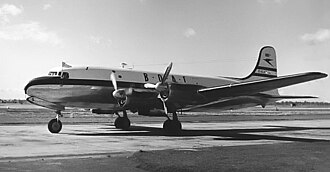
Canadair North Star: The Canadian Airliner That Combined the Best of Two Aircraft
The Canadair North Star was one of the most distinctive transport aircraft to emerge from the Canadian aviation industry in the years immediately following the Second World War. Developed during a period when airlines and military organizations were rapidly expanding their long-distance transport capabilities, the North Star combined the proven airframe concepts of the Douglas DC-4 and C-54 with a different powerplant arrangement that gave it an unusual blend of speed, range, and operational versatility. Manufactured by Canadair in Montreal, Quebec, the aircraft served commercial airlines and the Royal Canadian Air Force (RCAF), carrying passengers, freight, military personnel, and essential supplies across extensive domestic and international routes. Its appearance was familiar to anyone accustomed to the large four-engine transports of the era, but beneath its conventional silhouette lay an important engineering distinction: instead of the radial engines associated with the Douglas DC-4, the North Star used liquid-cooled Rolls-Royce Merlin V12 engines. This decision produced an aircraft that could cruise significantly faster than the standard DC-4, although the installation also introduced operational challenges, particularly the considerable noise generated inside the passenger cabin.
The North Star emerged at a time when aviation was changing from a wartime necessity into an increasingly important component of international commerce, government transportation, and civilian mobility. During the war, manufacturers had perfected the mass production of large aircraft, developed extensive maintenance systems, and trained thousands of pilots, navigators, radio operators, and engineers. After 1945, airlines needed to convert those advances into reliable peacetime services, while governments required transport aircraft capable of supporting personnel and equipment across enormous distances. Canada faced a particularly demanding transportation environment because its major population centres were separated by vast distances, northern communities were difficult to reach by conventional surface transport, and overseas military commitments required dependable long-range airlift. The North Star answered many of these needs with a design that drew upon established American airframe engineering while incorporating British engine technology and Canadian manufacturing expertise. It was not simply another derivative of a wartime transport: it represented a deliberate attempt to adapt an existing aircraft concept to the speed, capacity, and logistical demands of the postwar world.
Although the North Star did not enjoy the worldwide recognition of aircraft such as the Douglas DC-4, Douglas DC-6, or Lockheed Constellation, its contribution to Canadian aviation was substantial. It helped Trans-Canada Air Lines expand its services, provided Canadian Pacific Air Lines with another long-distance transport option, served the British Overseas Airways Corporation under the name Argonaut, and became an important long-range transport aircraft for the RCAF. Its military career included extensive Pacific airlift operations during the Korean War, humanitarian relief work, northern resupply missions, and the transportation of senior officials. The aircraft’s story is therefore about more than a particular combination of engines and airframe components. It is also a story of how a Canadian manufacturer adapted proven technology to national requirements and helped bridge the gap between wartime aviation and the modern commercial and military air transport systems that followed.
Origins and Development of the Canadair North Star
Canadair and the postwar aviation industry
Canadair’s development of the North Star began within a broader transformation of Canada’s aircraft manufacturing industry. During the Second World War, Canadian factories had produced enormous quantities of aircraft, components, and associated equipment to support Allied operations. When the conflict ended, manufacturers faced the challenge of maintaining their industrial capabilities in a market that no longer demanded wartime production on the same scale. Passenger airlines, cargo operators, and military organizations offered an opportunity to redirect those capabilities toward peacetime aircraft, but the competition was demanding. American manufacturers already possessed established designs and considerable production experience, while airlines increasingly expected higher speeds, greater comfort, improved operating economics, and dependable service over long routes.
Canadair, established in Montreal in 1944, was well positioned to participate in this transition. The company inherited aircraft manufacturing activities and continued work on established types while developing its own approach to commercial and military transport requirements. Rather than beginning with a completely new aircraft, Canadair pursued a design that incorporated much of the structural and aerodynamic experience accumulated through the Douglas DC-4 and its military counterpart, the C-54 Skymaster. This strategy reduced the uncertainty associated with designing an entirely new airframe, allowing the company to concentrate on the changes it believed would deliver the greatest operational benefit. The result was a Canadian-built aircraft whose basic proportions were familiar but whose propulsion system gave it a character of its own.
The North Star also illustrates how international aviation technology was exchanged during the period. Its underlying airframe heritage was American, its principal engines were British, and its manufacturing and adaptation were Canadian. Such combinations were common in an era when manufacturers frequently licensed designs, sourced engines from specialist companies, and tailored aircraft to meet the requirements of national airlines or military services. Canadair’s work demonstrated that an aircraft did not have to be entirely original in every component to represent a significant engineering achievement. A well-considered redesign of an existing platform could create an aircraft that met a specific market need more effectively than an unchanged production model.
The airline requirement that shaped the aircraft
The North Star’s origins are closely associated with Trans-Canada Air Lines, commonly known as TCA and the predecessor of today’s Air Canada. In 1944, the airline sought a transport capable of improving its long-distance operations during the transition to peacetime aviation. The standard Douglas DC-4 had already established itself as a useful four-engine transport, offering substantial passenger capacity and a dependable foundation for long-range services. However, the airline wanted a faster aircraft that could take advantage of improvements in engine technology and reduce journey times across Canada’s extensive route network.
Canadair’s answer was the DC-4M, with the letter M reflecting the Merlin engine installation. The prototype made its first flight on 15 July 1946, marking the beginning of a programme that would produce several related versions for civilian and military use. The design retained the general configuration of the Douglas transport while incorporating modifications to the fuselage, nose, landing gear, powerplant installation, and other systems. These changes reflected the practical priorities of the postwar airline industry: improve performance without abandoning the structural foundation and manufacturing knowledge associated with an established aircraft family.
The name North Star became the aircraft’s best-known designation, although it was not the only name associated with the family. Different versions were also identified as the DC-4M, Canadair Four, C-4, and C-5, while the aircraft supplied to British Overseas Airways Corporation became known as the Argonaut. The military transport version used by the RCAF was designated C-54GM and commonly identified as the North Star Mk 1. These names reflect the different ways operators and manufacturers classified closely related aircraft rather than indicating that every example was identical. Engine installations, cabin arrangements, pressurization, weights, and other equipment could vary according to the version and customer.
From prototype to production aircraft
The first flight in July 1946 was an important milestone, but the transition from prototype to operational service required further work. A transport aircraft intended for regular airline operations had to demonstrate predictable handling, reliable engine performance, manageable maintenance demands, and sufficient payload capability across a range of weather conditions and operating weights. Military customers added their own requirements, including durability, flexibility in passenger and freight arrangements, and the ability to support long-distance transport missions with relatively limited infrastructure at some destinations.
Canadair ultimately produced 71 aircraft across the related North Star, DC-4M, C-4, and C-5 family. The production run included civilian and military versions, with the majority using Rolls-Royce Merlin engines. One notable exception was the C-5, which used Pratt & Whitney R-2800 radial engines rather than the Merlin installation. This diversity is important when considering the aircraft’s specifications: published figures for one North Star variant should not automatically be applied to every member of the family. Passenger capacity, operating weight, pressurization, engine type, and performance could differ depending on the particular configuration.
The North Star’s production history was relatively brief, extending from 1946 to 1950, but the aircraft remained in service long after manufacturing ended. Its continued use through the 1950s and into the 1960s reflected the value of an established four-engine transport during a period when airlines and air forces were gradually moving toward newer piston aircraft and, eventually, turbine-powered designs. For Canadair, the programme also represented valuable experience in modifying a mature transport airframe to satisfy different customers, a capability that would remain important as the company expanded its role in Canada’s aviation industry.
Design and Engineering
An airframe derived from the Douglas DC-4
At first glance, the Canadair North Star resembled the Douglas DC-4 and C-54 Skymaster because its design retained much of their general layout. It was a large, low-wing, four-engine aircraft with a conventional tail, retractable landing gear, and a fuselage suitable for carrying passengers or freight. The wings provided the lift needed to support a substantial transport payload, while the four-engine arrangement gave the aircraft a level of redundancy that was particularly valuable on long routes over water or sparsely populated territory. The aircraft’s overall configuration was well suited to the technology of the 1940s, when reliable jet engines were not yet available for routine long-distance commercial service.
However, the North Star was not simply a DC-4 with different engines attached. Canadair incorporated features associated with several Douglas designs, including aspects of the DC-6’s forward fuselage and nose arrangement, while retaining major structural elements and the general aerodynamic configuration of the DC-4/C-54 family. Changes to the fuselage and systems allowed the aircraft to accommodate the new propulsion installation and the requirements of its intended operators. The combination of inherited and modified components gave Canadair a practical way to create a faster transport without undertaking the full cost and risk of developing an entirely new airframe.
This design philosophy was particularly appropriate for the immediate postwar market. Airlines needed new capacity quickly, but they could not afford to treat every new aircraft as an experimental technology programme. Familiar structures and established manufacturing practices could simplify production and maintenance, while targeted improvements could make the aircraft more attractive than an unmodified predecessor. The North Star demonstrates how an aircraft could occupy a position between a straightforward derivative and a genuinely distinct model: its ancestry was clear, but the changes were extensive enough to affect its operating characteristics, cabin environment, and performance.
The Rolls-Royce Merlin V12 engines
The most distinctive feature of the Canadair North Star was its use of Rolls-Royce Merlin piston engines. The Merlin is best remembered for its wartime service in aircraft such as the Supermarine Spitfire, Hawker Hurricane, and North American P-51 Mustang, but its underlying engineering principles were also suitable for certain transport applications. It was a liquid-cooled, twelve-cylinder engine arranged in a V configuration, designed to produce substantial power from a relatively compact installation. In the North Star, four Merlin engines replaced the radial piston engines used by the standard Douglas DC-4.
The RCAF’s North Star Mk 1 was equipped with four Rolls-Royce Merlin 622 engines, each rated at approximately 1,760 horsepower for take-off. This gave the aircraft a combined nominal take-off rating of roughly 7,040 horsepower. The engine installation was designed to deliver improved cruising performance, allowing the North Star to reach a published cruising speed of about 325 miles per hour, or 523 kilometres per hour, in the relevant configuration. The precise performance achieved in service depended on aircraft variant, weight, altitude, weather, engine rating, and operating conditions, but the speed advantage over the standard DC-4 was a central reason for the North Star’s development.
The Merlin installation also brought disadvantages. Liquid-cooled engines required radiators, coolant systems, and associated plumbing, adding maintenance considerations that differed from those of air-cooled radial engines. The North Star’s engine and propeller arrangement also produced a notably loud cabin environment. Passengers and crew frequently found the interior noise uncomfortable, and the aircraft became well known for this characteristic. The noise did not prevent the North Star from performing valuable transport work, but it illustrates an important engineering lesson: an improvement in one performance measure does not necessarily translate into a better experience in every aspect of operation. Faster cruising could be commercially attractive, yet comfort, maintenance, fuel consumption, and overall operating cost remained important parts of the equation.
Wings, fuselage, and landing gear
The North Star’s wing and fuselage reflected the conservative but effective principles used in large piston-engine transports of the period. Its low-mounted wing provided a stable platform for the four engines and a substantial internal structure to support the aircraft’s weight. The wing’s area and span allowed it to generate the lift needed for a fully loaded transport, while the conventional tail supplied the stability and control characteristics expected of a mature transport design. The aircraft was not intended to perform like a fighter or specialised aerobatic machine; its priorities were predictable handling, reliable operation, and the ability to move useful loads across long distances.
The fuselage was designed to accommodate passenger seating, freight, or a mixture of people and equipment depending on the operator’s needs. Civilian configurations could include passenger accommodations and, in some versions, cabin pressurization for higher-altitude cruising. Military examples were configured for transport duties, with the RCAF’s North Star Mk 1 operating without a pressurized cabin. This difference matters because the term North Star describes a family of related aircraft rather than a single immutable interior layout. A passenger airliner and a military freight transport could share the same broad design while having different equipment, payload arrangements, and operating requirements.
The retractable landing gear allowed the aircraft to reduce drag in flight while retaining the strength necessary for repeated take-offs and landings. Large transport aircraft of this era required substantial ground-handling support, and their operational usefulness depended not only on aerodynamic performance but also on the availability of suitable runways, maintenance facilities, fuel, and trained personnel. The North Star’s familiar configuration made it relatively straightforward to understand within the wider family of contemporary transports, although its Merlin engines introduced their own maintenance and support demands.
Cockpit, crew, and onboard systems
The North Star’s flight deck reflected the multi-crew approach typical of long-range aircraft in the 1940s and 1950s. Operating a large four-engine piston transport required more than a pilot and co-pilot. Depending on the mission and operator, crews could include a navigator, radio operator, flight engineer, and other personnel responsible for communications, navigation, engine monitoring, and operational coordination. The RCAF’s published North Star Mk 1 specifications list a crew of seven, illustrating the manpower required for the aircraft’s military transport role.
The flight engineer’s responsibilities were particularly significant on an aircraft powered by four complex piston engines. Engine temperatures, fuel systems, oil pressures, propeller settings, and other parameters needed regular monitoring, especially during long flights in which a small mechanical problem could become more serious if not detected early. The pilot and co-pilot concentrated on controlling the aircraft and managing the flight, while other crew members supported navigation and communication over routes that could cross oceans, remote terrain, or regions with limited ground infrastructure. This division of responsibilities was characteristic of the era before automation reduced the workload associated with many transport-aircraft functions.
Navigation and radio systems were also essential to the North Star’s long-range missions. Flights over the Pacific during the Korean War required careful planning, fuel management, weather assessment, and coordination with intermediate bases. The aircraft’s practical value therefore rested on a combination of airframe capability, engine reliability, crew training, route planning, and a functioning logistical network. Like many historic aircraft, the North Star was not merely a machine but the centre of a complex system involving pilots, technicians, dispatchers, ground crews, airfields, fuel supplies, and operational planners.
Performance and Flight Characteristics
Speed and cruising efficiency
Speed was the North Star’s principal selling point. The RCAF’s published specifications give the North Star Mk 1 a maximum speed of approximately 353 miles per hour, or 568 kilometres per hour, and a cruising speed of around 325 miles per hour, or 523 kilometres per hour. Those figures placed it among the faster piston-engine transports of its period, particularly when compared with the standard DC-4 configuration from which it had been developed. For airlines, higher cruising speed offered the prospect of shorter journey times and more productive use of aircraft and crew, especially on routes where a faster schedule could make a meaningful difference to connecting services.
Cruising speed should not, however, be confused with the average speed of a complete journey. Actual travel time depended on taxiing, climb, descent, weather, headwinds, routing, fuel stops, and the time spent on the ground. A transport aircraft might achieve an impressive speed under favourable conditions but still require careful scheduling and operational planning to maintain dependable service. The North Star’s value lay in its ability to combine relatively high speed with a useful payload and the established four-engine transport configuration, rather than in any single maximum-performance figure.
Its speed advantage was also connected to the particular characteristics of the Merlin engines and their installation. Engine power, propeller efficiency, altitude, drag, and aircraft weight all influenced the speed that could be maintained economically. A heavily loaded transport climbing toward cruising altitude would not behave exactly like a lighter aircraft operating under ideal test conditions. Published performance data should therefore be understood as representative figures for a specified variant and set of conditions, not as guaranteed values for every flight.
Range and long-distance operations
Range was central to the North Star’s role, especially for the RCAF. Canada is geographically immense, and military transport aircraft needed to connect bases separated by long distances while also supporting operations overseas. The North Star’s four-engine arrangement, substantial fuel capacity, and transport-oriented design made it suitable for long-distance work, although the distance it could cover depended on payload, fuel reserves, altitude, weather, and the specific configuration. The Canada Aviation and Space Museum lists an approximate range of 3,000 miles, or 4,830 kilometres, for its surviving North Star Mk 1, while other published specifications may vary because they refer to different versions or definitions of range.
The difference between maximum range and operational range is important. Maximum-range figures are usually associated with carefully defined conditions, and they do not necessarily describe the distance an aircraft could cover while carrying its maximum payload and retaining suitable fuel reserves. Military planners also had to account for alternate airfields, weather diversions, route restrictions, and the availability of refuelling stops. These considerations became particularly important during Pacific operations, where a missed landing opportunity or unexpected weather system could have serious consequences.
For this reason, the North Star’s long-range usefulness depended on the entire transport system rather than on its airframe alone. Staging bases, fuel depots, maintenance teams, communications facilities, and experienced crews were essential to keeping aircraft moving on a regular schedule. The aircraft provided the capacity and speed, but effective logistics turned those qualities into dependable transportation.
Payload and transport flexibility
The North Star could carry passengers or cargo, making it useful for both commercial and military work. The RCAF Mk 1 specifications describe provision for up to 44 passengers or approximately 11,500 pounds, equivalent to about 5,216 kilograms, of cargo, with a crew of seven. These figures are specific to the military transport configuration and should not be treated as universal limits for every DC-4M or Argonaut variant. Civilian passenger arrangements and operating weights varied, and particular aircraft could be modified for different roles over their service lives.
This flexibility was especially valuable to a military transport organization. A flight could be assigned to carry personnel, equipment, mail, spare parts, or essential supplies, with the loading arrangement determined by the mission. In an emergency, the ability to move people and freight rapidly could be more important than achieving the lowest possible operating cost. In regular airline service, by contrast, the aircraft’s value depended on balancing passenger capacity, baggage, cargo, fuel, comfort, and the economics of scheduled routes.
The North Star was therefore a practical workhorse rather than a specialised aircraft restricted to one narrow task. Its design could support several kinds of transportation without requiring a fundamentally different airframe for every assignment. That adaptability helps explain why both airlines and the RCAF found it useful, even though the aircraft’s noisy cabin and increasingly dated piston-engine technology eventually limited its appeal as newer designs entered service.
Commercial Airline Service
Trans-Canada Air Lines
Trans-Canada Air Lines was one of the principal civilian customers for the North Star family. As Canada’s national airline expanded its route network after the war, it needed aircraft that could carry passengers and freight over long distances with predictable schedules. The North Star offered a combination of speed and capacity that made it attractive during this transitional period, when airlines were trying to improve service while working with the technology available before the widespread introduction of jetliners.
For TCA, the aircraft’s significance lay in its role within a larger fleet rather than in its performance alone. An airline had to coordinate aircraft availability, maintenance schedules, crew training, route planning, and passenger demand. A faster transport could shorten flight times, but it also had to remain reliable and economical enough to justify its place in the fleet. The North Star’s established airframe heritage helped provide a familiar foundation, while its distinctive engine installation gave the airline a different performance profile from that of a standard DC-4.
Commercial operation also revealed the importance of passenger comfort. The aircraft’s loud Merlin engines became a recurring criticism, and cabin noise was an unavoidable part of its identity. In the immediate postwar years, many travellers were willing to accept compromises in comfort in exchange for the opportunity to travel by air, but airlines were increasingly competing on the quality of the passenger experience as well as on speed and route coverage. As newer transports offered improved cabins, better operating economics, and other refinements, the North Star’s shortcomings became more difficult to overlook.
Canadian Pacific Air Lines
Canadian Pacific Air Lines also operated North Stars, using the type during an era when long-distance air services were expanding across Canada and toward overseas destinations. Canadian Pacific’s network and commercial priorities differed from those of TCA, but the underlying requirement was similar: move passengers and freight reliably over considerable distances while maintaining an economically workable fleet. A transport with a substantial payload and competitive cruising speed could be useful in a market where geography often made air travel the most practical way to connect distant communities.
The North Star’s service with more than one Canadian airline illustrates the wider appeal of the aircraft’s performance concept. It was not a one-customer experiment that remained confined to a single operator. Instead, it became part of the broader postwar movement toward faster and more capable piston-engine transports. At the same time, the relatively small production run meant it never achieved the scale of the most widely manufactured American airliners, limiting the size of the operator community and the long-term benefits that might otherwise have arisen from standardisation.
BOAC and the Argonaut
The North Star family also found a place in British Overseas Airways Corporation service under the name Argonaut. This name is especially associated with the pressurized DC-4M-2 version used by BOAC, although details varied across the wider family. The British operator needed aircraft capable of supporting long-distance services in a period when commercial aviation was growing rapidly but turbine-powered passenger aircraft had not yet become the standard solution for every route.
The Argonaut’s use in British service demonstrates the international relevance of the Canadair design. Although the aircraft was developed and manufactured in Canada, it drew on a multinational combination of engineering and production experience and was suitable for operators beyond its original market. Its role with BOAC also illustrates the importance of cabin pressurization in the evolution of passenger aviation. By enabling aircraft to cruise at higher altitudes without exposing passengers to the same changes in cabin pressure, pressurized versions could improve the comfort and practicality of longer flights, although they still retained the characteristic noise and other limitations of piston-engine aircraft.
The North Star’s civilian career was gradually overtaken by the arrival of newer piston transports and, later, jet-powered airliners. These aircraft could offer different combinations of passenger comfort, speed, payload, and operating efficiency. Nevertheless, the North Star and Argonaut helped airlines maintain and expand their services during the years when the postwar aviation market was developing into the global system familiar today.
Military Service with the Royal Canadian Air Force
The RCAF North Star Mk 1
The Royal Canadian Air Force adopted the North Star as a long-range transport aircraft and designated its military version the C-54GM North Star Mk 1. The RCAF took 24 examples into service, beginning in 1947, and used them for passenger transport, freight movement, military logistics, and other general transport tasks. The aircraft’s speed and payload made it valuable to a country that needed to move personnel and supplies over long distances both within Canada and abroad.
Unlike some civilian variants, the RCAF North Star Mk 1 was unpressurized. Its interior arrangements were shaped by military requirements rather than the comfort expectations of a commercial passenger cabin, and the aircraft could be employed for a wide range of duties. Transport squadrons required aircraft that could carry personnel and equipment as operational demands changed, and the North Star’s adaptable interior helped it fulfil that role. Its four engines also provided a degree of redundancy for long-distance operations, although they did not remove the need for careful maintenance, fuel planning, and conservative operational decisions.
The North Star was assigned to No. 426 Transport Squadron, initially based at Dorval, Quebec, before the unit moved to Trenton, Ontario. The squadron’s work demonstrated the importance of air transport as a military capability in its own right. Aircraft such as the North Star were not primarily designed to engage enemy forces directly, yet their ability to move supplies and personnel could determine whether deployed units received the resources they needed. The aircraft’s service therefore reflected a broader understanding of military aviation in which logistical capacity was essential to sustained operations.
Operation Hawk and the Korean War airlift
One of the most significant chapters in the North Star’s history was its participation in the RCAF’s support effort during the Korean War. Beginning in 1950, North Stars operated across the Pacific in a transport network that connected North American bases with intermediate staging points and destinations in Japan and the wider Korean theatre. The aircraft helped carry supplies and personnel needed to sustain United Nations operations, demonstrating that a transport aircraft could make a substantial contribution to a conflict without being designed for direct combat.
The Canadair North Star’s Pacific missions required careful planning and a considerable support infrastructure. Flights operated through locations including McChord Air Force Base in Washington State and staging points in the Aleutian Islands, with Japan serving as a major destination for the transport network. The distances involved placed significant demands on navigation, engine monitoring, weather assessment, and fuel management. Aircrews had to operate in conditions that could change rapidly, and ground crews needed to keep the aircraft serviceable while maintaining a schedule that supported military requirements across the Pacific.
According to the Royal Canadian Air Force’s historical account, North Stars flew 599 round trips across the Pacific between 1950 and 1952, transporting approximately seven million pounds of cargo and carrying about 13,000 personnel in both directions. These figures underline the scale of the effort and help explain why the aircraft occupies an important place in Canadian military aviation history. The North Star was not simply an aircraft that happened to be available during the Korean War; it was a key element in the transportation system that allowed Canada to support an international military commitment across a vast ocean.
The Pacific airlift also demonstrated the difference between an aircraft’s design purpose and its strategic effect. The North Star had been developed to meet the needs of commercial and military transport operators, yet its operational value became especially clear when the RCAF needed to maintain long-distance supply lines. The success of such missions depended on trained crews, maintenance support, disciplined planning, and cooperation between military organisations. Aircraft performance mattered, but it was the combination of performance and logistics that made repeated long-distance flights possible.
Humanitarian relief and northern transportation
The North Star’s military service extended beyond overseas logistics. The aircraft was also used in domestic relief operations, northern resupply work, and international commitments during the 1950s. In Canada, long distances and severe weather could make the delivery of supplies difficult, particularly when communities depended on aircraft for transport during emergencies or when conventional routes were limited. A large transport capable of carrying substantial loads could move essential equipment and personnel much faster than many surface alternatives.
The aircraft took part in relief efforts associated with the Red River flooding in Manitoba, illustrating the value of military air transport in a domestic emergency. Flood relief can require the rapid movement of people, provisions, equipment, and other necessities, often under difficult operating conditions and with limited warning. Although the North Star was not a specialised search-and-rescue aircraft, its cargo capacity and ability to carry personnel made it useful in the wider response effort. This was an important aspect of military aviation during the period: transport aircraft could provide direct humanitarian value even when they were not engaged in conventional military operations.
Northern resupply was another demanding assignment. Remote communities and installations often had limited access to roads, railways, and other forms of surface transportation, making aircraft essential for moving supplies over long distances. Such operations required attention to weather, runway conditions, payload, and the availability of suitable support facilities. The North Star’s service in these roles demonstrated the value of a versatile transport aircraft in a country where geography could make routine logistics unusually complicated.
The type also supported United Nations peacekeeping-related missions and other transport requirements during the 1950s. These tasks formed part of the growing international responsibilities undertaken by Canadian forces after the Second World War. In each case, the North Star’s contribution was fundamentally practical: it moved the people and material required to sustain operations. Its historical significance therefore extends beyond performance figures to the everyday work of military transportation.
VIP transport and the end of RCAF service
Some North Stars were also used by No. 412 Squadron, based in Ottawa, for VIP transportation duties. Government and military officials needed dependable aircraft capable of travelling between Canadian cities and reaching international destinations when necessary. A large transport could accommodate passengers and support staff while providing the range needed for official travel, although its cabin environment remained less refined than that of some purpose-built executive aircraft.
By the early 1960s, the North Star was becoming increasingly dated as newer aircraft entered service. Piston-engine transports still had useful capabilities, but advances in turbine propulsion, aircraft design, and commercial aviation economics were steadily changing expectations. The North Star’s noise, maintenance demands, and age made replacement increasingly attractive, while the military’s transportation requirements continued to evolve.
No. 426 Squadron stood down in 1962, and many of the squadron’s North Stars were retired around that time. A small number remained in service for additional duties, including training, before the RCAF formally retired the type in 1965. The aircraft had served for nearly two decades after its introduction, a substantial period for a transport design developed during the immediate postwar transition. Its retirement marked the end of an important phase in Canada’s military airlift history, but it did not erase the operational experience accumulated by the crews and support personnel who had flown and maintained it.
Variants of the Canadair North Star
DC-4M-1
The DC-4M-1 was an early civilian version associated with Trans-Canada Air Lines. It used the Merlin-powered concept that distinguished the North Star from the standard Douglas DC-4, offering improved cruising performance while retaining the general layout of the established transport. The precise equipment and passenger arrangements reflected the needs of its operator, and the variant formed part of the first stage of Canadair’s effort to establish the design in the commercial market.
The DC-4M-1 is important because it represents the airline-oriented origins of the North Star programme. Its development was driven by the practical need for a faster long-distance transport, not by a desire to produce an entirely new aircraft for its own sake. The use of a proven airframe concept reduced design risk, while the Merlin engines provided a clear point of differentiation. This combination helped Canadair deliver a distinct product during a period when airlines were looking for improved performance but still needed aircraft that could be introduced and supported with manageable disruption.
DC-4M-2 and the Argonaut
The DC-4M-2 was a pressurized version intended to provide a more comfortable environment for passengers travelling at higher altitudes. Cabin pressurization became an increasingly important feature of commercial transports because it allowed aircraft to operate at altitudes where they could sometimes benefit from more favourable atmospheric conditions without requiring passengers to endure the full effects of low outside pressure. The resulting improvement in passenger comfort could be valuable on long-distance routes, although pressurization added structural and systems complexity.
BOAC’s Argonauts were associated with this branch of the North Star family. They demonstrate how Canadair adapted the basic design to meet the requirements of a major overseas operator, including the expectation that a long-distance passenger aircraft should provide a suitable cabin environment as well as competitive speed. While the North Star’s overall architecture remained recognisable across the variants, the differences in pressurization and equipment meant that individual versions had to be considered separately when discussing performance and operating characteristics.
C-54GM North Star Mk 1
The C-54GM North Star Mk 1 was the military transport version operated by the RCAF. It was unpressurized and used four Rolls-Royce Merlin 622 engines, each rated at approximately 1,760 horsepower for take-off. The aircraft was configured to carry military personnel or freight and became the most historically significant version in Canadian military service because of its extensive use in long-range transport operations, including the Korean War airlift.
The Mk 1’s published specifications differ in some respects from figures associated with civilian North Stars. Its military payload arrangements, cabin configuration, and operating weights were tailored to RCAF requirements, and the type’s service record reflects its use as a transport rather than as a conventional passenger airliner. For anyone studying the aircraft, the C-54GM is therefore the most useful version to examine when considering the North Star’s contribution to Canadian military aviation.
C-5
The C-5 was a related Canadair transport that differed from the Merlin-powered versions by using four Pratt & Whitney R-2800 radial engines. This makes it an important exception within the wider family. Although it shared the general transport design heritage of the North Star, its propulsion system was closer to the radial-engine arrangement associated with the Douglas DC-6. It illustrates that Canadair’s programme encompassed more than one approach to adapting the underlying airframe for transport duties.
The existence of the C-5 also highlights why aircraft histories must distinguish between a family name and a particular production model. Broad descriptions of the North Star often emphasise its Merlin engines because they were its defining feature, but not every closely related Canadair Four had the same powerplant. Technical comparisons should therefore identify the variant being discussed and avoid combining the performance figures of different aircraft into a single supposedly universal specification.
Strengths and Limitations of the North Star
The advantages of higher cruising speed
The North Star’s strongest advantage was its cruising speed relative to the standard DC-4. On routes where time mattered, the aircraft could offer a faster journey while retaining the payload capacity and four-engine layout expected of a large transport. This made it attractive to airlines seeking improved service and to the RCAF, which needed to move personnel and supplies over long distances. The speed advantage was particularly meaningful in an era when long journeys could involve many hours in the air and when the availability of intermediate airports was less extensive than it is today.
Its use of a familiar airframe also provided practical advantages. Canadair did not have to start from a blank sheet of paper, and operators could benefit from the accumulated knowledge associated with the DC-4 family. Familiarity with the general configuration could assist pilots, engineers, and maintenance organisations, although the Merlin engines and related systems still required appropriate training and support. The North Star thus combined evolutionary design with a meaningful performance change, a strategy that can be effective when an established aircraft needs to be adapted to new operational expectations.
Noise, maintenance, and operating economics
The aircraft’s principal drawback was its noisy cabin, a characteristic repeatedly associated with the Merlin installation. Interior noise could make long passenger journeys tiring and created a less comfortable environment than travellers increasingly expected from commercial aircraft. For military operations, the problem was less important than payload, reliability, and range, but it remained a notable feature of the type. The North Star’s reputation shows that aircraft performance cannot be judged solely by speed and carrying capacity: the environment experienced by passengers and crew also influences how successful a design becomes.
The engine installation introduced additional maintenance considerations as well. Liquid-cooled engines required their cooling systems to be maintained, while four engines and their associated propellers demanded regular inspection and servicing. Like other large piston transports, the North Star required a considerable support organisation, including trained mechanics, spare parts, ground equipment, and procedures for monitoring engine health. These requirements were manageable during the aircraft’s operational life, but they formed part of the overall cost of keeping the type in service.
The arrival of newer aircraft eventually reduced the North Star’s competitive position. Improved piston-engine transports offered alternative combinations of capacity, comfort, and efficiency, while turbine-powered aircraft began transforming long-distance travel. The North Star was not obsolete the moment newer designs appeared, and its military service continued because it still performed useful work. Nevertheless, the broader direction of aviation technology made it increasingly difficult for an aircraft of its generation to remain competitive in demanding passenger operations.
Preservation and Historical Legacy
The surviving North Star
The North Star’s historical importance is reflected in the preservation of aircraft associated with its service. The principal surviving complete airframe is RCAF North Star Mk 1 serial 17515, held by the Canada Aviation and Space Museum in Ottawa. The aircraft was manufactured in 1948, delivered to the RCAF that year, and spent its operational career with No. 426 Squadron. It was retired in 1965 and transferred to the museum in 1966, giving it a direct connection to the military transport operations that defined much of the type’s later history.
The aircraft has been the subject of conservation and restoration work intended to preserve its structure and historical significance. Preservation of an aircraft of this size is a demanding undertaking because a museum must consider structural condition, corrosion, historical accuracy, access for visitors, and the availability of specialist knowledge. A large piston transport is also more complex than a static display might suggest: its airframe, engines, systems, interior, and external surfaces all require attention if the aircraft is to remain an informative record of its original design.
A preserved North Star allows visitors and researchers to appreciate the scale of the aircraft in a way that photographs and written descriptions cannot fully reproduce. Its wingspan, fuselage dimensions, engine arrangement, and crew stations help explain why the type was suitable for long-distance transportation. More importantly, its survival connects a physical object to the experiences of the people who operated it, maintained it, and depended on it during military and civilian service.
The North Star’s place in Canadian aviation history
The Canadair North Star occupies a distinctive position in Canadian aviation because it was both a product of international engineering collaboration and an expression of Canada’s growing industrial capabilities. Its American airframe heritage, British engines, and Canadian manufacture demonstrate the interconnected nature of the aviation industry in the years following the Second World War. Canadair showed that adapting an existing design could create a useful aircraft with a clearly defined advantage, particularly when the requirements of airlines and military transport organisations were changing quickly.
Its operational record is equally significant. The North Star supported the expansion of Canadian commercial aviation, provided transport capacity to international airline services, and helped the RCAF maintain long-distance supply routes during the Korean War. Its participation in relief operations and northern transportation further demonstrates how military aircraft could serve practical national needs far removed from direct combat. The aircraft’s value was measured not only in miles per hour or kilograms of payload but also in the personnel, equipment, and supplies it delivered.
The North Star also serves as a reminder that successful aircraft are not always the most famous or the most numerous. Only 71 examples were built across the related family, and its service life was eventually overtaken by newer designs. Yet the aircraft made a meaningful contribution during a period of rapid change, when air transport was becoming essential to international commerce and modern military logistics. Its unusual Merlin engines gave it a distinctive identity, while its transport capacity and range made it useful in a variety of demanding environments.
Conclusion: A Fast and Unconventional Postwar Transport
The Canadair North Star was a distinctive solution to the transportation needs of the late 1940s and 1950s. By combining a proven Douglas-derived airframe with Rolls-Royce Merlin engines, Canadair created a transport aircraft that could cruise faster than the standard DC-4 while remaining suitable for passenger, freight, and military operations. Its design was neither a complete departure from existing practice nor a simple reproduction of an American aircraft. Instead, it represented a targeted adaptation that drew on international engineering expertise to meet the requirements of Canadian and overseas customers.
The aircraft’s career encompassed commercial airline service, military transportation, Korean War supply flights, humanitarian relief, northern resupply, and official travel. It was capable and versatile, although its noisy cabin and the maintenance demands associated with its powerplants were important limitations. As newer piston transports and jetliners entered service, the North Star gradually lost its place in frontline operations, but its contribution to Canadian aviation remained substantial. The preservation of an RCAF example at the Canada Aviation and Space Museum ensures that the aircraft’s physical form and historical story can continue to be studied.
Today, the Canadair North Star deserves recognition as more than an unusual variation of the Douglas DC-4. It was a Canadian-built transport that connected industrial innovation with practical service, supporting both civilian travel and national military commitments during a formative period in aviation history. Its story illustrates how a carefully modified aircraft could provide real value during a period of technological transition—and how the achievements of a relatively small production programme could leave a lasting mark on the history of air transport.
Summary Table of Technical Specifications
The following figures refer primarily to the RCAF C-54GM North Star Mk 1. Specifications differed among the civilian DC-4M variants, the Argonaut, and the C-5, so these figures should not be applied indiscriminately to every aircraft in the family.
| Specification | Canadair North Star Mk 1 |
|---|---|
| Manufacturer | Canadair Aircraft Ltd., Montreal, Canada |
| Aircraft type | Four-engine piston transport |
| First flight | 15 July 1946 |
| RCAF service entry | 1947 |
| RCAF retirement | 1965 |
| Number built across the related family | 71 |
| Military designation | C-54GM North Star Mk 1 |
| Crew | 7 |
| Passenger capacity | Up to 44 |
| Alternative cargo load | Approximately 11,500 lb (5,216 kg) |
| Powerplant | 4 Rolls-Royce Merlin 622 liquid-cooled V12 piston engines |
| Take-off power per engine | Approximately 1,760 hp |
| Total nominal take-off power | Approximately 7,040 hp |
| Maximum speed | Approximately 353 mph (568 km/h) |
| Cruising speed | Approximately 325 mph (523 km/h) |
| Range | Approximately 3,000 miles (4,830 km), published figure |
| Service ceiling | 36,000 ft (10,970 m) |
| Rate of climb | Approximately 972 ft/min (296 m/min) |
| Wingspan | 117 ft 6 in (35.8 m) |
| Length | Approximately 93 ft 9½ in (28.6 m) |
| Height | 27 ft 6 in (8.4 m) |
| Wing area | Approximately 1,462 sq ft (135.8 m²) |
| Empty weight | Approximately 43,500 lb (19,730 kg) |
| Gross weight | Approximately 73,000 lb (33,110 kg) |
| Landing gear | Retractable tricycle-type arrangement |
| Principal operators | Trans-Canada Air Lines, Canadian Pacific Air Lines, BOAC, Royal Canadian Air Force |
| Distinguishing feature | Merlin V12 engines instead of the radial engines used by the standard Douglas DC-4 |
