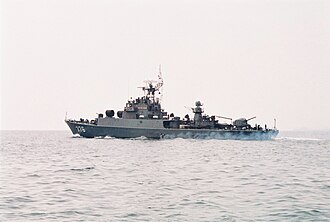
The ship is associated with the Parchim class, also identified with the East German Project 133.1 designation, and is known in Indonesian service as part of the Kapitan Pattimura-class group. Its original design emphasized anti-submarine warfare in relatively restricted waters, where compact dimensions, maneuverability, specialized sonar equipment, and dedicated weapons could provide meaningful advantages. After the end of the Cold War, the transfer of former East German naval vessels gave Indonesia an opportunity to expand its fleet with established platforms rather than build every ship from the ground up. Sultan Thaha Syaifuddin subsequently became part of a broader story of adaptation: a ship conceived for one regional confrontation was brought into a different maritime environment, where its capabilities could support Indonesia’s own national defense requirements. Available reference sources generally identify its Indonesian pennant number as 376, its former East German name as Bad Doberan, and its Indonesian commissioning date as 25 February 1995.
Origins and Development of the Parchim-Class Corvette
The East German naval requirement
The Parchim-class corvette was developed during the Cold War for the Volksmarine, the navy of East Germany. In that period, naval planners in the Warsaw Pact considered submarine operations in the Baltic Sea a major concern. The shallow waters, narrow passages, dense maritime traffic, and proximity of opposing forces made anti-submarine warfare an important part of regional naval planning. East Germany needed ships capable of operating near its coastline and within the Baltic’s confined operating areas, where a smaller vessel could patrol, search for submarines, escort other naval units, and respond to underwater threats without the cost or complexity of a much larger destroyer or frigate. The Parchim design emerged from this requirement, combining a relatively compact hull with machinery suited to rapid movement and a weapons fit centered on submarine detection and attack. Its role was not to dominate the open ocean or engage a major surface combatant in a prolonged duel; instead, it was intended to contribute to a coordinated defensive network in which shore-based systems, aircraft, larger warships, and smaller patrol vessels could work together.
Project 133.1 and shipyard construction
The vessels were constructed at Peene-Werft in Wolgast, a shipbuilding center in what was then East Germany. The class is often called Parchim in Western sources, while Project 133.1 is the designation associated with its original East German configuration. The design combined a displacement of under one thousand tonnes with a length of approximately 75 metres, giving it the scale of a compact corvette rather than a large ocean-going combatant. Even at this size, the ship carried several distinct weapons systems, including a twin-barrel 57 mm gun, a close-range 30 mm gun in its original configuration, anti-submarine rocket launchers, and torpedo tubes. It also carried sensors intended to help the crew detect surface contacts and locate submerged targets. The Parchim class therefore represented a specialized compromise: it was large enough to carry a meaningful anti-submarine suite and sustain a naval crew, but small enough to be suited to coastal patrol and relatively confined operating areas. Its design also reflected the technological and industrial conditions of its era, when East German shipyards built vessels for national requirements while participating in the broader naval production system of the Eastern Bloc.
From Bad Doberan to KRI Sultan Thaha Syaifuddin
The ship’s early career in East Germany
Before it became Sultan Thaha Syaifuddin, the vessel served as Bad Doberan, carrying pennant number 222 in the East German Navy. The ship was commissioned into East German service on 30 June 1982, during the final decade of the Cold War. At that time, its operational purpose was closely tied to the maritime defense of East Germany and the wider Warsaw Pact. Its likely tasks included coastal patrols, anti-submarine searches, training exercises, and cooperation with other naval units operating in the Baltic region. The ship’s compact size and specialized weapons made it appropriate for the environment for which it had been designed, where submarine threats and the protection of maritime approaches were important concerns. Bad Doberan entered service in a period of considerable political tension, but the strategic situation changed dramatically within less than a decade. The fall of the Berlin Wall in 1989 and the reunification of Germany in 1990 brought an end to the political system that had supported the East German Navy. As a result, vessels that had once formed part of a frontline Cold War fleet became surplus to the requirements of the unified German state, creating opportunities for other navies to acquire them.
Transfer to Indonesia
After German reunification, Indonesia acquired a group of former East German naval vessels as part of a wider effort to expand and diversify its fleet. Sultan Thaha Syaifuddin was among the Parchim-class ships transferred during this period, and its Indonesian service began following refurbishment and preparation for its new operator. It was commissioned into the Indonesian Navy on 25 February 1995, adopting the name Sultan Thaha Syaifuddin and pennant number 376. The transfer was significant because it allowed Indonesia to obtain relatively capable naval platforms without waiting for a new-build program to deliver comparable numbers of ships. However, transferring a warship between navies involves much more than changing its flag and name. The receiving navy must consider the availability of spare parts, crew training, ammunition compatibility, maintenance infrastructure, technical documentation, and the integration of the vessel into existing command arrangements. A ship designed around East German and Soviet-era equipment could not simply be expected to operate indefinitely without adjustments to suit Indonesian logistics and mission requirements. The refurbishment and subsequent modification of the former Bad Doberan reflected this need to adapt inherited equipment to a new fleet environment.
The Meaning Behind the Name Sultan Thaha Syaifuddin
Honoring a historical figure
The ship’s Indonesian name refers to Sultan Thaha Syaifuddin, a historical ruler associated with the Jambi Sultanate in Sumatra and remembered for resisting Dutch colonial expansion during the nineteenth century. His legacy is connected with the wider history of Indonesian resistance to colonial authority and the struggle to preserve local political independence. Naming a warship after a figure associated with resistance and sovereignty gives the vessel a significance beyond its machinery, weapons, and operational record. In naval traditions around the world, ship names often preserve national memories, honor military leaders, or commemorate people who symbolize courage and independence. For Indonesia, a country whose identity and security are closely linked to its many islands and surrounding seas, the use of a historical name also connects modern naval service with a much longer story of defending territory and political autonomy. Although the ship itself was built in Europe and originally served a European navy, its Indonesian identity was established through the name it received, the sailors who operated it, and the missions assigned to it by the TNI-AL.
A ship’s identity beyond its original design
The transformation from Bad Doberan to Sultan Thaha Syaifuddin illustrates how a naval vessel can acquire a new institutional identity while retaining much of its original physical structure. Its hull and basic layout remained rooted in the Parchim design, but its new name connected it to Indonesian history, and its subsequent service took place in a different strategic setting. Instead of being organized around the requirements of the East German Navy in the Baltic, the ship became part of a force responsible for protecting a sprawling archipelago with important shipping routes, coastal communities, ports, and maritime economic interests. The change did not make the vessel a new design, nor did it erase the limitations imposed by its age and original role. Rather, it gave an existing platform a second operational life. This distinction matters when assessing military equipment: a ship’s usefulness depends not only on the capabilities originally designed into it, but also on the missions it is assigned, the maintenance it receives, the systems fitted during its career, and the support available from the navy operating it.
Design and Physical Characteristics
A compact corvette built for coastal operations
Sultan Thaha Syaifuddin is a relatively small surface combatant, measuring approximately 75.2 metres in length and 9.78 metres in beam. Reference sources commonly list its standard displacement at about 865 tonnes and full-load displacement at approximately 935 tonnes, although individual records sometimes differ in their measurements or in the way displacement and draft are reported. These dimensions place the vessel firmly within the compact corvette category. Compared with a modern frigate or destroyer, the ship has limited internal volume for weapons, sensors, fuel, accommodation, and future upgrades. Nevertheless, the original Parchim design was not intended to compete with larger warships in every mission. Its proportions were selected to support a focused set of duties, especially submarine hunting and coastal security, while maintaining sufficient speed to maneuver between patrol areas and respond to developing situations. A relatively small hull can also be advantageous in certain operating environments, particularly where a navy needs to maintain patrols near shore or deploy vessels on routine duties that do not require a large, expensive combatant.
Hull, seaworthiness, and operating environment
The vessel’s hull and general arrangement reflect the priorities of a Cold War coastal anti-submarine ship. Its dimensions support a balance between maneuverability, stability, and the space required for propulsion machinery and mission equipment. Yet it is important not to interpret a compact corvette as an unrestricted ocean-going platform. Sea conditions, endurance, crew fatigue, fuel capacity, and the performance of its sensors and weapons all affect how effectively a ship can operate away from sheltered waters. The Parchim design was optimized for regional operations rather than for the same sustained deployments expected of much larger warships. Indonesian modifications, including reports of increased fuel capacity, were intended to make the vessels more suitable for the requirements of their new operator. Even so, the ship’s overall size and age placed practical limits on the amount of equipment it could carry and the extent to which it could be modernized. Its dimensions therefore reveal both its strengths and its constraints: a compact, specialized combatant with a useful range of functions, but not a substitute for every type of ship in a balanced modern fleet.
Propulsion, Speed, and Endurance
Three diesel engines and three propellers
The commonly published specifications for Sultan Thaha Syaifuddin list three M-504A-series diesel engines, each rated at approximately 4,750 horsepower, for a combined output of around 14,250 horsepower. The engines drive three propellers, a configuration that provides the thrust needed to propel the ship at speeds of approximately 24 to 24.5 knots under reported conditions. Diesel propulsion was appropriate for a ship of this size and mission, providing substantial power without the complexity of a large steam plant. The arrangement also reflects the design philosophy of a vessel expected to conduct regional patrols, move quickly when necessary, and spend significant periods at sea without requiring the machinery arrangement of a much larger warship. As with any aging naval platform, actual performance depends on machinery condition, maintenance quality, hull condition, sea state, loading, and other operational variables. Published maximum speed should therefore be understood as a design or reference figure rather than a guarantee of current performance following decades of service.
Range and the importance of endurance
Reference specifications commonly give the ship a range of approximately 2,100 nautical miles at 14 knots, though some sources list different figures depending on the assumed speed and configuration. Range is an important consideration for Indonesia because the country’s maritime responsibilities extend across a vast island chain, and vessels may need to travel considerable distances between ports, operating areas, and support facilities. A ship’s useful endurance, however, cannot be measured by fuel range alone. Provisions, crew accommodation, maintenance demands, spare parts, weather, and the need to remain available for unexpected tasks all influence the length of a practical deployment. A vessel can have sufficient fuel to travel a certain distance while still requiring logistical support before it can continue operating effectively. Indonesian changes to the class, including reported adjustments to fuel capacity, reflect the difference between the original Baltic-oriented operating concept and the needs of an archipelagic navy. Sultan Thaha Syaifuddin’s propulsion system was thus a central part of its utility, but its practical effectiveness depended on the maintenance and support system surrounding it just as much as on the engine rating listed in technical references.
Armament and Combat Capabilities
The twin 57 mm AK-725 naval gun
One of the vessel’s most recognizable weapons is its twin-barrel 57 mm AK-725 naval gun. The system was part of the original Parchim armament and was retained in descriptions of the ship’s Indonesian configuration. A medium-calibre naval gun offers flexibility because it can be used against surface targets and, within its operational limits, certain aerial threats. Compared with a heavy gun carried by a large destroyer, the 57 mm weapon has a more limited effect and engagement envelope, but it is appropriate to the scale and role of a compact corvette. Its value is not determined by calibre alone: fire-control equipment, sensor information, ammunition, crew proficiency, and the nature of the target all influence performance. The gun provides the ship with a direct-fire option that does not depend on using a missile or anti-submarine weapon, which can be useful during patrols and in encounters where a graduated response is required. Nevertheless, it should be viewed as one element of a broader weapons and sensor arrangement rather than as a stand-alone measure of the ship’s combat power.
Close-in defense and the Type 730 system
The ship’s close-range gun fit has been modified during Indonesian service. Accounts of its modernization report that the original twin 30 mm AK-230 was replaced by a Chinese-made Type 730 close-in weapon system (CIWS). This system uses a rapidly firing multi-barrel gun intended to engage threats at short range, including certain incoming missiles and other targets within its engagement envelope. A close-in weapon system is designed as a last line of defense, not as a replacement for long-range air-defense missiles or the layered protection that can be provided by a larger fleet formation. Its effectiveness depends on the quality of detection and tracking, reaction time, weapon condition, and the characteristics of the incoming threat. The replacement of the older 30 mm system represented an effort to improve the ship’s close-range defensive capability, while also illustrating a broader challenge faced by navies operating legacy platforms: newer weapons may offer improved performance, but they must be integrated with the ship’s sensors, power systems, control equipment, and maintenance arrangements. Published descriptions of the Indonesian vessel also mention additional 20 mm guns, though details of the final fit should be treated cautiously because sources do not always distinguish original, planned, and later configurations.
RBU-6000 anti-submarine rocket launchers
The Parchim-class design includes two RBU-6000 anti-submarine rocket launchers, a weapon system intended to attack submerged targets at relatively short range. Unlike a conventional naval gun that fires a projectile toward a visible surface target, an anti-submarine rocket launcher is part of a specialized process for engaging submarines based on underwater detection and tracking. The ship’s sonar must first provide information about a possible contact; the crew then needs to assess whether the contact is a submarine, establish a usable estimate of its position, and determine whether an attack is warranted. The launcher’s purpose is to deliver a salvo of anti-submarine munitions into the predicted area of the target. This makes the weapon closely dependent on the ship’s underwater sensors, the crew’s interpretation of sonar information, and the quality of the tactical picture. Its presence reflects the original design’s emphasis on submarine warfare rather than general-purpose surface combat. As with other weapons on an older platform, its practical value depends on ammunition availability, system condition, crew training, and whether the equipment remains supported and operational.
Torpedo tubes and changes to the original configuration
Torpedoes are a central weapon in many anti-submarine ships because they can be directed against a submarine or, depending on the weapon and installation, certain surface targets. Published sources differ on the torpedo arrangements associated with Sultan Thaha Syaifuddin. The original Parchim configuration is commonly described as having four 400 mm torpedo tubes, while some accounts of Indonesian modifications refer to the installation of Western-style triple 324 mm torpedo launchers on selected ships in the class. These descriptions should not be combined into a single definitive fit without ship-specific evidence. Changes in torpedo calibre and launcher design can reflect a navy’s effort to standardize ammunition with other vessels or move away from weapons for which suitable stocks are difficult to obtain. However, a launcher’s physical presence does not by itself prove that a ship has a fully supported and operational torpedo capability. The weapon, launch system, fire-control arrangements, maintenance support, and crew training must all be compatible. For that reason, the most reliable way to describe the ship’s torpedo armament is to distinguish its original design from the reported modernization history and acknowledge that public sources are not fully consistent about the final configuration.
Sensors, Sonar, and Anti-Submarine Warfare
Detecting submarines beneath the surface
Anti-submarine warfare depends on information as much as it depends on weapons. A submarine is difficult to locate because it can remain below the surface, limit its exposure, and exploit underwater acoustic conditions to avoid detection. For a ship such as Sultan Thaha Syaifuddin, sonar is therefore one of the most important elements of its original design. The class is associated with hull-mounted sonar equipment intended to detect and track underwater contacts. Sonar systems work by receiving and interpreting sound in the water; depending on the system and operating mode, they may listen for sound generated by a target or transmit acoustic energy and analyze the returning echoes. Each method has advantages and limitations, and performance can be affected by water depth, temperature layers, seabed conditions, background noise, vessel speed, and the acoustic behavior of the target. A sonar contact is not automatically a confirmed submarine, and effective anti-submarine operations require trained operators to distinguish meaningful information from noise and other possible sources. The ship’s original specialization thus rested on the combination of underwater sensors, tactical judgment, and weapons intended to act on the information those sensors provided.
Radar and situational awareness
Radar contributes a different but complementary picture of the environment by helping the crew detect and track surface contacts and, depending on the system, aircraft. In a maritime setting, radar can assist with navigation, collision avoidance, surveillance, and tactical awareness. These functions are important even for a ship whose primary design role is anti-submarine warfare, because it must operate safely around commercial vessels, fishing fleets, other naval units, and coastal traffic. The Parchim design is associated with radar and fire-control equipment developed during the Cold War, while Indonesia’s efforts to update the class included work on weapons and sensor systems. One report from 2014 described Sultan Thaha Syaifuddin undergoing work to install a 30 mm multi-barrel gun and new Chinese-made sensor and weapon-control equipment at PT PAL in Surabaya. Such work indicates that the ship’s combat systems did not remain entirely frozen in their original East German configuration. Nevertheless, the precise state of every radar and sensor at the end of the vessel’s career should not be inferred solely from historic modernization reports, since equipment can be replaced, upgraded, withdrawn, or rendered obsolete over time.
Modernization for Indonesian Naval Service
Adapting a Cold War ship to a new navy
The transfer of former East German ships gave Indonesia additional hulls, but those ships were not automatically optimized for Indonesian missions. A vessel built for Baltic operations faced different distances, climate conditions, maintenance arrangements, and deployment patterns once it entered service in Southeast Asia. Refurbishment and modification were therefore important parts of the acquisition process. Reports on the Indonesian Parchim-class ships describe changes intended to suit local requirements, including adjustments to endurance and the replacement or modernization of selected weapons and sensors. Sultan Thaha Syaifuddin is particularly associated in secondary sources with the replacement of its original close-range 30 mm gun by a Type 730 CIWS and with the installation of updated weapon-control equipment. Modernization of this kind can extend the usefulness of a legacy ship by improving selected capabilities without requiring the construction of an entirely new hull. However, the results are constrained by the vessel’s available space, electrical power, structural arrangement, age, and the compatibility of new systems with older equipment. A modern gun or sensor does not transform a decades-old corvette into a new-generation combatant; it improves particular parts of the ship’s capability while leaving other inherited limitations in place.
The maintenance challenge of mixed equipment
One of the difficulties of operating a ship acquired from another navy is maintaining equipment from different industrial and technological backgrounds. The original vessel was designed around East German systems and equipment associated with the broader Warsaw Pact environment. Indonesia, meanwhile, has sourced naval equipment from a variety of countries over the years. A modernization program may consequently involve not only new hardware but also different technical documentation, training requirements, spare-part chains, and maintenance procedures. Every additional system can improve a ship in a particular respect, but it can also introduce a new set of logistical obligations. The practical success of an upgrade therefore depends on whether the navy can support the system throughout its service life, not merely on whether it can be installed. For a ship already several decades old, the cost of keeping machinery, electronics, weapons, and hull structures serviceable may eventually become a decisive factor in determining whether further upgrades are worthwhile. Sultan Thaha Syaifuddin’s long career illustrates both the value of modernization and the difficulty of sustaining aging naval platforms over an extended period.
Operational Role in the Indonesian Navy
Maritime patrol and naval presence
Indonesia’s geography creates a wide range of maritime security responsibilities. The country spans thousands of islands and lies near important sea routes connecting the Indian and Pacific Oceans. Its navy must be able to maintain a presence in different maritime areas, support national sovereignty, and contribute to the protection of shipping and coastal approaches. A corvette such as Sultan Thaha Syaifuddin could support these objectives through patrols, training, exercises, escort duties, and operations alongside other naval units. The ship’s modest size makes it different from a large frigate designed for sustained operations in more demanding threat environments, but a fleet does not need every vessel to perform the same job. Smaller combatants can provide useful coverage for routine tasks while larger ships concentrate on missions requiring greater endurance, more advanced sensors, or heavier armament. The value of a corvette must therefore be considered in the context of the fleet as a whole. Its operational contribution comes from the duties it can perform reliably, the areas in which it can be deployed, and its ability to work as part of a coordinated force.
Participation in regional cooperation
A notable documented example of the ship’s later service came in December 2025, when KRI Sultan Thaha Syaifuddin took part in the 25th Indonesia–India Coordinated Patrol, known as Patkor Indindo-25, in the Andaman Sea. According to the Indonesian Navy’s report published on 18 December 2025, the ship operated alongside Indian Navy vessels INS Kulish and INS Chetlat. Activities included rendezvous and formation movements, radar and visual surveillance, tactical radio communications, and a range of training serials. The report also states that Sultan Thaha Syaifuddin was entrusted with duties as Officer Conducting Serial during some parts of the exercise, as well as a role at the head of the formation. Such participation illustrates how an older ship can still contribute to cooperation between navies when it is operationally available and assigned a suitable task. Coordinated patrols help participating forces practice communications, establish familiarity with one another’s procedures, and demonstrate a shared interest in maritime stability. They do not, on their own, prove that a vessel possesses the newest weapons or sensors; rather, they show that naval capability also includes seamanship, communications, discipline, and the ability to work effectively with partner forces.
The End of Service and the Ship’s Legacy
Reported decommissioning in January 2026
Although some online reference pages continue to describe Sultan Thaha Syaifuddin as active, more recent records indicate that the ship was decommissioned on 26 January 2026. A naval ship-arrival listing published by SeaWaves records its decommissioning in Jakarta on that date, and the specialist warship reference site Eugenio’s Warships gives the same date. These records are more recent than several general reference pages that still display the vessel’s earlier active status, so those older status descriptions should not be treated as current. The reported retirement followed a long career that began with East German service in 1982 and continued under the Indonesian flag from the mid-1990s into 2026. Decommissioning marks the end of a ship’s formal operational service, although it does not necessarily establish its ultimate fate. A vessel may be retained for disposal, transferred, dismantled, or used for another purpose, and a decommissioning notice alone does not confirm which outcome followed. In the case of Sultan Thaha Syaifuddin, the available sources cited here support the date of retirement, but do not establish a definitive subsequent disposal outcome.
What its career tells us about naval modernization
Sultan Thaha Syaifuddin’s career demonstrates how changing political conditions can reshape the lives of military vessels. Built for a Cold War navy, it became available to Indonesia after German reunification, was adapted to another fleet’s requirements, and continued operating for decades beyond its original commissioning. That history highlights the enduring value of a well-defined mission and the importance of technical support, maintenance, and modernization. It also reveals the limits of extending a ship’s life. As hulls and machinery age, and as the technological demands of naval warfare change, the costs and benefits of further investment must be assessed carefully. Weapons and sensors can be replaced, but a ship’s fundamental dimensions and much of its underlying design remain fixed. Eventually, even a vessel that has served effectively may no longer be the best platform for the tasks a navy needs to perform. The ship’s reported retirement in 2026 therefore forms a natural endpoint to its operational story, while its decades of service remain an example of how naval assets can be transferred, adapted, and employed across different eras and strategic environments.
Technical Specifications of KRI Sultan Thaha Syaifuddin
The following table summarizes commonly reported characteristics of the vessel. Figures vary slightly between reference sources, and weapons or sensor details may reflect different points in the ship’s career rather than one fully verified final configuration.
| Specification | Details |
|---|---|
| Name in Indonesian service | KRI Sultan Thaha Syaifuddin |
| Pennant number | 376 |
| Former name | Bad Doberan |
| Former pennant number | 222 |
| Ship type | Corvette / small anti-submarine warfare ship |
| Class | Parchim class; Indonesian Kapitan Pattimura-class grouping |
| Original project designation | East German Project 133.1 |
| Builder | Peene-Werft, Wolgast, East Germany |
| East German commissioning | 30 June 1982 |
| Indonesian commissioning | 25 February 1995 |
| Reported decommissioning | 26 January 2026 |
| Length overall | Approximately 75.2 m |
| Beam | Approximately 9.78 m |
| Draft | Figures vary by source; around 2.65 m in common reference tables |
| Standard displacement | Approximately 865 tonnes |
| Full-load displacement | Approximately 908–935 tonnes, depending on source |
| Propulsion | 3 × M-504A-series diesel engines |
| Combined engine output | Approximately 14,250 hp |
| Propellers | 3 |
| Maximum speed | Approximately 24–24.5 knots |
| Reported range | Approximately 2,100 nautical miles at 14 knots |
| Typical reported crew | Approximately 60–62 personnel |
| Main gun | 1 × twin 57 mm AK-725 |
| Close-in weapon system | Reportedly 1 × 30 mm Type 730 CIWS, replacing the original AK-230 |
| Additional guns | Sources report 20 mm guns; exact final fit should be treated cautiously |
| Anti-submarine weapons | 2 × RBU-6000 launchers |
| Torpedo armament | Configuration varies across sources; original 400 mm tubes and later modification reports differ |
| Primary designed mission | Coastal anti-submarine warfare |
| Notable later activity | Patkor Indindo-25, Andaman Sea, December 2025 |
Conclusion
KRI Sultan Thaha Syaifuddin occupies an interesting place in Indonesian naval history because its story crosses national borders, political eras, and different approaches to maritime defense. Constructed in East Germany as Bad Doberan, the vessel was designed to meet the specific anti-submarine requirements of the Cold War Baltic Sea. Its later transfer to Indonesia gave it a second career, during which it became part of a fleet responsible for safeguarding an extensive archipelago and maintaining a presence along important maritime routes. Modifications to its weapons and sensors show how Indonesia sought to adapt the ship to its own requirements, while its participation in Patkor Indindo-25 in December 2025 provides a documented example of its role in regional naval cooperation shortly before its reported retirement. Its decommissioning in January 2026 brings that operational chapter to a close, although the ship’s ultimate post-service fate is not established by the sources cited here. Ultimately, Sultan Thaha Syaifuddin is more than a set of technical specifications: it is an example of how a naval vessel can outlive the strategic circumstances that produced it, acquire a new national identity, and contribute to a different navy’s missions for decades before eventually reaching the end of its service life.
