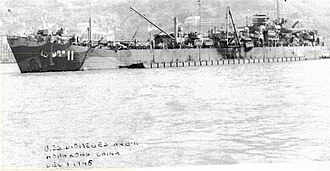
The story of Diomedes offers a valuable perspective on a part of naval history that receives less attention than major battles and famous combat ships. A modern fleet is only as effective as its ability to maintain its vessels, replace damaged equipment, and restore essential machinery when something goes wrong. During World War II, the enormous distances separating American forces in the Pacific from industrial centers on the United States mainland made those responsibilities particularly challenging. Repair ships helped address the problem by bringing specialized tools, machinery, lifting equipment, and skilled personnel closer to operational areas. Diomedes was one of the vessels developed to perform this function, and her postwar transfer to the West German Navy further demonstrates how wartime auxiliary ships could retain value after the strategic circumstances that led to their construction had changed.
The Origins of USS Diomedes
The need for specialized naval repair ships
The United States Navy’s expansion during World War II involved much more than producing combat vessels. Aircraft carriers needed escorts, amphibious forces required transports and landing craft, and the entire fleet depended on fuel, ammunition, food, replacement parts, and technical maintenance. Damage sustained during combat could make a ship unavailable even when its propulsion system and overall structure remained largely intact. Problems involving machinery, electrical systems, hull fittings, steering equipment, and other essential components could prevent a vessel from carrying out its assigned duties until repairs had been completed. Sending every damaged ship back to a major shipyard was time-consuming and potentially wasteful, especially in the Pacific, where operational areas were often separated from established repair facilities by thousands of miles of ocean. Battle damage repair ships offered a practical alternative by providing selected repair capabilities closer to the fleet.
Diomedes belonged to the Aristaeus class, a group of specialized repair vessels developed by converting tank landing ship hulls. The concept took advantage of ships already designed to carry substantial loads and operate in demanding maritime conditions. Rather than constructing an entirely new vessel for every support requirement, the Navy could adapt a suitable existing design and equip it for technical work. A converted ship could accommodate workshops, repair stores, specialized machinery, lifting equipment, and personnel trained to undertake maintenance and repair assignments. Although such a vessel could not replace a fully equipped naval shipyard or handle every kind of major structural reconstruction, it could help bridge the gap between emergency operational needs and extensive repairs requiring a large industrial facility. Diomedes was therefore part of a broader system designed to make American naval operations more sustainable across the Pacific.
From LST-1119 to ARB-11
Before she became USS Diomedes, the ship was known as LST-1119, reflecting her original designation as a tank landing ship. Vessels in this category were intended to transport military vehicles, personnel, and equipment to shore, including locations where conventional port facilities were unavailable or unsuitable for unloading. Their practical hull arrangements and ability to carry substantial loads made them useful for amphibious operations, but the Navy’s need for specialized support vessels encouraged the conversion of selected landing ships into other types of auxiliaries. LST-1119 was laid down on 19 October 1944 at the Bethlehem Steel Company’s shipyard in Hingham, Massachusetts, and launched on 11 January 1945. She was initially placed in partial commission on 23 January 1945 for the voyage to Baltimore, Maryland, where she was decommissioned on 21 February 1945 to undergo conversion into a battle damage repair ship.
The redesignation of LST-1119 as ARB-11 marked a fundamental change in the vessel’s intended purpose. Instead of primarily carrying vehicles and cargo for amphibious landings, she was to provide technical assistance to other ships. Her hull remained the foundation of the vessel, but the conversion transformed the spaces and equipment aboard into a working environment for naval maintenance and repair. This change reflected the flexibility of wartime American shipbuilding, in which standardized hull designs could be adapted to meet changing operational demands. The conversion also illustrates the distinction between a ship’s original construction category and the mission it eventually performs: although Diomedes began life as a landing ship, it was her later identity as a repair vessel that defined her historical role.
Construction and Conversion into a Repair Ship
Building Diomedes at Bethlehem Steel
Diomedes was built at the Bethlehem Steel Company’s shipyard in Hingham, Massachusetts, during the final phase of America’s wartime shipbuilding expansion. Her keel was laid on 19 October 1944, and she was launched on 11 January 1945, with Mrs. M. D. Hembree serving as the ship’s sponsor. The short period between keel-laying and launch reflected the industrial urgency of World War II, when American shipyards were producing large numbers of vessels to support operations across several theaters. Standardized construction methods allowed ships to be built efficiently, while the Navy’s ability to redirect suitable hulls toward specialized assignments helped it respond to changing requirements. For Diomedes, the initial construction process produced the physical foundation of a vessel whose eventual importance would depend less on amphibious transport than on her ability to support the maintenance of other ships.
The original tank landing ship design was a practical choice for conversion because it provided a sturdy hull with useful internal volume and the ability to carry substantial equipment. However, a repair ship required a different operational arrangement from a landing ship. Its equipment needed to support technical work rather than simply deliver cargo, and its personnel needed suitable spaces for maintenance activities, machinery, supplies, and the management of repair assignments. The conversion process in Baltimore therefore represented a major change in the vessel’s purpose, even though her basic hull and propulsion arrangement retained the characteristics of her original design. This was a recurring feature of American wartime shipbuilding: rather than treating every naval requirement as a reason to develop a completely new class of vessel, the Navy adapted proven designs when doing so offered a practical way to expand its capabilities.
Commissioning as USS Diomedes (ARB-11)
After her initial commissioning as LST-1119 on 23 January 1945, the ship proceeded toward Baltimore, where she was decommissioned on 21 February to undergo conversion. She was recommissioned as USS Diomedes (ARB-11) on 23 June 1945 under Lieutenant Commander Samuel H. P. Read Jr., United States Naval Reserve, marking her formal entry into service as a battle damage repair ship. This distinction between her initial commissioning and her later recommissioning is important when reconstructing her career, since the two dates refer to different stages in her development. The first covered her temporary naval service as a landing ship during the transfer to the conversion facility, while the second marked her readiness to undertake the specialized duties for which she became known.
The timing of her recommissioning placed Diomedes in the closing phase of the Pacific War. By the summer of 1945, American forces had established a far-reaching network of bases and anchorages throughout the Pacific, but the war’s approaching end did not eliminate the need to support ships operating in those areas. A repair vessel had to be prepared not only for its voyage across the ocean but also for the technical demands it would encounter after reaching its destination. Her crew would need to maintain the ship’s own machinery, manage equipment and stores, and coordinate repair work with other naval units. Although surviving summaries do not provide a complete account of every installation added during conversion, her classification and subsequent service clearly establish that her central purpose was to provide repair capabilities to the fleet.
Design and Technical Characteristics of USS Diomedes
Dimensions, displacement, and hull design
USS Diomedes measured approximately 328 feet (100 meters) in length, with a beam of 50 feet (15.2 meters) and a draft of about 11 feet 2 inches (3.4 meters). These dimensions gave her a substantial working platform without making her comparable in scale to a battleship, fleet carrier, or large ocean-going repair ship. Her reported light displacement was 1,781 long tons, while reference sources differ on her full-load displacement: NavSource lists 3,960 long tons, whereas the general specifications reproduced in the USS Diomedes overview list 3,700 long tons. This discrepancy is worth preserving rather than silently treating one figure as definitive, since technical summaries can reflect different conventions or records. For readers comparing vessels, the light displacement and principal dimensions provide a useful baseline, while the full-load figure should be understood as source-dependent.
The ship’s dimensions were closely connected to her practical mission. A repair vessel needed space for workshops, tools, spare parts, technical equipment, and the personnel required to operate them, while maintaining adequate stability and seaworthiness. Heavy lifting operations could place considerable demands on the ship’s deck arrangements, and equipment needed to be positioned so that work could be carried out safely and efficiently. Diomedes’s reported largest boom capacity was 50 tons, indicating that heavy lifting was part of her intended capability. That figure refers to the listed capacity of the largest boom, not a guarantee that every object of that weight could be lifted under every operating condition; actual lifting limits depend on factors such as boom position, radius, vessel stability, and the particular equipment configuration.
Propulsion and speed
Diomedes was powered by two General Motors 12-567A diesel engines, connected through reduction gearing to two propellers. The listed combined output was approximately 1,800 shaft horsepower, and published summaries generally place her maximum speed at around 11.6 to 12 knots. These figures describe a vessel designed for sustained movement and practical support work rather than rapid tactical maneuvering. A destroyer or fast combatant needed speed to escort other ships, respond to threats, and operate with formations, whereas a repair ship’s main value depended on reaching a forward base with its equipment intact and remaining useful once it arrived. The diesel-powered arrangement was consistent with the ship’s working role, balancing the demands of propulsion with the need to carry specialized machinery and supplies.
The relatively modest speed of Diomedes also illustrates why naval capability should not be judged by performance figures alone. In a fleet operating across enormous distances, a vessel that could provide repair services at a forward anchorage might save considerable time for damaged ships that would otherwise need to travel to a more distant facility. The support ship did not have to be fast enough to accompany every combat formation at full speed; it had to reach the appropriate operating area, function reliably, and provide the services that other ships required. Her propulsion system was therefore one element in a wider engineering design intended to sustain naval operations rather than directly influence the outcome of a surface engagement.
Armament and defensive equipment
Although Diomedes was not designed primarily for combat, she carried defensive weapons appropriate to the dangers facing naval vessels during World War II. Published technical records list two quadruple 40 mm anti-aircraft gun mounts and eight single 20 mm Oerlikon guns. The 40 mm Bofors and 20 mm Oerlikon weapons were widely used by Allied forces to provide short-range defense against aerial threats, although their effectiveness depended on circumstances such as the nature of the attack, firing opportunities, and coordination with other defenses. Their presence aboard Diomedes reflected the fact that auxiliary ships operating in forward areas could be exposed to the same general dangers as combatants and transports, even though their main assignments were logistical and technical.
The ship’s defensive armament should not be confused with a capacity to operate independently as a frontline warship. Her weapons offered a measure of self-defense, but her principal contribution remained the repair and maintenance of other vessels. She depended on the broader fleet for protection in dangerous waters, just as combat ships depended on auxiliary vessels for the supplies and technical assistance needed to remain operational. This division of responsibilities was characteristic of a well-organized naval force: different ships performed specialized roles, and their combined capabilities produced a fleet that was more sustainable than a collection of combatants operating without adequate support.
Crew and onboard working arrangements
NavSource lists Diomedes’s complement as 15 officers and 271 enlisted personnel, while the general USS Diomedes summary gives a total complement of 260. These figures are not identical, and the difference should be acknowledged when presenting her specifications. The larger listing totals 286 personnel, whereas the shorter figure may reflect a different summary or complement convention. In either case, the ship required a substantial workforce because she combined the ordinary responsibilities of operating a seagoing vessel with the specialized demands of a repair facility. Navigation, propulsion, electrical systems, stores, communications, and shipboard safety all required attention alongside the work of technical personnel assigned to support other ships.
The onboard organization of a repair ship had to be capable of responding to changing workloads. Some periods might be devoted primarily to maintaining the vessel itself and preparing equipment for use, while others could involve more intensive repair assignments for ships arriving at an anchorage. The crew needed to coordinate the movement of materials, maintain tools and machinery, and ensure that repair work did not compromise the safety or operation of their own ship. Although detailed staffing records for every department are not included in the commonly accessible summaries, the vessel’s classification and listed complement indicate the importance of human expertise to her mission. Diomedes was not simply a floating warehouse: she was intended to provide an organized technical service, and the skills of her personnel were central to making that service useful.
USS Diomedes in the Pacific Theater
Arrival at Okinawa in September 1945
After completing conversion and preparation, Diomedes deployed to the Pacific and arrived at Okinawa on 25 September 1945. Her arrival came several weeks after Japan announced its intention to surrender and less than a month after the formal surrender ceremony aboard USS Missouri on 2 September. Although major combat operations had ended, American naval forces still faced extensive responsibilities across East Asia, including the occupation of former enemy territories, the movement of personnel and supplies, and the maintenance of vessels stationed throughout the region. Okinawa had become an important American base following the intense campaign earlier in 1945, and its strategic location made it a useful staging point for operations across the western Pacific. Diomedes’s arrival placed her within this postwar network of bases and support facilities.
The timing of her deployment is important because it demonstrates that the Navy’s repair requirements did not disappear with the end of the war. Ships still needed maintenance after months or years of strenuous operations, and occupation duties required vessels to remain available for transport, patrol, communications, and other assignments. Repair ships could help sustain these activities by providing technical services closer to the locations where vessels were stationed. Diomedes was therefore entering a theater in transition, where the urgent requirements of wartime operations were gradually giving way to the more complex demands of occupation and postwar administration. Her service was part of the process of maintaining a large naval presence while the region moved from war toward an uncertain peace.
Departure for Hong Kong and repair operations
On 3 October 1945, Diomedes departed Okinawa for Hong Kong to provide repair services. Hong Kong was a major port with considerable maritime importance, and its position on the southern coast of China made it a useful location for naval activities in the region. The ship’s assignment there reflects the practical logic behind forward repair vessels: rather than keeping every ship close to a major American naval shipyard, the Navy could position specialized support capabilities in locations where vessels and equipment needed attention. A repair ship could provide an intermediate level of technical assistance, potentially allowing some problems to be addressed without sending the affected vessel on a long voyage elsewhere.
The historical record identifies Diomedes’s mission at Hong Kong as repair service, but the readily available summaries do not provide a complete itemized account of every vessel she assisted or the precise nature of every job undertaken. It is therefore better to describe her contribution in terms of her documented assignment than to attribute particular repairs to her without evidence. Even so, the location and purpose of the deployment reveal how auxiliary ships supported the wider naval organization. The arrival of a repair vessel could make a port more useful as a support center, especially when technical assistance was required for vessels operating far from their home bases. In this way, Diomedes helped represent the less visible infrastructure behind naval activity in East Asia after the war.
Operations at Keelung and Taku
Diomedes departed Hong Kong on 8 December 1945, called at Keelung—then commonly known in English-language records as Kiirun—on Taiwan, and arrived at Taku in northern China on 19 December. She continued repair work there until departing on 20 March 1946. This sequence of movements demonstrates the geographical reach of her postwar service, taking her from Okinawa to Hong Kong and onward to locations farther north along the East Asian coast. The journey also placed her in a region where the end of the Pacific War had left extensive military and logistical responsibilities, and where the Navy continued to maintain a presence while personnel and equipment were moved, ships were serviced, and occupation-related activities proceeded.
Keelung and Taku occupied different positions within the region’s maritime network, and the ship’s movement between them illustrates the mobility expected of an auxiliary repair vessel. Although she operated at a relatively modest speed, she could relocate her technical capabilities to where they were needed rather than remaining tied permanently to a single facility. Taku, near the approaches to Tianjin in northern China, was particularly relevant to maritime access in the region, while Keelung served as an important port on Taiwan. The historical sources establish that Diomedes visited these locations, but they do not justify assuming that her duties were identical at every stop. What can be said with confidence is that she continued repair work during this period, supporting the wider naval presence as the immediate wartime emergency gave way to postwar operations.
The importance of service after the surrender
The months following Japan’s surrender are sometimes treated as an epilogue to World War II, but for many naval personnel and support vessels they remained a demanding period of active duty. Ships needed to be maintained, personnel had to be transported, bases required supplies, and naval authorities had to manage operations over a wide geographic area. The conclusion of organized combat changed the purpose of many deployments without eliminating their practical difficulties. Repair vessels such as Diomedes were valuable because they could help keep ships functional during this transition, when the Navy was still operating far from its home ports and had not yet completed the process of reducing its wartime commitments.
Diomedes’s deployment also illustrates the difference between a ship’s formal wartime classification and the actual conditions in which it served. Although designated a battle damage repair ship, she was deployed after the main fighting had ended, when her capabilities could contribute to the broader maintenance needs of the occupation-era fleet. The underlying requirement remained similar: ships needed technical assistance, and forward repair capacity helped provide it. Her service at Okinawa, Hong Kong, and Taku is therefore significant not because it culminated in a famous battle, but because it demonstrates the continued relevance of naval engineering and logistics during a major historical transition.
The Return to the United States
Leaving China in March 1946
After completing her assignment at Taku, Diomedes departed on 20 March 1946 and began the journey back to the United States. Her return voyage included a stop at Pearl Harbor, Hawaii, before she reached Charleston, South Carolina, on 28 May 1946. She subsequently arrived in Jacksonville, Florida, on 2 June. The voyage marked the conclusion of her principal overseas assignment as an American repair ship, following several months of service in the western Pacific and East Asia. Her movements also illustrate the enormous distances that auxiliary vessels could cover during a deployment: Diomedes had crossed the Pacific, worked from several forward locations, and then returned to the American East Coast by way of Hawaii.
The return voyage was part of a broader reduction in America’s wartime naval commitments. With Japan defeated, the United States no longer needed to sustain its Pacific fleet at the same wartime scale, although occupation responsibilities and other overseas missions continued. Ships were gradually reassigned, placed in reserve, or prepared for disposal as the Navy adjusted to peacetime requirements. Diomedes’s journey home therefore represented both the end of a specific deployment and the beginning of a new stage in the vessel’s career. The repair ship had fulfilled her documented assignment in the Pacific, and the Navy now had to decide how she would fit into the postwar fleet.
Decommissioning and reserve status
On 3 December 1946, USS Diomedes was decommissioned at Jacksonville, Florida, and placed in the Atlantic Reserve Fleet. Her active American service had lasted only a relatively short period after her conversion, reflecting the timing of her completion near the end of the Pacific War and the rapid demobilization that followed. The Navy had acquired the vessel for a specific wartime purpose, but the strategic situation changed before she could accumulate a lengthy record of active repair operations. Her decommissioning did not mean that the ship was immediately scrapped or permanently rendered unusable; rather, she entered a reserve system through which the Navy retained vessels that might have future value or could be maintained without the full costs of continuous active service.
Reserve fleets played an important role in the transition from wartime mobilization to peacetime naval planning. Keeping ships in reserve allowed the Navy to reduce operating expenses while preserving some of the vessels, equipment, and capabilities accumulated during the war. However, reserve status also introduced uncertainty about a ship’s future. Some vessels were eventually reactivated, others were transferred to allied or partner navies, and many were sold or scrapped as their usefulness declined. Diomedes remained outside active American service for years, but her later transfer to West Germany demonstrates that her career was not yet over. A vessel that no longer matched the immediate requirements of the United States Navy could still offer useful capabilities to another naval organization.
From USS Diomedes to Wotan (A513)
Transfer to the West German Navy
On 7 June 1961, the former USS Diomedes was transferred to West Germany and renamed Wotan, receiving the hull designation A513. Her new name came from Wotan, the Germanic counterpart associated with Odin in Norse and Germanic mythology. The transfer placed the vessel in a different political and strategic environment from the one in which she had been built. In the years after World War II, West Germany was rebuilding its armed forces within the framework of its new democratic state and its relationship with Western defense institutions. Older American vessels offered a way to acquire useful naval capabilities without the time and expense of building every auxiliary ship from scratch.
The transfer was also an example of the long-term usefulness of specialized naval vessels. Although Diomedes had been designed around the requirements of American wartime operations, her basic function as a support ship remained relevant in a postwar navy. Auxiliary vessels did not need the most advanced weapons or the highest speeds to provide value; they needed reliable machinery, suitable equipment, and the ability to perform practical tasks in support of other ships. The change from Diomedes to Wotan therefore represented more than a new name. It marked the vessel’s transition from an American World War II auxiliary to a ship serving the developing maritime requirements of another country during the Cold War.
Commissioning and service as Wotan
Although Wotan was transferred to West Germany in 1961, the transfer date should not be confused with the date on which she entered commissioned German service. Published ship summaries list her German commissioning as 20 January 1966, several years after the transfer. The distinction matters because acquisition, preparation, refitting, and formal commissioning are separate stages in a ship’s administrative and operational history. Wotan’s later career demonstrates that a transfer did not necessarily mean immediate entry into fully operational service, especially when a vessel required preparation for the procedures and responsibilities of a new navy.
The former Diomedes remained in German naval service for decades, with the commonly cited chronology listing her decommissioning on 23 August 1991. This extended career stands in contrast to her relatively brief period of active service under the American flag. Her longevity highlights how the service life of a naval vessel can depend on its role, maintenance, and the needs of the navy operating it. A ship may become surplus to one fleet’s requirements while remaining useful elsewhere, particularly when it performs a specialized support function rather than competing directly with newer frontline combatants. Wotan’s service also connects the industrial mobilization of World War II with the later history of West German naval development.
What happened to Wotan after 1991?
The final disposition of the former USS Diomedes is less straightforward than her American and German service dates. Some secondary accounts state that Wotan was used for training and public events associated with the Bundeswehr after her decommissioning, while other summaries simply record her final fate as unknown. These accounts do not establish a sufficiently clear, independently verified sequence to state confidently whether the ship survives today, when she was finally disposed of, or what ultimately happened to her hull. The most responsible conclusion is therefore that Diomedes was decommissioned from German naval service in 1991, while her subsequent physical fate remains uncertain in the available ship histories.
This uncertainty is not unusual for older auxiliary ships. Major combat vessels often attract extensive historical documentation because of their involvement in important battles, their technological significance, or their association with well-known commanders. Support ships may leave a less complete paper trail, particularly after they are transferred, converted, placed in reserve, or used for secondary purposes. In Diomedes’s case, the known chronology already provides a substantial history: construction during World War II, conversion into a repair ship, service across East Asia, return to the United States, reserve status, and eventual transfer to West Germany. The uncertain details of her final disposition do not diminish the importance of that documented career.
The Meaning Behind the Name Diomedes
The Greek hero of the Trojan War
The name Diomedes comes from Greek mythology. Diomedes of Argos was a prominent hero of the Trojan War, celebrated in Homer’s Iliad for his courage and prowess in battle. In the epic tradition, he is among the leading Greek warriors and plays an important role in the fighting outside Troy. His name therefore carried associations with military determination and heroic achievement, making it appropriate to the naming traditions of a navy that frequently drew upon classical mythology and historical figures when identifying its ships. USS Diomedes was the only United States Navy vessel to bear this name, according to the commonly cited ship history.
There is an interesting contrast between the legendary figure and the ship that carried his name. The mythological Diomedes is remembered for direct action on the battlefield, whereas the naval vessel named after him performed a specialized support role. Her contribution came through technical work, maintenance, and the practical task of keeping other ships available for duty. This contrast highlights the breadth of naval service: the names of heroes and warriors were not reserved exclusively for ships whose main purpose was combat. A repair vessel could carry a distinguished name while serving a mission that depended on engineering, discipline, and endurance rather than direct engagement with an enemy.
The significance of changing the ship’s name
When the vessel became Wotan in German service, her identity changed to reflect the traditions of her new navy. Such renaming was common when vessels were transferred between countries, since the receiving navy could assign names and designations consistent with its own customs. The transition from Diomedes to Wotan also reflects the ship’s movement between different historical and cultural contexts: she began as an American landing ship, became an American repair vessel, and later served West Germany as an auxiliary under a name drawn from Germanic mythology.
The ship’s changing names provide a useful framework for understanding her full career. Searching only for USS Diomedes reveals the American phase, while records under Wotan (A513) are needed to follow the vessel into German service. Historians and readers researching naval auxiliaries should therefore account for changes in hull number, national ownership, and vessel name when tracing a ship’s history. These details are particularly important for vessels that survive long enough to move between fleets, because their later service may be documented in a different country’s archives and historical publications.
Why USS Diomedes Matters in Naval History
The overlooked importance of repair vessels
USS Diomedes demonstrates that the strength of a navy depends on more than the number or quality of its combat ships. Warships operate in demanding environments, and their machinery, electrical systems, hull structures, and auxiliary equipment require continuous attention. Battle damage can create urgent repair requirements, but even ships that have not suffered direct enemy action may develop mechanical failures or defects that reduce their availability. Repair ships helped address these challenges by providing technical assistance near operational areas, potentially reducing the time and distance associated with returning to major shipyards. Their value lay in preserving the effectiveness of the larger force rather than in achieving individual combat victories.
This support function was especially relevant to American operations across the Pacific. The distances between the United States mainland, Hawaii, the Marianas, Okinawa, and the ports of East Asia created a formidable logistical challenge. A ship that needed repair could not always return quickly to a large industrial facility, and a prolonged absence could affect the readiness of the wider force. By placing repair capabilities closer to operating areas, the Navy could strengthen the resilience of its logistics network. Diomedes’s documented service at Okinawa, Hong Kong, and Taku reflects this strategy, even though surviving summaries do not provide a complete list of the ships she repaired or a detailed inventory of every job she performed.
The relationship between logistics and naval power
Naval logistics is often less visible than combat, but it is fundamental to sustained military operations. Ships require fuel, food, ammunition, spare parts, trained personnel, and access to repair facilities. If any of these elements becomes unavailable, a vessel may be unable to fulfill its assigned role, regardless of its armament or technical sophistication. Repair ships formed one part of the network that kept the fleet functioning by enabling certain maintenance tasks to be carried out closer to the ships that needed them. They did not eliminate the need for large naval shipyards, but they helped distribute repair capabilities across the theater and reduce dependence on a small number of distant facilities.
Diomedes also illustrates the importance of using vessels for missions that match their design and equipment. Her relatively low speed and defensive armament were appropriate to a support role, where carrying equipment and providing technical services mattered more than high-speed maneuvering or offensive firepower. This distinction reminds us that naval effectiveness is not simply a competition between the fastest or most heavily armed ships. A fleet becomes more capable when its individual units perform complementary functions, allowing combatants, transports, tankers, repair ships, and other auxiliaries to support one another as part of a coordinated system.
From wartime mobilization to Cold War service
The vessel’s later career as Wotan adds another layer to her historical importance. She was constructed during a global war, placed in reserve during the postwar reduction of American forces, and eventually transferred to a West German navy operating in a new strategic environment. This sequence reflects the broader changes in international security during the middle decades of the twentieth century, when the military infrastructure created during World War II was reorganized to meet the demands of the Cold War. Older ships did not always become obsolete immediately after the conflict that produced them; some continued to offer useful capabilities for years or decades under different ownership.
The transfer of Diomedes also demonstrates how naval history extends beyond the boundaries of a single country. A ship’s construction may belong to one nation’s industrial history, its wartime service to another period of military operations, and its later career to the defense policies of a different state. Following the vessel from LST-1119 to USS Diomedes and then Wotan produces a fuller understanding of its historical significance than focusing on only one stage. Her career is a reminder that ships are long-lived industrial assets whose roles can evolve as political circumstances, military requirements, and maintenance needs change.
Summary Table of USS Diomedes Technical Specifications
The following table summarizes the commonly published technical particulars of USS Diomedes (ARB-11) during her American service. Some reference sources differ on full-load displacement, total crew complement, and maximum speed, so those variations are identified rather than presented as a single unquestionable figure. The technical data is drawn primarily from NavSource’s ship record and the published USS Diomedes overview.
| Specification | Details |
|---|---|
| Official U.S. Navy name | USS Diomedes |
| Hull number | ARB-11 |
| Original designation | LST-1119 |
| Ship type | Battle damage repair ship |
| Class | Aristaeus class |
| Original hull type | Tank landing ship |
| Builder | Bethlehem Steel Company |
| Shipyard location | Hingham, Massachusetts, USA |
| Keel laid | 19 October 1944 |
| Launched | 11 January 1945 |
| Initial commissioning | 23 January 1945 |
| Decommissioned for conversion | 21 February 1945 |
| Recommissioned as ARB-11 | 23 June 1945 |
| U.S. Navy decommissioning | 3 December 1946 |
| Transferred to West Germany | 7 June 1961 |
| Later name | Wotan |
| German hull designation | A513 |
| German commissioning | 20 January 1966 |
| German decommissioning | 23 August 1991 |
| Light displacement | 1,781 long tons (approximately 1,810 metric tonnes) |
| Full-load displacement | 3,700–3,960 long tons, depending on source |
| Overall length | 328 ft (approximately 100 m) |
| Beam | 50 ft (approximately 15.2 m) |
| Draft | 11 ft 2 in (approximately 3.4 m) |
| Main engines | 2 × General Motors 12-567A diesel engines |
| Combined power output | Approximately 1,800 shaft horsepower |
| Transmission | Main reduction gearing |
| Propulsion | 2 propellers |
| Maximum reported speed | Approximately 11.6–12 knots |
| Listed complement | 260–286 personnel, depending on source |
| Officers | 15, according to NavSource |
| Enlisted personnel | 271, according to NavSource |
| Main defensive armament | 2 quadruple 40 mm anti-aircraft gun mounts |
| Additional defensive armament | 8 single 20 mm Oerlikon guns |
| Largest reported boom capacity | 50 tons |
| Primary wartime role | Repairing and maintaining damaged ships |
| Principal documented operating locations | Okinawa, Hong Kong, Keelung, Taku |
| Return to the United States | May–June 1946 |
| Final known service identity | Wotan (A513), West German Navy |
| Ultimate physical fate | Uncertain in available summaries |
Technical note: The full-load displacement and complement figures vary among published summaries. The table retains those differences to avoid implying greater precision than the available records support.
Conclusion
USS Diomedes (ARB-11) was a specialized naval support vessel whose importance lay in helping maintain the operational effectiveness of American forces during the final stages of World War II and the immediate postwar period. Built originally as LST-1119, she was converted into an Aristaeus-class battle damage repair ship and commissioned in June 1945. Her deployment to Okinawa, Hong Kong, and Taku placed her within the network of forward bases and ports that supported American naval operations across East Asia. Following her return to the United States in 1946, she was decommissioned and placed in reserve, but her career continued when she was transferred to West Germany in 1961 and subsequently served as Wotan (A513) until 1991.
Her history provides a useful example of the essential but often overlooked role played by auxiliary vessels. Diomedes was not designed to dominate a naval engagement through speed or firepower; she was intended to help other ships remain functional by providing repair capabilities closer to the fleet. Her conversion, deployment, postwar reserve status, and eventual transfer to another navy illustrate how military vessels can serve changing requirements across different historical periods. Although the available records leave some questions about her final disposition and differ on a few technical particulars, the broader chronology is clear. USS Diomedes remains a meaningful example of the relationship between naval engineering, logistics, and sustained maritime power.
_at_anchor_in_Hong_Kong_Harbor,_1_December_1945.jpg)