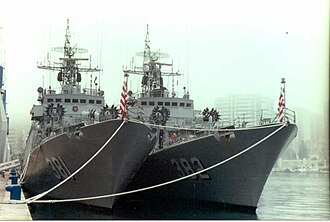
The vessel is particularly interesting because its original design reflects a specific Cold War problem: the need to detect and engage submarines operating near the coastline and in restricted maritime environments. The East German Navy, known as the Volksmarine, needed ships capable of contributing to the defense of the Baltic Sea and its approaches, where geography, submarine activity, and the proximity of opposing forces made coastal anti-submarine warfare an important mission. After German reunification, a large number of former East German naval vessels became available for transfer or sale. Indonesia acquired several Parchim-class corvettes as part of its efforts to expand the fleet, and these ships subsequently served in a maritime environment very different from the Baltic for which they had originally been conceived. Tjiptadi entered Indonesian service on 10 May 1996, received pennant number 381, and took its name from Captain Ciptadi, an Indonesian naval officer remembered in connection with the Battle of the Aru Sea in 1962. Published reference sources list the ship as an active Indonesian Navy vessel, although current operational status should always be checked against the latest official naval announcements.
The Origins of the Parchim-Class Corvette
East Germany’s Cold War naval requirements
The Parchim-class corvette was developed during the Cold War, when East Germany’s position on the Baltic Sea placed it within a strategically sensitive maritime region. The Baltic is characterized by narrow passages, variable depths, extensive coastal areas, and significant commercial and military traffic. These conditions shaped the requirements of regional naval forces, which needed to monitor approaches, protect maritime routes, and prepare for the possibility of submarine operations in confined waters. For East Germany, a fleet of smaller anti-submarine ships offered a way to strengthen coastal defense without relying exclusively on larger and more expensive combatants. A compact corvette could patrol near the coast, cooperate with other ships, investigate underwater contacts, and use specialized weapons against submarines if required. It could also contribute to training and routine surveillance during periods when a major naval confrontation was not taking place. The Parchim design emerged from this strategic environment, combining relatively modest dimensions with propulsion and armament intended to make the vessel useful in the demanding but geographically restricted waters of northern Europe.
Project 133.1 and construction at Peene-Werft
The class is commonly associated with East Germany’s Project 133.1 designation and was built at Peene-Werft in Wolgast. Its size placed it between a small patrol vessel and a much larger frigate, with sufficient internal space for a naval crew, propulsion machinery, sensors, and a specialized weapons suite. A Parchim-class ship measures approximately 75.2 metres in length and 9.78 metres in beam, while its published displacement is generally given as around 865 tonnes standard and 935 tonnes at full load. Those figures describe a compact platform, but one capable of carrying multiple weapons systems, including a twin-barrel 57 mm naval gun, close-range guns, anti-submarine rocket launchers, and, in the original configuration, torpedo tubes. The class also incorporated radar and sonar equipment intended to support navigation, surface surveillance, and underwater detection. Rather than trying to match the full capabilities of a large ocean-going combatant, the design concentrated on a narrower mission set and aimed to provide a useful combination of speed, weapons, and sensors in a relatively small hull. That specialization would later influence both the strengths and the limitations of the ships when they were transferred to Indonesia.
From Bergen to KRI Tjiptadi
The vessel’s early service in East Germany
Before entering Indonesian service, the ship was known as Bergen and carried the East German hull number 213. Reference sources record its commissioning into the East German Navy on 10 February 1985, during the final years of the Cold War. Its original duties were associated with the defensive maritime strategy of the Volksmarine, which operated in a region where submarine detection and coastal security were significant naval priorities. Bergen would have formed part of a broader system of maritime defense rather than operating as an isolated warship: naval vessels, shore facilities, sensors, and other military assets were expected to contribute to a shared picture of activity at sea. The ship’s anti-submarine equipment was central to that role, because the ability to identify and track underwater contacts could help a naval force protect its own ships and respond to potential submarine threats. Its commissioning also came at a time when East Germany’s naval organization was preparing for a strategic environment that would soon change dramatically. The political upheavals of 1989 and German reunification in 1990 ended the state structure for which the ship had originally been built, and the future of the East German fleet consequently shifted from Cold War readiness toward disbandment, reassignment, and disposal.
Transfer to the Indonesian Navy
After German reunification, Indonesia became one of the foreign recipients of former East German naval equipment. The transfer of Parchim-class corvettes provided an opportunity to expand the Indonesian fleet with ships that already existed, rather than waiting for new vessels to be designed, built, and delivered. Bergen was transferred and prepared for Indonesian service, eventually receiving the name KRI Tjiptadi and pennant number 381. The vessel was commissioned into the Indonesian Navy on 10 May 1996, alongside another former East German corvette, Güstrow, which became KRI Hasan Basri. The change of operator required more than a simple alteration of markings: the Indonesian Navy had to incorporate the ship into its command arrangements, train personnel on its equipment, establish maintenance practices, and obtain the spare parts and technical support needed to sustain the vessel. The ship’s original weapons and sensors had been developed for a different navy and a different operating environment, so its long-term usefulness depended on how effectively those systems could be maintained and integrated into Indonesia’s broader fleet. Its transfer represented a practical way to obtain additional hulls, but it also brought the usual challenges associated with keeping older foreign-built military equipment operational.
The Meaning and Legacy of the Name Tjiptadi
Honoring Captain Ciptadi
The name Tjiptadi is associated with Captain Ciptadi, an Indonesian naval officer remembered for his death during the Battle of the Aru Sea on 15 January 1962. The confrontation occurred during the campaign over West New Guinea, when Indonesian naval forces faced Dutch warships in waters near the Aru Islands. The Indonesian patrol boat RI Matjan Tutul was lost during the engagement, and Commodore Yos Sudarso and other Indonesian personnel died. Captain Ciptadi is commemorated in Indonesian naval accounts as one of the officers who lost his life in that action. Naming a warship after him places the vessel within a tradition of honoring naval personnel whose service has become part of the nation’s military memory. Such names give a ship a historical identity beyond its hull number or technical classification, linking the daily work of the serving crew with earlier generations of sailors who faced different circumstances but shared the responsibility of serving the country at sea.
Why naval names matter
Warship names often serve several purposes at once: they commemorate national figures, preserve historical events, and express the values a navy wishes to associate with its service. For Indonesia, a country whose territory consists of thousands of islands, naval history has a particularly close relationship with sovereignty, maritime access, and national unity. A ship named for a fallen officer becomes a floating reminder of that history, visible during port visits, training exercises, patrols, and official ceremonies. The name does not change the ship’s design or improve its equipment, but it shapes the meaning attached to its service and gives the crew a point of connection with the institution’s past. In Tjiptadi’s case, the contrast between its European construction and Indonesian namesake is especially notable. Its physical origins lie in the Cold War shipbuilding industry of East Germany, while its identity in Indonesian service is linked to a national naval figure and the history of Indonesia’s own maritime struggles.
Design and Physical Characteristics
Hull dimensions and displacement
KRI Tjiptadi is a relatively compact warship, with a published overall length of approximately 75.2 metres, a beam of around 9.78 metres, and a draft of roughly 2.65 metres. Reference sources commonly list its standard displacement as 865 tonnes and its full-load displacement as 935 tonnes, although some Indonesian reference listings provide lower figures, illustrating that the published data are not entirely uniform. These dimensions make the vessel considerably smaller than a modern frigate, but its size was deliberately suited to the mission for which the Parchim class was created. A smaller hull can be easier to operate in some coastal environments and requires fewer resources than a larger combatant, while still providing room for substantial propulsion machinery, a crew, sonar, radar, and dedicated anti-submarine weapons. Its physical arrangement reflects the priorities of a specialized Cold War warship rather than those of a modern multirole vessel designed from the outset to accommodate extensive missile systems, large helicopters, and multiple layers of air defense.
Seaworthiness and the limits of a compact warship
A ship’s length and displacement provide useful clues about its capabilities, but they do not tell the whole story of how it performs at sea. Seaworthiness depends on hull design, stability, loading, weather conditions, and the vessel’s ability to operate safely and effectively over time. For a compact corvette, the available internal volume places constraints on fuel, stores, accommodation, mission equipment, and the size of any later modernization package. Compared with a larger frigate, Tjiptadi has less space for additional systems and fewer opportunities to expand its capabilities without affecting weight distribution or other aspects of the original design. Its relatively shallow draft was appropriate to the class’s coastal operating concept, but it does not mean that the ship could operate without limitations in every maritime environment. The waters around Indonesia present a different set of conditions from the Baltic Sea, including tropical weather, long distances between some ports, and the need to move among numerous island groups. The ship’s actual usefulness in these waters therefore depends on maintenance, operational planning, crew readiness, and the conditions in which it is deployed, not simply on the dimensions listed in a specification sheet.
Propulsion, Speed, and Operational Range
Diesel propulsion and three propellers
Published technical records for KRI Tjiptadi commonly describe its propulsion system as three M-504A-series diesel engines, each rated at approximately 4,750 horsepower, for a combined output of about 14,250 horsepower. These engines are associated with three fixed-pitch propellers, providing the thrust needed for the ship to achieve a reported maximum speed of approximately 24.5 knots. It is worth noting that reference sources on the wider Parchim class also report different machinery arrangements for particular ships, so the three-engine description should be understood as the commonly published specification for Tjiptadi rather than assumed to apply to every vessel in the class. Diesel propulsion is well suited to a ship of this size because it provides substantial power without requiring a large steam propulsion plant. The combination of multiple engines and propellers was intended to support the vessel’s need to maneuver, accelerate when necessary, and move rapidly between patrol areas. As with any aging warship, however, a published maximum speed is a design reference rather than proof of the speed the ship can achieve today; actual performance depends on engine condition, maintenance, hull fouling, loading, and sea conditions.
Range and endurance at sea
Commonly listed figures give Tjiptadi a range of approximately 2,100 nautical miles at 14 knots, while some secondary accounts provide a different range based on a lower cruising speed. Such differences are not necessarily contradictory because range changes with speed, loading, weather, and the condition of the propulsion plant. In naval operations, range must also be distinguished from endurance. A ship may have sufficient fuel to cover a considerable distance, yet still need to return to port or receive support because of provisions, maintenance requirements, crew fatigue, or the need to replenish supplies. These considerations are particularly relevant for Indonesia, where a naval unit may be required to travel between widely separated island groups and operate far from its usual maintenance facilities. The Parchim class was originally designed for regional operations in the Baltic, so its transfer to Indonesia introduced a different set of logistical demands. Its range could support patrols and movements between operating areas, but the practical length of a mission would depend on the availability of fuel, spare parts, port facilities, and the wider support network provided by the Indonesian Navy.
Armament and Combat Systems
The twin 57 mm AK-725 naval gun
One of the principal weapons associated with KRI Tjiptadi is the twin-barrel 57 mm AK-725 naval gun. The system was part of the original Parchim-class weapons arrangement and is listed in descriptions of the Indonesian ship as well. A 57 mm gun provides a medium-calibre direct-fire capability that can be used against surface targets and, within its limits, certain aerial threats. Its significance lies partly in its flexibility: unlike a weapon designed for only one specialized purpose, a naval gun can be used in a range of circumstances where a direct-fire response is appropriate. Its effectiveness nevertheless depends on the gun’s condition, fire-control equipment, ammunition, target information, and the training of the personnel operating it. A twin-barrel arrangement allows the system to fire from two barrels, but that feature alone does not establish the weapon’s accuracy or effectiveness against any particular modern threat. The gun is best understood as one component of a compact combat system, supporting the vessel’s broader duties rather than making it equivalent to a larger missile-armed combatant.
The 30 mm AK-230 close-range gun
The ship’s commonly reported Indonesian configuration also includes a twin 30 mm AK-230 gun. This weapon was designed for close-range defense, particularly against aerial targets within its engagement envelope, and formed part of the original Soviet-influenced weapons arrangements used by several Cold War naval forces. A rapid-firing gun of this type can provide a useful defensive layer against targets that come within range, but it is not a substitute for a modern, integrated air-defense system. The ability to engage a threat successfully depends on detection, tracking, fire control, reaction time, and the characteristics of the target. The gun also requires continued maintenance and a reliable supply of compatible ammunition, particularly when operated long after its original production period. As with the ship’s other inherited equipment, the presence of the AK-230 in published specifications should not be interpreted as definitive proof of its present operational condition. Open-source listings usually describe a reported configuration at a particular point in time, and equipment can be changed, removed, or rendered unavailable during a vessel’s service life.
Denel GI-2 20 mm guns
Some technical summaries of Tjiptadi’s Indonesian configuration list two Denel GI-2 20 mm guns in addition to the main 57 mm gun and the twin 30 mm system. The GI-2 is a South African-designed 20 mm cannon, and its appearance in the ship’s reported armament illustrates how equipment from different national suppliers can coexist aboard a vessel originally constructed in East Germany. Smaller-calibre guns can be useful for close-range surface engagements, warning or security duties, and other situations in which a larger weapon may not be necessary or appropriate. Their presence can also provide a degree of flexibility when a ship is conducting routine maritime patrols rather than operating in a high-intensity combat environment. However, publicly available records do not always make it clear whether every listed weapon was installed simultaneously, whether all remained operational throughout the ship’s career, or whether the published information reflects different modernization periods. It is therefore more accurate to describe these guns as part of the reported Indonesian fit than to claim that every secondary source establishes the ship’s exact current configuration.
RBU-6000 anti-submarine rocket launchers
The RBU-6000 anti-submarine rocket launcher is one of the most important weapons associated with the Parchim class because it directly reflects the ship’s original anti-submarine warfare role. The system is designed to launch a salvo of rocket-propelled anti-submarine munitions into a predicted area where an underwater target may be located. This makes it fundamentally different from a conventional gun, which is generally aimed at a visible or otherwise tracked target above the water. Anti-submarine weapons depend on a chain of information and decisions: the ship must first detect a possible contact, interpret the available sensor data, establish a useful estimate of the target’s position, and determine an appropriate response. The launcher then provides a means of attacking the estimated target area. The system’s usefulness consequently depends not just on the launcher itself, but also on sonar performance, the crew’s experience, tactical coordination, ammunition availability, and the condition of the associated equipment. The RBU-6000’s inclusion in Tjiptadi’s reported armament is a reminder that the vessel was designed first and foremost around a specific naval mission rather than as a general-purpose surface combatant.
Torpedo tubes and reported differences in configuration
The original Parchim-class configuration is commonly described as carrying four 400 mm torpedo tubes. However, published descriptions of Tjiptadi’s Indonesian armament do not always list torpedo tubes, and some accounts emphasize its gun armament and anti-submarine rocket launchers instead. This difference is important because a class-wide specification does not automatically establish the exact weapons fitted to every individual ship after years of service and modification. Torpedo systems also involve more than the visible launch tubes: the ship needs compatible weapons, appropriate control equipment, maintenance support, and personnel trained to operate the system. If a particular configuration is no longer supported or its weapons are unavailable, the presence of the original launch arrangement does not necessarily translate into a usable combat capability. For this reason, the safest description is that torpedo tubes were part of the original class design, while the exact operational torpedo fit of Tjiptadi should be treated cautiously unless supported by a reliable ship-specific record. This distinction helps avoid presenting a historical or generic specification as an unquestionable description of the vessel’s condition at every stage of its Indonesian career.
Sensors and Anti-Submarine Warfare
Sonar and the search for underwater contacts
For a corvette built around anti-submarine warfare, sonar is as important as its weapons. Submarines can remain submerged, reduce their exposure, and exploit underwater conditions to make detection difficult. A ship’s sonar system helps operators listen for acoustic signals or, depending on the equipment and mode, transmit sound and analyze the returning echoes. The resulting information can help the crew identify and track possible underwater contacts, although interpreting sonar data requires experience because the sea contains many sources of noise. Commercial traffic, marine life, water layers, seabed conditions, and the vessel’s own machinery can all affect what the operators hear and how confidently they can classify a contact. The Parchim class was designed with underwater detection as a central mission requirement, and Tjiptadi’s historical sensor listings include sonar equipment associated with that role. Yet sensor capability cannot be evaluated from a system name alone: equipment condition, calibration, operator training, and the tactical circumstances all affect practical performance. An older sonar system can remain useful for certain duties, but its capabilities must be considered in relation to the demands of modern underwater warfare and the support available to keep it working.
Radar and surface surveillance
Radar provides the ship with a complementary view of the maritime environment. While sonar is primarily associated with underwater detection, radar helps identify and track surface contacts and can contribute to awareness of aircraft, depending on the system and circumstances. It is also important for routine navigation, collision avoidance, and the safe movement of the vessel through busy waters. These functions matter even when the ship is primarily assigned to anti-submarine duties, because it must operate around merchant vessels, fishing fleets, other naval ships, and coastal traffic. Indonesian reference material has associated Tjiptadi with radar systems including the MR-302, also known as Strut Curve, and the MR-123 Vympel/Muff Cob fire-control radar. These names indicate the type of equipment historically associated with the ship, but they should not be taken as confirmation that every system remains fitted and fully operational today. Radar equipment can become outdated, be replaced during refits, or require maintenance that affects availability. As with the weapons, the ship’s true capability depends on the condition and integration of its systems rather than simply the number of sensor names listed in an online specification.
The Role of KRI Tjiptadi in the Indonesian Navy
Patrols and maritime security
Indonesia’s geography creates a complex set of maritime security responsibilities. The country stretches across a vast archipelago, with important commercial sea routes, coastal communities, ports, fisheries, and maritime economic zones spread across many islands. A navy operating in this environment needs a mixture of ships rather than a fleet consisting entirely of large combatants. Smaller vessels can be assigned to routine patrols, training, presence missions, and cooperation with other units, allowing larger and more expensive warships to focus on tasks that require greater endurance or more sophisticated combat systems. A corvette such as Tjiptadi can contribute to this mix by providing a platform for maritime presence and naval operations within the limits of its design, condition, and assigned mission. It should not be assumed that every patrol involves a combat encounter; much of naval activity consists of maintaining readiness, exercising, monitoring maritime areas, and demonstrating the ability to operate at sea. The ship’s historical value therefore lies partly in the range of duties it can support as part of a wider organization, rather than in any single weapon or headline specification.
Training and cooperation with other naval units
Naval effectiveness depends on more than the technical performance of individual ships. Communications, bridge procedures, watchkeeping, maintenance discipline, tactical coordination, and the ability to follow common operating procedures are all important parts of effective service. A corvette may participate in exercises with other Indonesian vessels, carry out training activities, and work within a formation where each ship has a different role. Such activities help crews maintain proficiency and allow commanders to assess how individual vessels contribute to a broader mission. They also provide opportunities to practice coordination between ships and other military assets. In this context, a ship’s age does not automatically make it irrelevant, but it does mean that the nature of its contribution should be assessed realistically. A legacy corvette may remain useful for selected tasks if its machinery, sensors, and weapons are adequately maintained, while being less suitable for missions that demand the newest air-defense, anti-ship, or anti-submarine technology. The value of Tjiptadi is therefore best understood as part of Indonesia’s broader naval force structure, where the availability of a vessel and the mission assigned to it are just as important as its original design.
Challenges of Operating an Older Warship
Maintenance and spare-parts availability
Maintaining a naval vessel for decades is a complex technical undertaking. Hull structures must be inspected, machinery serviced, electrical systems repaired, sensors calibrated, and weapons kept in a safe and serviceable condition. For a ship built in East Germany and later operated by Indonesia, the maintenance challenge can be particularly demanding because some original components may no longer be manufactured or easily obtained. Older systems can require specialist knowledge, and even a relatively minor equipment failure may become difficult to resolve if replacement parts are scarce. A navy may respond by repairing components, finding compatible alternatives, replacing selected systems, or drawing on expertise from domestic shipyards and external suppliers. Each approach involves trade-offs between cost, reliability, time, and the long-term availability of support. These considerations are especially important for an aging corvette, where the cost of keeping older machinery and electronics operational must be weighed against the benefits of retaining the hull in service. The ship’s original design can remain sound in principle while its practical availability is constrained by the condition of the equipment installed inside it.
Modernization and the limits of the original design
Modernization can extend the useful life of a warship, but it cannot remove every limitation of its original design. Replacing a gun, updating a radar, or improving communications can strengthen a particular capability, yet the vessel’s size, internal layout, power supply, and fundamental hull characteristics remain largely fixed. More extensive upgrades may require structural changes and integration work, while also adding weight and introducing new maintenance requirements. This is particularly relevant for ships conceived during the Cold War, when electronics, weapons, and operational assumptions differed from those of today. A platform can remain useful for patrols and selected combat roles without being suitable for every mission expected of a modern warship. For Indonesia, the decision to maintain older corvettes must therefore be considered alongside the cost and availability of newer ships, the need to maintain enough vessels for a geographically dispersed maritime force, and the operational requirements of different regions. Tjiptadi’s long service illustrates the potential value of extending a vessel’s working life, while also showing why modernization must be accompanied by realistic assessments of capability, reliability, and cost.
KRI Tjiptadi and the Legacy of the Parchim Class
A Cold War design in a different maritime region
The transition from Bergen to Tjiptadi captures a larger story about the movement of military equipment after the Cold War. The vessel was designed for a European navy operating in a politically divided region, but later served a country whose maritime geography and strategic priorities were very different. This transition demonstrates that the usefulness of a warship depends partly on how well its existing characteristics match the needs of a new operator. A ship designed for coastal anti-submarine warfare can still provide value in a different region, but its new navy must adapt its support arrangements, train its crew, and decide how to employ it alongside other platforms. Indonesia’s acquisition of former East German corvettes expanded the fleet relatively quickly, but it also introduced the long-term challenge of sustaining older equipment from a different industrial base. The experience of the Parchim class thus provides a useful case study in naval procurement: acquiring a vessel is only the beginning, while keeping it useful throughout its operational life requires continued investment in people, parts, maintenance, and training.
The place of Tjiptadi in Indonesian naval history
Tjiptadi’s significance is not limited to its original weapons or its reported speed. It represents a period in which Indonesia expanded its naval inventory through the acquisition of existing vessels and adapted them to the requirements of an archipelagic state. Its Indonesian name connects it with a national naval figure, while its physical design reflects the industrial and strategic conditions of Cold War Europe. These different strands make the vessel an interesting subject for anyone studying naval history, military procurement, or the evolution of Indonesia’s fleet. The ship also illustrates the distinction between a vessel’s historical specifications and its present operational condition: published technical data can explain what a ship was designed to do, but they do not by themselves establish the state of its machinery, weapons, or sensors at a particular moment. As a result, any assessment of Tjiptadi should combine its historical record with up-to-date official information about its status and service. Its career offers a clear example of how an older warship can take on a new identity and remain part of a navy’s story long after the political circumstances of its construction have changed.
Technical Specifications of KRI Tjiptadi
The table below summarizes commonly published characteristics of KRI Tjiptadi. Some values vary across reference sources, and the listed weapons and sensors should be read as reported configurations rather than a definitive confirmation of the ship’s present equipment or readiness.
| Specification | Details |
|---|---|
| Name | KRI Tjiptadi |
| Pennant number | 381 |
| Former name | Bergen |
| Former hull number | 213 |
| Country of original service | East Germany |
| Current navy | Indonesian Navy (TNI-AL) |
| Ship type | Corvette |
| Class | Parchim class; associated with Indonesia’s Kapitan Pattimura-class corvettes |
| Original project | East German Project 133.1 |
| Builder | Peene-Werft, Wolgast, East Germany |
| East German commissioning | 10 February 1985 |
| Indonesian commissioning | 10 May 1996 |
| Namesake | Captain Ciptadi, Indonesian naval officer |
| Standard displacement | Approximately 865 tonnes; some sources give lower figures |
| Full-load displacement | Approximately 935 tonnes; some sources give lower figures |
| Length | Approximately 75.2 m |
| Beam | Approximately 9.78 m |
| Draft | Approximately 2.65 m |
| Propulsion | Commonly listed as 3 × M-504A-series diesel engines |
| Combined engine output | Approximately 14,250 hp, according to commonly published ship-specific data |
| Propellers | 3 fixed-pitch propellers |
| Maximum speed | Approximately 24.5 knots |
| Reported range | Approximately 2,100 nautical miles at 14 knots |
| Crew | Approximately 62 personnel |
| Main gun | 1 × twin 57 mm AK-725 |
| Close-range gun | 1 × twin 30 mm AK-230, as commonly reported |
| Additional guns | Some sources list 2 × 20 mm Denel GI-2 guns |
| Anti-submarine weapons | 2 × RBU-6000 rocket launchers |
| Torpedo tubes | Four 400 mm tubes in the original class configuration; ship-specific Indonesian fit is not consistently documented |
| Reported sensors | MR-302/Strut Curve radar; MR-123 Vympel/Muff Cob fire-control radar; sonar equipment reported in Indonesian reference listings |
| Original primary mission | Coastal anti-submarine warfare |
| Status | Some public references list the ship as active; verify against the latest official Indonesian Navy information |
Conclusion
KRI Tjiptadi is a compelling example of how a naval vessel can move between countries, strategic environments, and historical eras while retaining the core characteristics of its original design. Built as Bergen for the East German Navy and commissioned in 1985, it was developed for the coastal anti-submarine warfare requirements of the Cold War Baltic. Following German reunification, it entered Indonesian service in 1996, received a name honoring Captain Ciptadi, and became part of a fleet responsible for safeguarding a vast archipelago and its maritime interests. Its compact dimensions, diesel propulsion, twin 57 mm gun, and reported anti-submarine weapons reflect the priorities of the Parchim class, while the challenges of maintaining older machinery and weapons highlight the realities of operating legacy warships for decades. The ship’s history also shows why technical specifications must be interpreted carefully: different sources report varying displacement figures and weapons configurations, and historical listings do not always confirm present-day readiness. Ultimately, Tjiptadi’s story is about more than its armament or performance figures. It is about the adaptation of military equipment to new national requirements, the importance of maintenance and training, and the enduring role of naval vessels in a country whose geography makes maritime security a central part of national defense.
