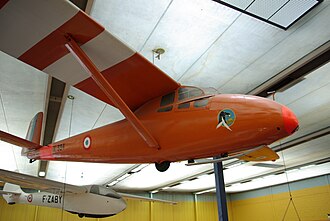
The Caudron C.800 Épervier occupies an important position in the history of French recreational and training aviation. Developed during the difficult years of the Second World War, this two-seat glider was created with a practical objective: to provide French flying clubs with a reliable, accessible aircraft that could introduce new pilots to the art of soaring flight. Although its development began under wartime restrictions, the C.800 achieved its greatest importance after the Liberation, when France faced the enormous task of rebuilding its aviation industry, restoring civilian flying activities, and training a new generation of pilots. Its simple construction, robust airframe, and forgiving flying characteristics made it particularly suitable for these objectives. Produced in substantial numbers after the war, the C.800 became a familiar sight at French gliding centres and remained one of the country’s principal elementary training gliders for many years.
The aircraft was known as the Épervier, the French word for sparrowhawk, although the nickname was not consistently used in everyday aviation references. It was designed as a side-by-side two-seat training glider, allowing an instructor and pupil to sit together and share the experience of flight. This arrangement made communication easier during instruction and gave beginners a more reassuring introduction to gliding than they might have received in a single-seat machine. The C.800 was not intended to compete with specialised high-performance sailplanes designed to establish distance or altitude records. Instead, it was designed around durability, accessibility, ease of maintenance, and the ability to teach the essential skills of unpowered flight. Its success demonstrated that a training aircraft did not need to be technically complicated or exceptionally fast to make a lasting contribution to aviation.
The C.800 also reflects a fascinating period in French aircraft manufacturing. The Caudron name had been associated with aircraft design since the early twentieth century, including touring machines, military aircraft, and streamlined racing monoplanes. By the time the C.800 was developed, the company had become part of a much larger industrial history involving Renault and the restructuring of French aviation manufacturing. The glider’s postwar production was undertaken within the reorganised French aircraft industry, with manufacturing associated particularly with SNCAN and Fouga. Consequently, the C.800 is not merely a story about one successful glider design; it is also a story about industrial recovery, civilian aviation, technical education, and the revival of a national flying culture after years of disruption.
Historical Background: French Gliding Before and During the Second World War
The development of French soaring flight
Gliding had developed into an established aviation activity in Europe during the interwar period. Unlike powered flying, which required engines, fuel, and relatively expensive infrastructure, gliding offered an opportunity to experience flight with fewer mechanical requirements. A glider could be launched by winch, by an automobile tow, or behind a powered aircraft, and once released it relied on the movement of air rather than an engine. Early gliding was often associated with experimentation and sporting achievement, but by the 1930s it was increasingly recognised as a valuable form of pilot education. Students could learn to understand lift, drag, stability, turning, and the relationship between airspeed and control without having to manage an engine at the same time.
France possessed a growing network of aviation clubs and enthusiasts interested in this form of flying. Gliding appealed to young people, aviation students, and experienced pilots who wanted to develop their understanding of atmospheric conditions. It also provided a relatively economical route into aviation, particularly for people who could not afford the cost of powered flying. Training gliders therefore had to be practical machines: they needed to survive repeated landings, tolerate frequent handling by inexperienced pilots, and remain affordable enough for clubs to operate them in meaningful numbers.
The Second World War interrupted much of this development. The German occupation, restrictions on civilian aviation, and the division of France into occupied and unoccupied zones severely limited normal flying activities. Nevertheless, interest in rebuilding French gliding remained alive. Some aviation projects continued in restricted circumstances, and designers began considering how the country’s civilian flying organisations could be restored when political conditions permitted. The C.800 emerged from this environment, where the need for a simple and useful training glider was already apparent even before the war had ended.
The need for a new two-seat training glider
The design of the C.800 was connected with the desire to equip French gliding clubs with a suitable two-seat school aircraft. A training glider needed to fulfil a different purpose from a high-performance sailplane. Its primary task was not to remain airborne for the longest possible time or travel the greatest distance, but to help pilots develop basic flying skills in a safe and repeatable manner. It needed predictable handling, sufficient structural strength, straightforward controls, and a cockpit arrangement that allowed an instructor to supervise a student closely.
A two-seat aircraft was especially valuable because it reduced the risks associated with early instruction. The instructor could demonstrate control movements, explain how the glider responded to changes in pitch and bank, and intervene when necessary. The student could observe the surrounding landscape and the aircraft’s attitude while receiving immediate guidance. A side-by-side seating arrangement also made conversation more natural than in a tandem cockpit, where instructor and pupil were separated along the fuselage.
The C.800 was conceived as a practical response to these needs. Its designers did not attempt to create an advanced competition sailplane. Instead, they aimed to produce a stable, durable, and relatively uncomplicated aircraft that could be operated by clubs with limited resources. This practical philosophy would prove particularly valuable after 1945, when the demand for elementary flight training increased and France needed aircraft that could be manufactured and maintained without excessive difficulty.
Design and Development of the Caudron C.800
Raymond Jarlaud and the design project
The C.800 was designed by French engineer Raymond Jarlaud, who developed the aircraft in response to the demand for a two-seat school glider. The project began around 1941, when French aviation organisations were looking ahead to the eventual restoration of civilian flying. The prototype flew in 1942, with specialist historical sources commonly identifying April 1942 as its first-flight date. Some institutional summaries give January 1942, so the precise month is not entirely consistent across published accounts. What is clear is that the aircraft was already flying during the war, several years before it entered large-scale postwar production.
The C.800 was developed in parallel with the Castel C.25S, another French two-seat training glider. The two aircraft shared a broad design philosophy: both were relatively large, high-wing gliders intended for elementary instruction, and both used conventional construction methods appropriate to the manufacturing conditions of the period. Their similarity reflected the practical requirements of the French gliding movement rather than an attempt to produce identical aircraft. Both designs were intended to provide clubs with dependable training equipment that could be manufactured in series and maintained by ordinary aviation workshops.
The prototype’s development took place under difficult conditions. The occupation and restrictions on French industry limited the ability to organise a normal production programme, while the invasion of the previously unoccupied zone in November 1942 further disrupted aviation activity. The C.800 therefore remained a promising design rather than immediately becoming the widely available training aircraft its designers had intended. Its real opportunity came after the war, when the French aviation industry began to reorganise and civilian gliding could once again expand.
From wartime prototype to postwar production
The Liberation created a new environment for French aviation. The country needed to rebuild aircraft factories, restore flying clubs, train pilots, and establish a modern civilian aviation system. Gliding was particularly suitable for this recovery because it offered an accessible way to introduce large numbers of people to aviation without the cost of providing every student with a powered aircraft. The C.800 was selected for this postwar expansion and entered large-scale production from 1945 onwards.
The manufacturing history is associated with the reorganisation of French aircraft production and the formation of larger industrial groups. The Caudron design passed into the postwar manufacturing structure associated with SNCAN, while production was also undertaken by Fouga, particularly at its Aire-sur-l’Adour factory. The use of established aircraft manufacturers helped transform the C.800 from a wartime prototype into a standard training aircraft available to clubs throughout France.
Published production totals vary. Some historical references give approximately 248 examples, while others report more than 300 or around 315 aircraft. These differences may reflect the treatment of production batches, manufacturing changes, and aircraft completed by different organisations. Whatever precise figure is adopted, the C.800 was produced in sufficient numbers to become one of the most widely used French two-seat training gliders of the postwar period. Its success was measured less by records or spectacular individual flights than by the number of students who learned to fly in it.
Construction and General Design
A conventional high-wing glider
The Caudron C.800 was a high-wing monoplane with a conventional tail arrangement and a relatively long, slender fuselage. Its high-mounted wing provided the lift required for unpowered flight while giving the occupants a broad view of the surrounding landscape. The wing was supported by external struts, which connected it to the fuselage structure. This braced arrangement was well suited to the aircraft’s intended role because it provided a practical means of supporting the wing without relying on a more complicated cantilever structure.
The wing had a span of approximately 16 metres and an area of about 22 square metres. These dimensions gave the C.800 a moderate aspect ratio, allowing it to combine adequate lift with manageable handling characteristics. Its wing was designed for training rather than extreme performance. The airfoil sections were selected to provide useful lift at the relatively low speeds associated with gliding instruction, while the overall planform contributed to stable flight and predictable behaviour. Published technical references identify Göttingen 654 and Göttingen 676 profiles at different positions along the wing.
The high-wing layout also made the aircraft practical for ground handling and instruction. The instructor and pupil could sit beneath the wing in a cockpit with a clear view forward and to the sides. Although the wing and its supporting structure created some visual obstruction, the arrangement offered a useful compromise between aerodynamic performance, structural simplicity, and ease of operation. The design was deliberately conventional because reliability and ease of maintenance mattered more to a flying club than the novelty of an advanced aerodynamic configuration.
Wooden construction and fabric covering
The C.800 used traditional wooden aircraft construction, with plywood and fabric covering employed in different parts of the airframe. Wood was an established material in glider manufacturing because it could be shaped into efficient structural components without requiring the specialised metalworking facilities needed for some all-metal designs. It was also suitable for relatively low-volume production and could be repaired by workshops familiar with conventional aircraft woodworking.
The use of wood did not mean that the C.800 was a crude or primitive machine. Glider structures must be carefully engineered because their wings and fuselages experience significant aerodynamic loads, particularly during winch launches, aerotows, and manoeuvres in turbulent air. The aircraft therefore required properly designed spars, ribs, joints, and bracing arrangements. Plywood provided structural stiffness in selected areas, while fabric covering helped produce smooth aerodynamic surfaces without adding excessive weight.
The wooden structure also made the C.800 relatively straightforward to inspect and maintain when operated by clubs with appropriate skills and facilities. However, wooden aircraft required protection from moisture and careful attention to the condition of their coverings and structural joints. Long-term storage in unsuitable conditions could lead to deterioration, and repairs needed to preserve the original structural characteristics. These requirements were familiar to gliding organisations of the period and were considered manageable in exchange for the advantages of a simple and economical airframe.
Two-seat side-by-side cockpit
One of the C.800’s most distinctive characteristics was its side-by-side seating arrangement. Unlike many training gliders that placed the instructor and student one behind the other, the C.800 positioned both occupants next to each other. This arrangement made the aircraft particularly suitable for elementary instruction because the instructor could communicate easily with the pupil and demonstrate control movements without the physical separation associated with a tandem cockpit.
Both seats were equipped with flying controls, allowing the instructor to take over when necessary and enabling the student to practise under supervision. The shared cockpit also made it easier for occupants to observe instruments and discuss the aircraft’s behaviour during flight. For a beginner, this could be reassuring, particularly during the first stages of learning how to control pitch, maintain a steady approach, and coordinate turns.
The fuselage was sufficiently spacious to accommodate two occupants while retaining the long, narrow shape needed for gliding efficiency. The cockpit canopy and glazing provided protection from the airflow and helped maintain a comfortable environment during training flights. The C.800 was not a luxurious aircraft, but it was designed to provide a functional working environment in which instructor and student could concentrate on learning the principles of flight.
Landing gear and ground handling
The C.800 used a simple ground-contact arrangement suited to glider operations. Historical descriptions identify a fixed central wheel, together with a forward skid and a rear tailskid. This configuration reduced mechanical complexity and was appropriate for aircraft that operated from grass airfields. Unlike a powered aircraft, a training glider did not need a complicated retractable undercarriage or a system designed to withstand repeated high-speed landings on paved runways.
The wheel helped with ground movement and take-off operations, while the skids provided support and protection during landing. The arrangement was consistent with the philosophy of producing a robust training aircraft that could tolerate the repeated cycles of launch, flight, and landing associated with club instruction. The simplicity of the system also reduced maintenance demands and made it easier for ground crews to inspect the aircraft between flights.
Flight Characteristics and Performance
Designed for instruction rather than competition
The C.800 was intended to provide stable and predictable flying characteristics rather than exceptional competition performance. This distinction is important when assessing its specifications. A high-performance sailplane is designed to minimise drag, achieve a strong glide ratio, and exploit rising air efficiently. A training glider, by contrast, must also be forgiving, easy to control, and capable of tolerating the repeated handling associated with novice pilots. The C.800 sought to balance these requirements.
Its published glide ratio is generally quoted at approximately 21 or 22, depending on the reference and the configuration used for the calculation. This means that under suitable conditions the aircraft could travel roughly 21 to 22 units horizontally for every unit of altitude lost. For a basic training glider, this represented useful performance. It allowed students to practise recognising lift, maintaining efficient airspeed, and making sensible decisions about the use of available altitude.
The aircraft’s normal gliding speed was relatively modest, with sources quoting figures around 68 to 78 km/h for different performance measures and configurations. A commonly repeated figure for normal gliding speed is approximately 72 km/h, although the exact value should not be treated as a universal operating speed. The appropriate speed depended on aircraft loading, atmospheric conditions, and the purpose of the flight. For training, the ability to fly safely and predictably across a useful range of speeds was more important than achieving a single headline figure.
Climb, sink rate, and soaring capability
Because the C.800 had no engine, its ability to remain airborne depended on its aerodynamic efficiency and the atmospheric conditions available to it. In descending air, the glider lost altitude, while rising air could allow it to maintain height or climb. Pilots therefore had to understand how to identify thermals, ridge lift, and other sources of atmospheric energy. These skills were central to the educational value of the aircraft.
Published performance information gives a minimum sink rate of approximately 0.93 metres per second at around 68 km/h in one commonly cited specification set. This figure indicates the rate at which the glider lost altitude in its most efficient low-sink configuration under the specified conditions. A relatively low sink rate was useful for elementary soaring because it allowed pilots to remain in weak rising air and practise circling within thermals.
Some institutional accounts describe the C.800 as capable of flights lasting up to 17 hours and reaching a ceiling of approximately 5,300 metres under favourable conditions. These should be understood as reported capabilities rather than routine training-flight figures. Such flights required suitable weather, skilled pilots, and appropriate atmospheric lift. The aircraft’s principal purpose remained instruction, but its performance was sufficient to allow experienced pilots to undertake longer soaring flights and explore the possibilities of cross-country gliding.
Launch methods and everyday operation
The C.800 could be launched using methods common to postwar gliding clubs, including winch launching and aerotow behind a powered aircraft. Winch launching used a cable connected to a powerful ground winch to accelerate the glider along the airfield and raise it rapidly into the air. Aerotow involved attaching the glider to a powered aircraft, which climbed to a suitable release altitude before the glider continued independently.
Each method offered different educational opportunities. Winch launching taught students to manage the rapid changes in airspeed and attitude associated with a steep initial climb, while aerotow introduced them to the need to maintain a stable position behind another aircraft. Both methods allowed the C.800 to be used regularly at clubs without requiring it to carry an engine or fuel system.
Once released, the pilot had to manage the available altitude carefully. The aircraft could not simply accelerate or climb under its own power, so students learned to plan their circuits, monitor their height, and select a suitable landing area. This made the C.800 an effective educational platform because every flight required an understanding of energy management and the relationship between aircraft performance and the surrounding atmosphere.
The Caudron C.800 in Postwar French Aviation
Rebuilding the gliding movement after 1945
The end of the Second World War created an opportunity to restore civilian aviation throughout France. Flying clubs had to recover from years of restrictions, equipment shortages, and organisational disruption. Many people who had been interested in aviation before the war wanted to return to flying, while a new generation of students was eager to experience aircraft for the first time. Gliding was a natural part of this revival because it could be organised at relatively modest cost and did not require every club to maintain a fleet of powered aircraft.
The C.800 became one of the principal tools of this recovery. Its availability in series production meant that clubs could acquire a standardised training aircraft rather than relying entirely on older machines or individual experimental designs. A common type also simplified the sharing of maintenance knowledge, spare parts, and instructional experience. Instructors could become familiar with the aircraft’s handling and teach successive groups of students using a consistent platform.
The aircraft’s importance extended beyond the number of gliders manufactured. It helped make organised gliding accessible to a much wider public and supported the development of club-based aviation throughout the country. A beginner could arrive at a local gliding centre, receive ground instruction, and begin learning in a two-seat aircraft with an experienced instructor. The C.800 therefore played a direct role in making postwar recreational aviation a practical activity rather than an ambition available only to a small group of enthusiasts.
A standard training glider for French clubs
For more than twenty years, the C.800 served as a standard elementary training glider in French flying clubs. Its combination of durability, manageable performance, and relatively simple construction made it well suited to the repeated use expected of a school aircraft. Thousands of pilots learned fundamental gliding skills in the type, and many experienced aviators first encountered unpowered flight from its side-by-side cockpit.
Its longevity was particularly notable because glider design was evolving rapidly during the postwar decades. Newer aircraft increasingly used improved aerodynamic profiles, more efficient structures, and advanced materials. These developments allowed designers to produce sailplanes with higher glide ratios and better cross-country performance. Yet the C.800 continued to be useful because its original role was not to compete with those specialised machines. It was designed to teach the basics, and it continued to fulfil that task effectively even as the wider glider industry advanced.
The aircraft’s reputation was built through ordinary club operations rather than dramatic events. It was launched repeatedly, landed on grass airfields, inspected by volunteer maintenance teams, and used to introduce successive generations of students to flight. That everyday reliability is an important part of its historical significance. Many aviation designs become famous through records or military service, while the C.800 earned its place through decades of practical educational work.
Variants and Related Developments
The C.800 Épervier
The principal version of the aircraft was the standard two-seat C.800 training glider. It retained the basic configuration developed by Raymond Jarlaud and became the production model associated with postwar French gliding. Although individual aircraft could differ in details as production and maintenance practices evolved, the essential characteristics remained consistent: a high braced wing, wooden construction, two side-by-side seats, and a conventional unpowered glider layout.
The Épervier name appears in historical references, but it was not always used consistently. Some sources treat it as the aircraft’s established nickname, while others note that the name never became as widely adopted as the C.800 designation itself. For this reason, the aircraft is most reliably identified as the Caudron C.800, with Épervier used as an associated name.
The C.801
An improved development known as the C.801 appeared in the early 1950s. It was intended to refine the original design and incorporate improvements based on experience with the C.800. Production was very limited, with approximately ten examples commonly reported. The C.801 is sometimes associated with the name Épervier-Ramier in historical summaries, although terminology varies between sources.
The limited production of the C.801 illustrates the strength of the existing C.800 design. The standard aircraft was already well established in clubs, and the advantages of introducing a small number of improved examples were not necessarily sufficient to justify replacing the larger fleet. Training organisations generally benefited from standardisation, especially when aircraft had to be maintained by local clubs with limited budgets. The C.800 therefore remained the dominant member of the family.
The C.810 Colibri and other related projects
The C.810 Colibri was a separate single-seat glider project associated with the wider Caudron glider development programme. It was conceived during the same wartime period and differed from the C.800 in its intended role and cockpit arrangement. The C.810 prototypes were reportedly destroyed during bombing, preventing the project from developing into a production aircraft. A later improved single-seat design, the C.811, was also considered, but it did not achieve the success of the C.800.
These related projects show that Caudron’s glider work was not restricted to a single training aircraft. Designers were exploring different configurations and levels of performance, from two-seat elementary trainers to single-seat gliders intended for other stages of pilot development. Nevertheless, the C.800 remained the most successful of these designs because it addressed a clear and widespread need within the French aviation community.
International Use and Surviving Examples
The C.800 beyond France
Although the C.800 was closely associated with French flying clubs, examples also appeared outside France. Its relatively conventional design and reputation as a practical training aircraft made it suitable for use by organisations interested in establishing or expanding gliding activities. Surviving aircraft and museum records demonstrate that the type became part of a wider European aviation heritage.
One example is preserved in the collection of the Royal Museum of the Armed Forces and Military History in Brussels. The museum identifies the aircraft as the Caudron C.800 Épervier and records its arrival in the collection in 1973. The presence of a French training glider in a Belgian museum illustrates how aircraft that began as national training equipment can later become important historical objects beyond their country of origin.
Preservation in French aviation museums
Several French aviation museums and heritage organisations have preserved C.800 gliders. The Musée Espace Air Passion at Angers-Marcé includes the aircraft in its collection of historic gliders, explaining its importance as a postwar school glider. Ailes Anciennes Toulouse also preserves a C.800, which arrived at the organisation in 1992 from Niort. Its collection information highlights the type’s role in French gliding and the fact that several examples remained in flying condition long after production had ended.
The survival of these aircraft is particularly valuable because the C.800 represents a form of aviation that can be overlooked when historical attention focuses on powered military aircraft. Gliders were central to the development of civilian flying skills, and their operation required specialised knowledge of weather, aerodynamics, and energy management. Preserved examples help explain how flying clubs introduced new people to aviation during the postwar period and how the French gliding movement developed over several decades.
Why the C.800 remained in service for so long
The long service life of the C.800 was not simply the result of a lack of alternatives. It reflected the fact that the aircraft was well suited to its intended role. A training glider had to be robust, understandable, economical, and predictable. It did not need the advanced performance of a competition sailplane, and its relatively simple construction made it practical for clubs that operated with limited financial resources.
As newer designs appeared, the C.800 gradually became less competitive in performance terms. However, training organisations often preferred to continue using a familiar aircraft that could still perform its basic task effectively. A well-maintained C.800 could introduce students to the fundamentals of flight even if more modern gliders offered better performance in cross-country soaring. Its continued use therefore reflected a sensible distinction between the needs of beginners and the demands of advanced pilots.
The C.800’s Place in the History of Glider Design
The Caudron C.800 belongs to a generation of gliders that prioritised conventional construction and practical training. Its wooden airframe, braced high wing, and side-by-side cockpit reflected a design philosophy in which simplicity and durability were considered essential. This approach was particularly relevant during the 1940s, when manufacturing resources were limited and the French aviation industry was preparing for a major postwar recovery.
The aircraft also demonstrates the importance of standardisation in aviation education. A gliding club that operated several examples of the same aircraft could develop consistent maintenance procedures, share technical knowledge, and train instructors who understood the machine’s behaviour in detail. Students moving from their first flights to more advanced gliders could build on a common foundation of skills. In this respect, the C.800 was more than an individual aircraft design: it was part of a wider system of pilot education and recreational aviation.
Its performance was respectable for a training glider of its generation, but the C.800’s greatest achievement was its accessibility. It made it possible for large numbers of people to learn how to fly without relying on an engine. The aircraft helped preserve the culture of gliding in France at a time when the country was rebuilding its civilian institutions, and it remained useful long after newer sailplane designs had transformed the sport.
Conclusion
The Caudron C.800 Épervier was one of the most significant French training gliders of the postwar era. Designed during the Second World War by Raymond Jarlaud, it first flew in 1942 and entered large-scale production after the Liberation. Its two-seat side-by-side cockpit, high braced wing, conventional wooden construction, and straightforward ground-handling arrangement made it particularly suitable for elementary instruction. Rather than pursuing extreme performance, the designers created an aircraft that could withstand repeated use and introduce beginners to the principles of unpowered flight.
Its contribution to French aviation was measured in decades of service and the thousands of students who learned to fly in it. The C.800 helped restore the country’s gliding clubs after the war, provided a common training platform, and remained a familiar sight at French airfields well into the 1960s. Although it was eventually superseded by more modern gliders, its design continued to be appreciated for its simplicity and durability. The surviving aircraft preserved in museums and private collections now provide a tangible connection to an important chapter in the history of recreational aviation.
The C.800 is a reminder that the most influential aircraft are not always the fastest, most powerful, or most technically advanced. Some become important because they serve a practical purpose exceptionally well. The Caudron C.800 did exactly that: it gave generations of pilots their first experience of soaring flight and helped ensure that French gliding could flourish again after the disruption of war.
Caudron C.800 Technical Specifications
The following table summarises commonly published specifications for the standard Caudron C.800 Épervier. Figures differ slightly between historical references, particularly for length, empty weight, maximum weight, and performance speeds. The values below should therefore be treated as representative rather than as a definitive specification for every production aircraft.
| Specification | Details |
|---|---|
| Aircraft designation | Caudron C.800 Épervier |
| Aircraft type | Two-seat elementary training glider |
| Country of origin | France |
| Designer | Raymond Jarlaud |
| Manufacturer | Caudron design; postwar production associated with SNCAN and Fouga |
| First flight | 1942; commonly reported as April |
| Production period | From 1945 onwards |
| Crew | 2 (instructor and student) |
| Seating arrangement | Side-by-side |
| Powerplant | None; unpowered glider |
| Construction | Wooden structure with plywood and fabric covering |
| Wing configuration | High-wing monoplane, externally braced |
| Wingspan | 16.00 m |
| Length | Approximately 8.00–8.35 m |
| Height | Approximately 1.80–2.36 m, depending on reference |
| Wing area | Approximately 22.0–22.05 m² |
| Aspect ratio | Approximately 11.6 |
| Empty weight | Approximately 240–260 kg |
| Maximum loaded weight | Approximately 420–440 kg |
| Typical gliding speed | Approximately 68–78 km/h, depending on operating condition |
| Never-exceed speed | Approximately 170 km/h |
| Minimum sink rate | Approximately 0.93 m/s at 68 km/h in one published specification |
| Glide ratio | Approximately 21–22 |
| Service ceiling | Reported up to approximately 5,300 m |
| Reported endurance | Up to approximately 17 hours in favourable soaring conditions |
| Reported distance capability | Approximately 180 km in suitable conditions |
| Landing arrangement | Fixed central wheel with skids |
| Production total | More than 300 in some sources; other references give lower totals |
| Primary role | Elementary glider training and club flying |
