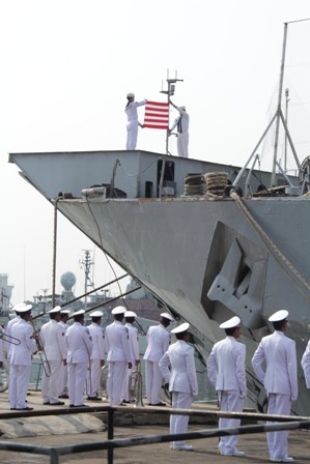
KRI Teluk Berau (534): History, Technical Specifications, and Service in the Indonesian Navy
KRI Teluk Berau (534) was an amphibious landing ship operated by the Indonesian Navy (Tentara Nasional Indonesia Angkatan Laut, or TNI AL). Designed to transport troops, military vehicles, equipment, and other supplies, the vessel belonged to the Frosch I class, also known as Project 108, a family of landing ships developed for the East German Navy during the Cold War. Unlike frigates and corvettes, whose primary roles involve naval combat and maritime security, landing ships are built around a different requirement: moving personnel and heavy cargo from sea to shore, including in areas where conventional port facilities may be limited.
The ship had an interesting international history. Before entering Indonesian service, it served in the East German Navy under the name Eberswalde-Finow. Following the end of the Cold War and the dissolution of East Germany’s naval forces, the vessel became available for transfer abroad. Indonesia acquired it during the 1990s as part of a wider effort to obtain former East German naval vessels. It was subsequently commissioned as KRI Teluk Berau, receiving the pennant number 534 and becoming part of Indonesia’s amphibious transport capability.
Although KRI Teluk Berau is no longer in service, its history remains relevant to understanding the development of Indonesia’s naval forces after the Cold War. Its career illustrates how surplus military ships can be adapted to meet another country’s requirements, how amphibious vessels support operations across an archipelagic nation, and how ageing platforms eventually reach the limits of their useful service lives. The ship was retired in September 2012 and later used as a target during a naval exercise, bringing its operational career to a close.
Origins and Development of the Frosch-Class Landing Ship
The East German naval requirement
The Frosch-class landing ships were developed to provide the East German Navy, known as the Volksmarine, with a practical means of transporting military forces and equipment by sea. During the Cold War, East Germany was a member of the Warsaw Pact and maintained naval forces intended to operate in the Baltic Sea and its surrounding waters. Its naval requirements included coastal defence, maritime patrol, mine warfare, and the movement of troops and supplies between locations along the coast.
Amphibious transport was an important part of this broader military structure. A landing ship could carry vehicles and personnel from a harbour or staging area and deliver them to a suitable beach or landing point. This capability offered military planners more flexibility than relying exclusively on conventional ports, which could be damaged, obstructed, or unavailable during a conflict. A vessel with a vehicle-carrying deck and landing facilities could also support logistics operations in peacetime, making it useful beyond a narrowly defined combat role.
The Frosch I design, identified as Project 108, was intended for medium landing operations. It combined a relatively large cargo capacity with a hull suitable for coastal and regional maritime operations. Its design reflected the priorities of the period: practical transport capacity, straightforward propulsion, and defensive weapons sufficient to provide a degree of self-protection. The class was not intended to function as a major surface combatant, but rather as a specialised platform for moving forces and material.
Construction at VEB Peenewerft
KRI Teluk Berau began its life at VEB Peenewerft in Wolgast, a shipbuilding facility in what was then East Germany. The vessel was laid down on 10 September 1975, launched on 15 July 1976, and commissioned into the Volksmarine on 28 May 1977. It entered service under the name Eberswalde-Finow, with the yard number 334. These dates place its construction within a period when East Germany was continuing to develop and modernise the maritime capabilities of its armed forces.
The ship’s construction was based on the requirements of a landing vessel rather than those of a conventional warship. Its dimensions and internal arrangement were intended to accommodate cargo and military vehicles, while its propulsion system provided enough power for regional deployments. The design also included defensive weapons and radar equipment, allowing the vessel to operate in a military environment without requiring it to perform the duties of a dedicated escort ship.
The Frosch class represented a practical approach to amphibious transport. Its value came from the ability to carry substantial loads and deliver them close to shore, rather than from exceptional speed or advanced combat systems. This made the design useful for a navy that needed to move equipment and personnel across coastal waters and support operations involving multiple maritime locations.
From Eberswalde-Finow to KRI Teluk Berau
Service in the East German Navy
As Eberswalde-Finow, the ship served in the Volksmarine from 1977 until the political changes that transformed Germany at the end of the Cold War. The reunification of Germany in 1990 brought the East German armed forces to an end and led to the restructuring of its naval inventory. Many former East German vessels were not incorporated into the unified German Navy, leaving a number of ships available for disposal, sale, or transfer.
The vessel was decommissioned from East German service in October 1990. Its subsequent availability formed part of a much wider change in the European military environment. The end of the Cold War reduced the need for several categories of military equipment, while countries outside Europe gained opportunities to purchase vessels that had previously served within Warsaw Pact naval forces. Indonesia was among the countries that took advantage of this surplus.
Acquisition by Indonesia
Indonesia acquired the former Eberswalde-Finow in 1993, as part of its broader procurement of ex-East German naval vessels. The acquisition offered the Indonesian Navy an opportunity to expand its amphibious transport fleet without commissioning an entirely new ship from a shipyard. The vessel was subsequently prepared for Indonesian service and received the name KRI Teluk Berau, with pennant number 534.
The name referred to Teluk Berau, or Berau Gulf, a geographical name associated with the Indonesian archipelago. Naming naval vessels after Indonesian locations is part of a wider tradition that connects the fleet to the country’s geography and maritime identity. For a nation made up of thousands of islands, such names also reflect the importance of the sea in national transport, security, and territorial administration.
Sources commonly list 25 August 1993 as the acquisition date and 10 March 1995 as the commissioning date. The ship therefore entered Indonesian naval service after a period of transfer and preparation. Some contemporary reporting gives a different date in April 1995, so the precise commissioning date can vary between secondary accounts. The date most often listed in the ship’s service chronology is 10 March 1995.
KRI Teluk Berau’s Role in the Indonesian Navy
Amphibious transport and landing operations
The central purpose of KRI Teluk Berau was to transport military personnel, vehicles, and supplies by sea. As a landing ship tank, or LST, it belonged to a category of vessels designed to move heavy cargo and deliver it to shore. This function is especially relevant to Indonesia, where the distance between islands and the limited availability of suitable port infrastructure can make maritime logistics a major operational challenge.
An LST provides a useful connection between naval transport and land-based forces. It can carry vehicles and equipment from a larger port and deliver them to a landing area, reducing the need for every destination to have extensive unloading facilities. This is particularly valuable during military exercises, logistical deployments, disaster-relief missions, and other operations in which supplies must reach coastal communities or remote locations.
KRI Teluk Berau’s reported cargo capacity was approximately 400 to 600 tonnes, with some class descriptions indicating the ability to transport up to 11 amphibious tanks. It was also designed to carry a company-sized group of marines. These figures describe the vessel’s general class capability and should be treated as indicative rather than as a guarantee that every cargo configuration could be carried simultaneously. The actual load would depend on vehicle dimensions, weight distribution, fuel, personnel, and operational conditions.
Supporting an archipelagic nation
Indonesia’s geography makes amphibious transport an important element of naval capability. The country extends across a vast maritime area, with populated islands, remote coastal settlements, and strategically important sea lanes. Moving personnel and equipment between these locations requires ships that can operate independently of major commercial ports and deliver cargo to suitable coastal areas.
A landing ship such as KRI Teluk Berau could contribute to this requirement by supporting the movement of troops, vehicles, engineering equipment, and supplies. Such a vessel could also be useful during exercises that test coordination between naval units and land forces. Amphibious operations require more than simply transporting troops: they involve planning loading sequences, maintaining communications, coordinating approach routes, and ensuring that vehicles and personnel can be moved ashore safely.
The same basic transport capability can have peacetime applications. Military ships are sometimes used to deliver essential supplies after natural disasters, when roads, bridges, or local port facilities have been damaged. Although KRI Teluk Berau should not be described as a dedicated humanitarian vessel, its general role as a transport and landing ship illustrates why this type of platform can be valuable beyond conventional combat operations.
Design and Physical Characteristics
Hull dimensions and displacement
KRI Teluk Berau was a relatively large landing ship compared with smaller landing craft designed for short coastal journeys. Commonly published Frosch-class specifications give a length of approximately 98 metres, a beam of 11.1 metres, and a draught of around 2.8 metres. The ship’s full-load displacement is frequently reported at approximately 1,980 metric tonnes.
There is, however, a difference between some general class specifications and Indonesian reporting about the individual ship. A 2013 report published by Indonesia’s Directorate General of State Assets (DJKN) describes KRI Teluk Berau as approximately 90.7 metres long, 11.12 metres wide, and about 1,900 tonnes in displacement. This means that figures quoted for the class should not automatically be treated as identical to measurements recorded for the individual vessel. For historical writing, it is useful to identify the source and distinguish between general class data and figures reported specifically for KRI Teluk Berau.
The vessel’s hull was designed to support the weight and volume of military cargo while maintaining sufficient stability for maritime operations. Its relatively broad beam provided space for the landing ship’s internal arrangements, while its shallow draught compared with many larger combat ships helped it approach coastal areas. These characteristics were closely connected to its intended mission: transporting heavy loads and bringing them close to a landing point.
Propulsion and speed
The Frosch I design used two diesel engines driving two propeller shafts. Published specifications commonly give a combined installed power of approximately 5,000 horsepower, with a maximum speed of around 18 knots. This was a practical arrangement for a landing ship whose primary mission was cargo transport rather than high-speed interception or fleet combat.
Diesel propulsion offered a balance between power, endurance, and operating practicality. A landing ship must be capable of travelling between ports and operating areas while carrying heavy loads, so propulsion reliability is essential. The vessel’s speed was adequate for regional transport and amphibious support, although it was not comparable to that of faster frigates, destroyers, or modern patrol vessels.
The ship’s performance also depended on its load and operating environment. A vessel carrying heavy vehicles and supplies would not necessarily achieve the same speed or handling characteristics as one sailing with a lighter load. Sea conditions, machinery condition, and maintenance also influence the performance of an ageing ship. The published 18-knot figure is therefore best understood as a general maximum-speed specification rather than a constant operational speed.
Armament and Defensive Equipment
Gun systems
Although KRI Teluk Berau was primarily an amphibious transport ship, it carried defensive weapons. Published accounts of its Indonesian configuration commonly list one single Bofors 40 mm L/60 gun, one twin V-11 37 mm gun mount, and two twin 2M-3 25 mm gun mounts. These weapons gave the ship a degree of close-range defensive capability, but they did not turn it into a specialised surface combatant.
The Bofors 40 mm gun was a widely used naval and land-based weapon, valued for its relatively versatile role against surface and airborne threats. The twin 37 mm and 25 mm mounts added further close-range firepower. Together, these systems were consistent with the defensive requirements of a transport vessel that might operate in areas where some protection was necessary but where the ship’s main task remained the movement of cargo and personnel.
It is important to distinguish the ship’s Indonesian armament from descriptions of its original East German configuration. Some historical accounts list different weapons fitted when the vessel served as Eberswalde-Finow, including twin 57 mm and 30 mm guns. Such differences reflect the possibility of refits and changes made during the transfer between navies. A description of the original ship should not be presented as though it necessarily represents the configuration used throughout its Indonesian career.
Radar and electronic equipment
Published technical summaries associate the Frosch-class vessel with a TSR-333 navigation radar and an MR-302 Strut Curve air-and-surface search radar. These systems served different purposes within the ship’s operating environment. Navigation radar helped the crew monitor surrounding vessels, coastlines, and navigational hazards, while the broader search radar provided information about contacts in the surrounding air and maritime environment.
The ship is also reported to have carried PK-16 chaff launchers. Chaff is a form of radar countermeasure that releases reflective material intended to create misleading radar returns and complicate the tracking of a vessel. Such equipment formed part of the ship’s defensive suite, although the presence of countermeasures did not provide the same level of protection as the advanced integrated defensive systems found on modern warships.
For a landing ship, sensors and communications are important not only for self-protection but also for safe navigation and coordination with other units. Amphibious operations require careful timing and situational awareness, particularly when ships approach a coast or operate alongside landing craft and other vessels. Radar and communications equipment therefore contributed to the ship’s ability to perform its transport mission.
Operational Limitations and the Challenges of Ageing Ships
The limits of a transport-focused design
KRI Teluk Berau’s design was shaped by a specific operational purpose. Its cargo capacity and landing capability were more important than sophisticated anti-submarine warfare systems, long-range air defence, or high-speed manoeuvring. This made it useful for amphibious transport but limited its suitability for independent operations in a high-threat combat environment.
A landing ship generally relies on other naval units to provide protection when operating in contested waters. Its size, cargo-focused layout, and comparatively modest speed can make it less suited to confronting modern surface combatants or aircraft. The vessel’s defensive guns and radar were intended to provide a measure of self-protection, not to replace the capabilities of frigates, corvettes, or dedicated air-defence ships.
The distinction is important when evaluating the ship’s contribution to the Indonesian Navy. Its value should be measured primarily through its transport and amphibious functions rather than through comparisons with front-line combat vessels. A navy requires different types of ships to perform different tasks, and an amphibious transport ship can be strategically useful even if it is not equipped to dominate a naval engagement.
Maintenance and service life
Like all naval vessels, KRI Teluk Berau required regular maintenance to keep its propulsion system, hull, electrical equipment, navigation systems, and weapons in serviceable condition. The ship had originally been built in the 1970s and had already served in the East German Navy before its transfer to Indonesia. By the time it was retired in 2012, its design and construction were several decades old.
Age alone does not determine whether a ship remains useful, but older vessels can become increasingly expensive and difficult to maintain. Spare parts may be harder to obtain, equipment can become obsolete, and the cost of modernising a vessel may eventually outweigh the benefits of keeping it in service. These challenges are especially relevant when a navy operates ships acquired from different countries, since their machinery, electronics, and weapons may require distinct maintenance arrangements.
The Indonesian Navy ultimately retired KRI Teluk Berau after its operational service had come to an end. Contemporary reporting described the decision as being based on technical and strategic considerations, including the ship’s age and the need for more capable replacements. This decision illustrates the broader challenge faced by navies that rely on older vessels: maintaining useful capability while balancing operating costs, safety, and the availability of newer platforms.
Decommissioning and Final Fate
Retirement from Indonesian naval service
KRI Teluk Berau was formally retired on 28 September 2012. The decommissioning marked the end of its role as an active unit of the Indonesian Navy. The ceremony was held in Surabaya, where the ship’s naval service was formally concluded. Reports from the period described the vessel as having completed approximately 18 years of Indonesian service, although the exact commissioning date varies between accounts.
Retirement was a significant moment in the ship’s history because it closed a career that had begun in East Germany during the Cold War and continued in Southeast Asia after the political transformation of Europe. The ship had served under two different national flags, carried two different names, and fulfilled the amphibious transport requirements of two different naval organisations.
Its withdrawal also reflected the changing requirements of the Indonesian Navy. As older vessels reached the end of their useful service lives, the navy needed to consider replacement platforms capable of meeting modern logistical and operational requirements. The retirement of a landing ship does not necessarily mean that its role has become unimportant; rather, it indicates that the individual vessel is no longer considered the best way to fulfil that role.
Used as a target during a naval exercise
KRI Teluk Berau did not end its history through sale for commercial use or preservation as a museum ship. After decommissioning, it was used as a target during the Indonesian Navy’s Armada Jaya XXXI/2012 exercise. On 13 October 2012, the vessel was sunk during a live-fire event involving the Yakhont anti-ship missile launched from KRI Oswald Siahaan (354).
The event was later described by Indonesia’s Directorate General of State Assets, which reported that the destruction of KRI Teluk Berau and KRI Teluk Semangka had been approved as part of the process for disposing of state-owned military assets. The report identifies KRI Teluk Berau as a Frosch-class landing ship and confirms that it was sunk as a target during the exercise.
Using a retired vessel as a target can provide a realistic training opportunity. A decommissioned ship offers a physical target with dimensions and structural characteristics that are more representative of a real vessel than a simple simulated target. Such exercises can help evaluate weapon performance and train personnel in the procedures associated with missile engagements. In this case, the sinking of KRI Teluk Berau became the final event in its naval career.
Historical Significance of KRI Teluk Berau
Part of Indonesia’s post-Cold War naval acquisitions
KRI Teluk Berau is an example of the way the end of the Cold War reshaped the international market for military equipment. The dissolution of East Germany’s armed forces created opportunities for other countries to acquire ships that had been built for a different strategic environment. Indonesia’s purchase of former East German vessels was part of a broader effort to strengthen its naval inventory using available second-hand platforms.
Such acquisitions can offer important advantages. A used vessel may be obtained more quickly and at a lower initial cost than a newly constructed ship. It can provide a navy with additional capacity while longer-term procurement plans are developed. However, second-hand ships also bring challenges involving age, refit requirements, spare parts, and the integration of unfamiliar systems into an existing fleet.
KRI Teluk Berau’s history demonstrates both sides of this process. Its transfer allowed Indonesia to add an amphibious transport ship to its fleet, but the vessel’s eventual retirement also highlights the finite service life of older platforms. The wider lesson is that acquiring a ship is only the beginning of its lifecycle; sustained operational value depends on maintenance, training, logistics, and the availability of suitable replacements.
A reminder of the importance of amphibious logistics
The history of KRI Teluk Berau also demonstrates why transport ships deserve attention in discussions of naval capability. Public interest often focuses on warships equipped with missiles, advanced radars, and sophisticated combat systems. Yet the ability to move troops, vehicles, and supplies across the sea is equally important for many naval missions.
For an archipelagic country such as Indonesia, amphibious logistics can support national defence, military readiness, and operations in remote regions. A landing ship can help connect islands, deliver heavy equipment, and provide a means of moving forces where road transport is unavailable or impractical. These functions may not be as visible as missile launches or naval combat, but they are essential to the practical operation of a geographically dispersed military.
KRI Teluk Berau was not a modern high-end combat ship, nor was it designed to be one. Its significance came from the work it was built to perform: carrying people and equipment, supporting landing operations, and contributing to the logistical reach of the Indonesian Navy. Its service under two navies and its final use in a major exercise make it a distinctive part of Indonesia’s naval history.
Conclusion
KRI Teluk Berau (534) was a Frosch I-class landing ship that served the Indonesian Navy after beginning its career as Eberswalde-Finow in the East German Navy. Built at VEB Peenewerft in Wolgast and commissioned in 1977, the vessel was transferred to Indonesia in the 1990s and entered Indonesian service as part of the country’s post-Cold War acquisition of former East German naval ships.
Its principal role was amphibious transport. With the ability to carry military vehicles, cargo, and troops, it provided a practical capability for moving forces and supplies across Indonesia’s extensive maritime territory. Its diesel propulsion, landing-ship hull, defensive gun armament, and radar equipment reflected the requirements of a medium landing vessel rather than those of a specialised surface combatant.
After almost two decades in Indonesian service, KRI Teluk Berau was retired in September 2012. It was subsequently sunk as a target during the Armada Jaya XXXI/2012 naval exercise on 13 October 2012. Although the ship is no longer part of the fleet, its history remains an informative example of international naval transfers, amphibious logistics, and the challenges of operating ageing military vessels.
KRI Teluk Berau (534): Technical Specifications
The following table summarises the commonly published specifications of KRI Teluk Berau. Some measurements differ between general Frosch-class references and Indonesian reports about the individual vessel. Where a discrepancy exists, it is identified rather than presented as a single unquestionable figure.
| Specification | Details |
|---|---|
| Name | KRI Teluk Berau |
| Pennant number | 534 |
| Former name | Eberswalde-Finow |
| Class | Frosch I |
| Project designation | Project 108 |
| Ship type | Landing Ship Tank (LST) |
| Original operator | East German Navy (Volksmarine) |
| Indonesian operator | Indonesian Navy (TNI AL) |
| Builder | VEB Peenewerft, Wolgast, East Germany |
| Laid down | 10 September 1975 |
| Launched | 15 July 1976 |
| Original commissioning | 28 May 1977 |
| Acquired by Indonesia | 1993 |
| Indonesian commissioning | 10 March 1995 (commonly listed) |
| Decommissioned | 28 September 2012 |
| Final fate | Sunk as a target ship on 13 October 2012 |
| Full-load displacement | Approximately 1,980 tonnes (class reference); Indonesian report gives approximately 1,900 tonnes |
| Length | Approximately 98 m (class reference); Indonesian report gives 90.7 m |
| Beam | Approximately 11.1 m |
| Draught | Approximately 2.8 m |
| Propulsion | 2 diesel engines |
| Propeller shafts | 2 |
| Installed power | Approximately 5,000 hp |
| Maximum speed | Approximately 18 knots |
| Cargo capacity | Approximately 400–600 tonnes |
| Vehicle capacity | Reported capacity of up to 11 amphibious tanks |
| Troop capacity | Approximately one company of marines |
| Crew | Approximately 46 in published class specifications |
| Main armament | 1 × Bofors 40 mm L/60 |
| Secondary armament | 1 × twin V-11 37 mm mount |
| Additional armament | 2 × twin 2M-3 25 mm mounts |
| Navigation radar | TSR-333 |
| Air/surface search radar | MR-302 Strut Curve |
| Countermeasures | 2 × PK-16 chaff launchers |
Specifications are drawn from published Frosch-class references and Indonesian reporting. Individual-vessel measurements and crew figures vary between sources; the table should be treated as a historical summary, not a verified final refit record.
