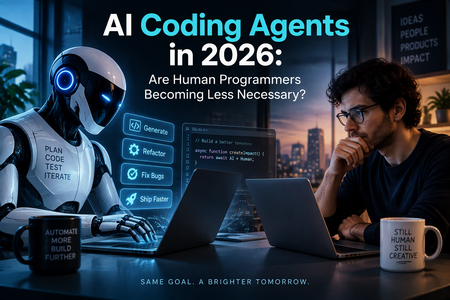
Artificial intelligence is changing the software development industry faster than many people expected. Just a few years ago, AI coding assistants were mainly used to suggest code snippets, complete functions, and help developers find programming errors. In 2026, however, AI coding agents have become considerably more powerful. They can understand project requirements, write entire applications, fix bugs, run tests, modify existing codebases, and even manage complex development tasks with limited human intervention.
Tools such as Claude Code, OpenAI Codex, GitHub Copilot, and Cursor are transforming how software is created. Developers can now describe what they want in natural language and allow AI agents to handle much of the implementation.
This raises an important question: Are human programmers becoming less necessary, or is artificial intelligence simply changing what it means to be a programmer?
The answer is more complicated than a simple yes or no.
1. The Rise of AI Coding Agents in 2026
AI coding agents represent a significant step forward from traditional AI-powered code completion tools.
Unlike basic coding assistants that suggest individual lines of code, modern agents can independently perform multiple development tasks. They can analyze a repository, understand dependencies, create new files, modify existing functionality, execute commands, identify errors, and suggest solutions.
For example, imagine asking an AI coding agent to build a simple e-commerce website. Instead of manually writing every component, a developer can provide a detailed description of the desired application.
The agent may then:
- Create the project structure.
- Develop the frontend and backend.
- Connect the application to a database.
- Implement authentication.
- Generate API endpoints.
- Write automated tests.
- Identify and fix common errors.
- Prepare the application for deployment.
This ability to work across multiple stages of development makes AI agents particularly attractive to startups, independent developers, and established software companies.
According to JetBrains’ 2026 Developer Ecosystem Survey, 90% of professional developers reported using AI coding agents at work at least weekly, while 68% used them daily. These figures demonstrate how quickly agentic development has become part of everyday programming.
AI coding agents are no longer experimental technologies. They are becoming standard tools in modern software engineering.
2. Can AI Replace Human Programmers?
AI can already perform many tasks traditionally associated with software developers. However, replacing individual programming tasks is not the same as replacing an entire profession.
Consider some activities that AI coding agents can perform particularly well:
Routine coding: AI can generate boilerplate code, create standard functions, build simple interfaces, and implement repetitive programming patterns.
Bug fixing: Agents can analyze error messages, inspect relevant files, identify potential causes, and suggest corrections.
Testing: AI can generate unit tests, identify missing test cases, and help developers detect potential problems.
Documentation: Writing technical documentation, explaining unfamiliar code, and updating project descriptions can be delegated to AI.
Code refactoring: AI agents can reorganize existing code, improve readability, and suggest architectural improvements.
These capabilities can significantly reduce the amount of manual coding required.
However, software development involves much more than producing code.
Human programmers still need to understand business requirements, make architectural decisions, evaluate security risks, manage complex systems, and ensure that the finished product actually solves the intended problem.
An AI agent might successfully generate a login system, but does that system meet the company’s security requirements? Does it protect sensitive information? Can it handle thousands of simultaneous users?
These questions require more than code generation.
The real distinction is that AI can increasingly handle implementation, while humans remain responsible for determining whether the implementation is appropriate, reliable, and valuable.
3. Why Human Programmers Still Matter
Despite impressive technological progress, human expertise remains essential in several areas of software development.
Understanding Business Requirements
Clients rarely describe software requirements in perfectly structured technical language.
They might explain a business problem without knowing exactly what features, integrations, or technical architecture are necessary.
An experienced programmer can ask the right questions, identify hidden requirements, and translate business objectives into a practical development strategy.
AI can help with this process, but understanding the broader context remains a major challenge.
Software Architecture and Technical Decisions
Building a working application is relatively easy compared with building a scalable, secure, and maintainable software system.
Developers must decide how different components communicate, which technologies to use, how databases should be structured, and how the application will evolve over time.
Poor architectural decisions can create serious problems that become expensive to fix later.
AI agents can recommend architectural solutions, but experienced engineers must evaluate those recommendations against the project’s actual requirements.
Security and Reliability
AI-generated code is not automatically secure.
An agent might introduce vulnerable dependencies, expose sensitive information, generate unsafe database queries, or overlook important authorization requirements.
In industries such as banking, healthcare, and cybersecurity, these mistakes can have serious consequences.
Human review, security testing, and professional accountability remain critical.
Creativity and Problem-Solving
Programming is not simply about translating instructions into code.
Sometimes the most important part of software development is discovering what should be built in the first place.
Creating a new product, designing an intuitive user experience, solving an unusual technical problem, or finding an innovative approach requires creativity and judgment.
AI can support these activities, but humans still play an important role in defining meaningful problems and evaluating possible solutions.
4. The Biggest Change: Programmers Are Becoming AI Orchestrators
One of the most interesting developments in 2026 is the changing role of software engineers.
Traditionally, programmers spent much of their working time writing, reviewing, debugging, and maintaining code.
Today, an increasing portion of implementation work can be delegated to AI agents.
This creates a different development workflow.
Instead of manually implementing every feature, developers increasingly:
- Define the problem and desired outcome.
- Break complex requirements into smaller tasks.
- Select the appropriate AI tools.
- Provide context and instructions to coding agents.
- Review the generated implementation.
- Run tests and verify functionality.
- Correct mistakes and improve the final product.
In other words, developers are gradually moving from writing every line of code toward managing the entire software creation process.
This does not mean programming knowledge is becoming irrelevant. In fact, understanding programming fundamentals may become even more important.
A developer who understands databases, networking, algorithms, security, and software architecture is better equipped to identify incorrect AI output than someone who simply copies generated code.
The most effective programmers will likely be those who combine strong technical knowledge with the ability to use AI agents efficiently.
5. Will AI Make It Harder for Junior Developers to Find Jobs?
One of the biggest concerns surrounding AI coding agents is their potential impact on entry-level programming positions.
Historically, junior developers learned through relatively straightforward assignments, such as writing basic functions, fixing minor bugs, creating simple interfaces, and updating documentation.
These tasks are increasingly suitable for automation.
As a result, companies may have less incentive to hire large numbers of inexperienced programmers for repetitive implementation work.
A June 2026 research paper published by the Institute of Labor Economics (IZA) found a 14–15% relative decline in junior software developer vacancies compared with senior vacancies following the introduction of ChatGPT. The study also identified an increase in experience requirements for software development positions.
This suggests that entering the software development profession may become more challenging.
However, it does not mean aspiring programmers should abandon their ambitions.
Instead, the path into the industry may change.
Future junior developers will need to demonstrate more than basic coding ability. They should understand how to:
- Build complete applications.
- Work with databases and APIs.
- Use AI coding agents effectively.
- Debug complex problems.
- Review and validate generated code.
- Understand software security.
- Communicate technical ideas clearly.
Personal projects, open-source contributions, internships, and practical experience may become even more important when competing for entry-level positions.
The biggest challenge for the industry will be ensuring that beginners still have opportunities to develop the experience needed to become senior engineers.
6. AI Coding Agents Are Not Always More Productive
It is tempting to assume that if AI generates code faster, the entire software development process must also become faster.
Unfortunately, reality is more complicated.
AI agents can produce large amounts of code in a relatively short time, but that code still needs to be reviewed, tested, integrated, and maintained.
An agent might generate a solution that appears correct but introduces subtle bugs or unnecessary complexity.
Developers may then spend considerable time investigating problems that would not have existed if the code had been written more carefully from the beginning.
Research published by the Centre for Economic Policy Research in June 2026 highlighted an important distinction between writing code and actually shipping software. Although AI tools increase coding activity, improvements in overall software output can be limited by bottlenecks in code review, testing, integration, and release processes.
This is an important lesson for companies adopting AI development tools.
The objective should not simply be to generate more code. It should be to deliver better software with less wasted effort.
Successful teams will need effective testing procedures, clear development standards, reliable review processes, and appropriate human supervision.
7. Which Programming Skills Will Be Most Valuable in the AI Era?
As AI takes over more routine implementation work, the value of certain programming skills is likely to increase.
Here are some areas developers should prioritize.
System Design and Software Architecture
Understanding how complete applications work is more valuable than knowing how to write isolated functions.
Developers should learn about distributed systems, database architecture, API design, scalability, and system integration.
AI Tool Proficiency
Knowing how to work with coding agents will increasingly become a standard professional skill.
Developers should understand how to provide context, structure instructions, manage agent workflows, and evaluate generated solutions.
Debugging and Code Review
AI-generated code needs careful validation.
The ability to identify logical errors, performance problems, security vulnerabilities, and architectural weaknesses will remain extremely important.
Cybersecurity
As applications become easier to generate, security mistakes may also become easier to introduce.
Knowledge of authentication, authorization, encryption, secure coding practices, and vulnerability testing will be valuable.
Communication and Critical Thinking
Developers often work with designers, managers, clients, and other engineers.
The ability to understand requirements, explain technical decisions, and solve problems collaboratively will remain an important professional advantage.
Continuous Learning
Programming technologies evolve constantly, and AI is accelerating that process.
Developers who regularly experiment with new tools, learn unfamiliar technologies, and adapt their workflows will have an advantage over those who rely exclusively on outdated methods.
8. What Does the Future of Software Development Look Like?
Looking ahead, software development is likely to become increasingly collaborative, with humans and AI agents sharing responsibilities.
We can expect several important developments.
More autonomous development workflows: AI agents will handle increasingly complex tasks, including implementing features across multiple files, running tests, and preparing changes for human review.
Smaller development teams: Some companies may accomplish the same amount of work with fewer developers, particularly when projects involve repetitive or standardized tasks.
More software created by non-programmers: Business owners, designers, analysts, and other professionals will be able to build simple applications using natural-language instructions and AI development platforms.
Greater demand for experienced engineers: Organizations will still need professionals who can manage complex systems, evaluate technical risks, and make important architectural decisions.
New programming-related careers: Roles involving AI agent management, AI-assisted software quality assurance, security validation, and automated development infrastructure may become increasingly important.
However, these developments will not happen equally across every industry.
A simple website and a safety-critical aviation system have very different requirements. The level of autonomy appropriate for one project may be completely unsuitable for another.
Human oversight will remain particularly important wherever reliability, security, and accountability are essential.
9. Should You Still Learn Programming in 2026?
Absolutely.
In fact, learning programming can be an excellent investment, even if AI agents continue becoming more capable.
The important thing is to approach programming differently.
Instead of focusing exclusively on memorizing syntax or writing repetitive code, aspiring developers should learn how software systems work.
Start with programming fundamentals, choose a language such as Python, JavaScript, or TypeScript, and gradually build practical projects.
Learn databases, APIs, version control, testing, and basic cybersecurity.
At the same time, become familiar with AI coding agents. Use them to accelerate your learning, explore unfamiliar concepts, and experiment with more ambitious projects.
However, avoid blindly accepting generated code.
Read it, understand it, test it, and try to identify potential weaknesses. Treat AI as a development partner rather than an unquestionable source of truth.
The goal should be to become a programmer who can build better software with AI, not someone who depends on AI without understanding what it produces.
Conclusion: Human Programmers Are Evolving, Not Disappearing
AI coding agents in 2026 have fundamentally changed the software development landscape. They can generate applications, automate repetitive programming tasks, identify bugs, and perform work that previously required considerable developer time.
There is little doubt that some traditional programming tasks will become less valuable, and certain entry-level positions may face increasing pressure.
However, software engineering involves much more than writing code.
Understanding complex problems, designing reliable systems, protecting sensitive data, making architectural decisions, and delivering products that meet real-world needs are responsibilities that cannot simply be reduced to generating code.
The future will probably not belong exclusively to human programmers or artificial intelligence. It will belong to developers who know how to combine human expertise with increasingly capable AI tools.
The most important question is no longer whether AI can write code. It is whether programmers can use AI to create better software, solve more difficult problems, and deliver greater value.
Human programmers may write fewer lines of code in the future, but their ability to think, design, evaluate, and make meaningful technical decisions will remain essential.