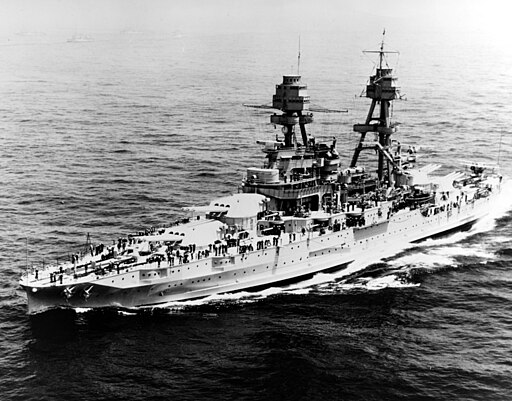
USS Pennsylvania (BB-38)
The USS Pennsylvania (BB-38) holds a storied history as a symbol of American naval power and resilience during the first half of the 20th century. Commissioned in 1916 as the lead ship of the Pennsylvania-class battleships, the USS Pennsylvania played a crucial role in World War I, providing escort duties for Allied convoys in the Atlantic. Throughout the interwar years, the battleship underwent various modernizations, adapting to emerging naval technologies. When World War II erupted, the USS Pennsylvania found itself at the forefront of the Pacific Theater, surviving the attack on Pearl Harbor on December 7, 1941, with damage that required extensive repairs.
Post-repair, the USS Pennsylvania became a crucial participant in the Pacific campaigns, contributing to the Battle of Surigao Strait, Leyte Gulf, and the invasion of Okinawa. Its formidable armament, including twelve 14-inch guns, showcased the battleship’s versatility in engaging both surface and aerial threats. After the war, the USS Pennsylvania underwent decommissioning in 1946, marking the end of its active service. Although initially targeted for scrapping, efforts to preserve the historic vessel proved successful, and the USS Pennsylvania eventually found a permanent home as a museum ship in San Francisco, allowing future generations to explore and learn from its rich naval history.
armament of USS Pennsylvania (BB-38)
The USS Pennsylvania (BB-38), a Pennsylvania-class battleship, was armed with a formidable array of weaponry. Here is a list of the main and secondary armament of the USS Pennsylvania:
Main Battery:
- Twelve 14-inch/45 caliber guns
- Mounted in four triple turrets (two forward and two aft)
Secondary Battery: 2. Twenty-two 5-inch/51 caliber guns
- Placed in casemates along the sides of the ship
Anti-Aircraft Battery (as upgraded during World War II): 3. Four 5-inch/25 caliber guns
- Initially part of the ship’s anti-aircraft defense.
- Twelve 1.1-inch/75 caliber anti-aircraft guns
- Added during World War II to enhance the ship’s anti-aircraft capabilities.
- Twenty-four 20mm Oerlikon anti-aircraft guns
- Deployed for close-range anti-aircraft defense.
The USS Pennsylvania underwent various modifications and upgrades to its armament during its service, adapting to the changing requirements of naval warfare. The battleship played a significant role in both World War I and World War II, and its armament showcased its versatility in engaging both surface and aerial threats.
Parameters and dimensions of USS Pennsylvania (BB-38)
The USS Pennsylvania (BB-38), a Pennsylvania-class battleship, stood as a formidable symbol of American naval power during the first half of the 20th century. Commissioned in 1916, the USS Pennsylvania featured robust parameters that emphasized its capabilities for long-range naval operations. The battleship had an overall length of 608 feet, a beam (width) of 97 feet, and a draft (maximum depth submerged) of 29.5 feet. With a displacement exceeding 31,400 tons, the USS Pennsylvania was a substantial and heavily armored vessel. These dimensions provided the battleship with stability and seaworthiness, essential for navigating the vast expanses of the Pacific and Atlantic Oceans.
The parameters of the USS Pennsylvania played a crucial role in its operational effectiveness. The battleship’s length and breadth allowed for the accommodation of a powerful armament, including twelve 14-inch guns in four triple turrets. The draft facilitated deep-water navigation, making the USS Pennsylvania versatile in various maritime environments. Throughout its service, the battleship underwent modernization to adapt to evolving naval technologies, ensuring it remained a formidable force in both World War I and World War II. The USS Pennsylvania’s dimensions and capabilities marked it as a cornerstone of American naval strength during a critical period in history.
