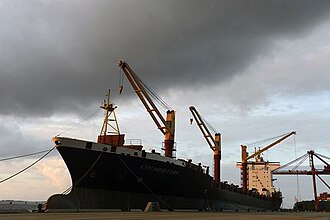
MV Capt. David I. Lyon (T-AK-5362): The Backbone of Strategic Sealift Logistics
In the vast architecture of global military logistics, there exists a class of vessels that rarely make headlines yet quietly sustain the operational reach of armed forces across continents. Among these ships, MV Capt. David I. Lyon (T-AK-5362) occupies a vital place as part of the United States’ prepositioning fleet. Built not for combat but for readiness, not for speed but for reliability, this vessel embodies the principle that wars are not only won by weapons—but by supply chains.
Operating under the Military Sealift Command, the ship represents a sophisticated integration of commercial maritime engineering and military logistics doctrine. It is designed to transport, store, and rapidly deploy heavy equipment and supplies in support of expeditionary operations, ensuring that U.S. forces can respond swiftly to crises anywhere in the world.
This article explores the vessel in depth—its origins, engineering, cargo systems, operational philosophy, and strategic role—culminating in a comprehensive table of technical specifications.
Origins of the LMSR Concept
From Cold War Logistics to Rapid Deployment
The concept behind vessels like MV Capt. David I. Lyon originates in the logistical lessons of the late Cold War. The United States recognized that forward-deployed forces required immediate access to heavy equipment—tanks, armored vehicles, engineering machinery—without waiting for slow transoceanic transport.
This realization led to the development of Large, Medium-Speed Roll-on/Roll-off (LMSR) ships, a class designed to carry massive volumes of wheeled and tracked vehicles while maintaining relatively high transit speeds.
Unlike earlier cargo ships, LMSRs were engineered specifically for rapid military deployment, combining:
- High cargo capacity
- Roll-on/roll-off (RO/RO) capabilities
- Strategic endurance
- Prepositioning readiness
Construction and Classification
MV Capt. David I. Lyon was constructed in the late 1990s as part of the LMSR program. It belongs to the Watson-class of LMSR vessels, named after Medal of Honor recipients, and built to serve the Maritime Prepositioning Force.
These ships are owned by the U.S. Navy but operated by civilian mariners under the Military Sealift Command, reflecting a hybrid model that blends commercial efficiency with military purpose.
Design Philosophy: Capacity, Flexibility, and Speed
A Floating Warehouse
At its core, MV Capt. David I. Lyon is designed as a floating warehouse—one that can carry an entire brigade’s worth of equipment across oceans. Its internal spaces are optimized for maximum cargo density, with multiple decks connected by ramps that allow vehicles to be driven directly onboard and secured.
This approach eliminates the need for cranes in many situations, dramatically reducing loading and unloading times.
Roll-on/Roll-off Efficiency
The ship’s RO/RO design is one of its defining features. Vehicles can drive onto the vessel via stern or side ramps, be positioned within designated decks, and later exit in reverse order at the destination.
This system offers several advantages:
- Rapid deployment
- Reduced port infrastructure requirements
- Minimal handling of cargo
In operational scenarios where time is critical, these advantages can make the difference between readiness and delay.
Dimensions and Structural Characteristics
Hull Design and Scale
MV Capt. David I. Lyon is a massive vessel, measuring approximately 950 feet (290 meters) in length, with a beam of about 106 feet (32 meters). Its size places it among the largest cargo ships in the U.S. government fleet.
The ship’s deep draft and broad beam provide stability and cargo capacity, while its reinforced hull ensures durability during long deployments.
Cargo Deck Configuration
Internally, the ship features multiple cargo decks with extensive square footage dedicated to vehicle storage. These decks are connected by internal ramps, allowing continuous vehicle movement throughout the ship.
The total cargo capacity exceeds 300,000 square feet of usable deck space, enabling the transport of:
- Tanks and armored vehicles
- Trucks and trailers
- Engineering equipment
- Containers and supplies
Propulsion and Engineering Systems
Diesel Propulsion Plant
The ship is powered by a diesel propulsion system designed for reliability and efficiency. While not as fast as naval combatants, its cruising speed of approximately 24 knots is relatively high for a vessel of its size and purpose.
This speed allows it to respond quickly to emerging operational requirements.
Power Generation and Distribution
The vessel includes multiple auxiliary generators that supply electricity to onboard systems, including:
- Navigation and communication systems
- Cargo handling equipment
- Crew accommodations
The integration of these systems ensures continuous operation during long deployments.
Maneuverability and Handling
Despite its size, MV Capt. David I. Lyon is equipped with bow thrusters and advanced steering systems that allow it to maneuver in confined ports and maintain control during docking operations.
Cargo Handling Systems
Internal Ramps and Elevators
The ship’s internal layout includes a network of ramps and elevators that connect different cargo decks. This design allows vehicles to move efficiently throughout the vessel without external assistance.
Securing Systems
Cargo is secured using a combination of:
- Tie-down points
- Chains and straps
- Locking mechanisms
These systems ensure that vehicles remain stable during transit, even in rough seas.
Container Handling
In addition to vehicles, the ship can carry containers on its decks, providing flexibility for different types of cargo.
Operational Role and Mission Profile
Maritime Prepositioning Force
MV Capt. David I. Lyon is part of the Maritime Prepositioning Force (MPF), a fleet of ships strategically positioned around the globe to support rapid military deployment.
These ships are preloaded with equipment and supplies, allowing forces to fly into a region and immediately access the resources they need.
Strategic Mobility
The ship’s primary mission is to provide strategic mobility—transporting heavy equipment across oceans quickly and efficiently.
This capability is essential for:
- Humanitarian assistance
- Disaster relief
- Military operations
Global Reach
With its long range and endurance, MV Capt. David I. Lyon can operate anywhere in the world, supporting operations in remote or underdeveloped regions.
Crew and Life Onboard
Civilian Mariners
The ship is operated by civilian mariners employed by the Military Sealift Command. These professionals are responsible for navigation, engineering, and day-to-day operations.
Living Conditions
Despite its utilitarian purpose, the ship provides comfortable accommodations for its crew, including:
- Private or shared cabins
- Dining facilities
- Recreational areas
Strategic Importance in Modern Warfare
Logistics as a Force Multiplier
In modern warfare, logistics is often the determining factor in success. Ships like MV Capt. David I. Lyon ensure that forces have the equipment they need when they need it.
Rapid Response Capability
By prepositioning equipment at sea, the United States can respond to crises faster than if it had to transport everything from domestic bases.
Supporting Joint Operations
The ship supports joint operations involving multiple branches of the military, providing a common logistical platform.
Engineering Strengths and Limitations
Strengths
- Massive cargo capacity
- High operational reliability
- Flexible loading systems
- Global reach
Limitations
- Dependence on port infrastructure (for full unloading)
- Limited self-defense capabilities
- High operational costs
Legacy and Future Outlook
Continued Relevance
As global logistics become more complex, vessels like MV Capt. David I. Lyon remain essential. Their ability to deliver large quantities of equipment quickly ensures their continued relevance.
Future Developments
Advances in automation, fuel efficiency, and cargo handling may shape the next generation of sealift vessels, but the fundamental principles embodied by this ship will endure.
Technical Specifications Table
| Parameter | Specification |
|---|---|
| Ship Name | MV Capt. David I. Lyon (T-AK-5362) |
| Type | Large, Medium-Speed Roll-on/Roll-off (LMSR) |
| Class | Watson-class LMSR |
| Operator | Military Sealift Command |
| Owner | U.S. Navy |
| Length | ~950 ft (290 m) |
| Beam | ~106 ft (32 m) |
| Draft | ~32 ft (9.8 m) |
| Displacement | ~62,000 tons (full load) |
| Propulsion | Diesel engine, single shaft |
| Speed | ~24 knots |
| Range | Global (intercontinental capability) |
| Crew | Civilian mariners (approx. 25–30) |
| Cargo Capacity | ~300,000+ sq ft |
| Vehicle Capacity | Hundreds of vehicles |
| Decks | Multiple RO/RO decks |
| Ramps | Stern and side ramps |
| Special Equipment | Internal ramps, cargo securing systems |
| Role | Strategic sealift / prepositioning |
| Armament | None |
Final Thoughts
MV Capt. David I. Lyon (T-AK-5362) is not a ship designed to fight, but it is a ship that enables fighting forces to exist and operate. It represents the often-overlooked backbone of military capability: logistics.
Without vessels like this, rapid deployment would be impossible, and global operations would be severely constrained. In that sense, MV Capt. David I. Lyon is not just a cargo ship—it is a cornerstone of modern military strategy.
