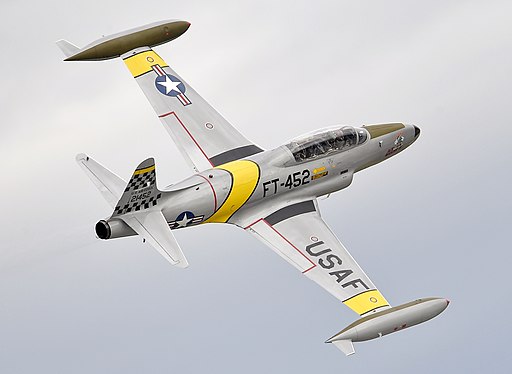
Lockheed T-33
The Lockheed T-33, derived from the renowned P-80 Shooting Star, holds a significant place in aviation history as one of the world’s first jet-powered training aircraft. Introduced in the late 1940s, the T-33 served as a vital platform for training generations of military pilots in the intricacies of jet flight. Its design retained much of the performance and handling characteristics of the P-80, offering trainees a taste of jet-powered aviation while preparing them for more advanced fighter aircraft. With its tandem-seat configuration, the T-33 allowed instructors to closely monitor and guide student pilots, ensuring they gained the skills necessary for operational success.
Beyond its primary role as a training aircraft, the T-33 found utility in various secondary roles, showcasing its versatility and adaptability. In addition to pilot training, it served as a platform for experimental research, instrument calibration, and even light attack missions in certain air forces. Its ability to carry light armament, such as machine guns or rocket pods, allowed it to simulate combat scenarios for trainees or fulfill other operational requirements as needed. Despite lacking the speed and firepower of frontline fighter jets, the T-33’s reliability, simplicity, and ease of maintenance made it a valuable asset in military aviation for decades.
Throughout its operational lifespan, spanning over half a century, the Lockheed T-33 remained a staple in the air forces of numerous countries worldwide. Its enduring legacy is a testament to its reliability, effectiveness, and contribution to the training and development of countless military aviators. Even as more advanced training aircraft emerged, the T-33 continued to serve in various capacities, leaving an indelible mark on the history of military aviation and cementing its status as a classic jet trainer aircraft.
Armament Lockheed T-33
The Lockheed T-33, a variant of the P-80 Shooting Star, was primarily used as a trainer aircraft and did not typically carry armament for combat purposes. However, in certain configurations and roles, it could be equipped with light armament for training or reconnaissance missions. The armament options for the T-33 could include:
- Machine Guns: Some variants of the T-33 were equipped with trainable machine guns, typically .50 caliber Browning M2 machine guns, for training purposes. These machine guns were often installed in the nose or wing-mounted pods to simulate firing during training exercises.
- Rocket Pods: In some cases, the T-33 could be outfitted with underwing rocket pods to simulate air-to-ground rocket attacks or to provide additional training opportunities for pilots. These rocket pods typically carried unguided rockets and were used to train pilots in basic air-to-ground attack techniques.
- Smoke Generators: The T-33 could also be equipped with smoke generators to simulate smoke trails during training exercises, allowing pilots to visualize maneuvers or simulate combat scenarios. These smoke generators were non-lethal and primarily used for training and instructional purposes.
Overall, while the Lockheed T-33 was not designed or widely used as a combat aircraft, it could be configured with light armament or simulation devices to support training activities and provide pilots with a more realistic training experience.
Dimensions of the Lockheed T-33
The Lockheed T-33, a variant of the Lockheed P-80 Shooting Star, has the following approximate dimensions:
- Length: Approximately 11.5 meters (38 feet).
- Wingspan: Approximately 11.9 meters (39 feet).
- Height: Approximately 3.4 meters (11 feet).
These dimensions may vary slightly depending on the specific variant and configuration of the T-33.
