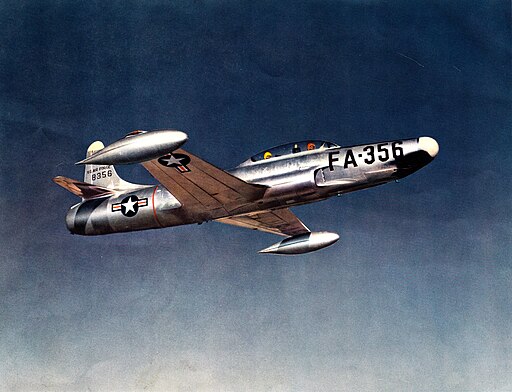
Lockheed F-94 Starfire
The Lockheed F-94 Starfire, a crucial part of early Cold War-era aviation, emerged as one of the first jet-powered all-weather interceptors operated by the United States Air Force (USAF). Initially derived from the T-33 Shooting Star trainer aircraft, the F-94 underwent significant modifications to fulfill its interceptor role, including the addition of a radar system and a weapons suite tailored for aerial combat. Its development marked a critical milestone in the transition from piston-engine to jet-powered interceptors, reflecting the technological advancements of the time.
Introduced in the early 1950s, the F-94 Starfire played a vital role in safeguarding North American airspace against potential threats, particularly Soviet bombers during the tense years of the Cold War. Equipped with advanced radar systems capable of detecting and tracking enemy aircraft in all weather conditions, the F-94 provided a reliable defense capability against airborne intruders, enhancing national security and deterring potential aggressors. Its ability to operate day or night and in adverse weather conditions made it a formidable adversary in the evolving landscape of aerial warfare.
Despite its important role in air defense, the F-94 Starfire saw limited combat action, primarily serving as a deterrent against potential aerial threats rather than engaging in active combat. Nevertheless, its contributions to the development of all-weather interceptors and the evolution of air defense strategies cannot be overstated. The F-94’s service paved the way for subsequent generations of interceptors and laid the foundation for the integrated air defense systems that continue to safeguard the skies today, highlighting its enduring significance in the annals of aviation history.
Armament Lockheed F-94 Starfire
The armament of the Lockheed F-94 Starfire, an early Cold War-era interceptor aircraft, typically included a combination of air-to-air rockets and cannons for engaging enemy aircraft. While specific configurations may have varied depending on mission requirements and operational theaters, the F-94 Starfire was typically armed with:
- Air-to-Air Rockets: The F-94 Starfire was equipped with unguided air-to-air rockets, primarily the Mighty Mouse Folding-Fin Aerial Rocket (FFAR). These rockets were typically mounted in underwing rocket pods and provided the F-94 with a short-range air-to-air capability for engaging enemy aircraft.
- 20mm Cannon: The F-94 Starfire was armed with an internal 20mm M24A1 cannon, which was mounted in the nose of the aircraft. This cannon provided the F-94 with a close-range air-to-air capability for engaging enemy aircraft within visual range. The cannon was typically used as a secondary armament option when engaging enemy aircraft.
Overall, the armament of the Lockheed F-94 Starfire was tailored to its role as an interceptor aircraft, providing it with the capability to engage enemy aircraft in all-weather conditions and safeguard North American airspace during the early years of the Cold War.
Dimensions of the Lockheed F-94 Starfire
The Lockheed F-94 Starfire, an early Cold War-era interceptor aircraft, has the following approximate dimensions:
- Length: Approximately 12.57 meters (41 feet 3 inches).
- Wingspan: Approximately 11.58 meters (38 feet 0 inches).
- Height: Approximately 4.82 meters (15 feet 10 inches).
These dimensions may vary slightly depending on the specific variant and configuration of the F-94 Starfire.
