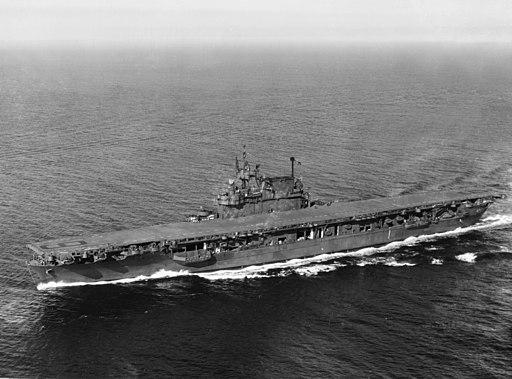
USS Enterprise CV-6
The USS Enterprise (CV-6) stands as one of the most iconic and storied vessels in the history of the United States Navy. Commissioned in 1938, she played a pivotal role throughout World War II, earning the nickname “The Big E” for her immense contributions to Allied victories in the Pacific Theater. As one of the few carriers to survive the entirety of the conflict, the Enterprise became a symbol of American resilience and naval power, participating in some of the most significant battles of the war, including Midway, Guadalcanal, and Leyte Gulf.
Equipped with a formidable arsenal of aircraft and weapons, the USS Enterprise was a force to be reckoned with on the high seas. Her air wing, consisting of fighters, bombers, torpedo planes, and reconnaissance aircraft, delivered devastating blows to enemy targets while providing crucial air support to ground and naval forces. Alongside her aircraft, the Enterprise boasted a formidable array of anti-aircraft guns and machine guns, ensuring her ability to defend against enemy air attacks. This combination of air power and defensive armament made the Enterprise a formidable adversary and a vital asset to the Allied war effort.
Beyond her combat prowess, the USS Enterprise was renowned for her resilience and adaptability. Despite sustaining damage in multiple engagements, including a near-miss by a Japanese bomb at the Battle of the Eastern Solomons, she remained in service throughout the war, earning numerous accolades and commendations for her gallantry and service. Even after the war, the legacy of the USS Enterprise endured, inspiring future generations of sailors and serving as a testament to the enduring spirit of the American Navy.
Armament of USS Enterprise (CV-6)
The armament of the USS Enterprise (CV-6) comprised a combination of aircraft and shipboard defensive weaponry, reflecting her role as an aircraft carrier in the United States Navy during World War II.
- Aircraft: The primary armament of the USS Enterprise was her air group, consisting of various types of aircraft such as fighters, dive bombers, torpedo bombers, and reconnaissance planes. These aircraft provided offensive capabilities, delivering airstrikes against enemy ships, aircraft, and ground targets. The aircraft aboard the Enterprise were instrumental in achieving air superiority and conducting strategic bombing raids throughout the Pacific Theater.
- Anti-Aircraft Guns: To defend against enemy air attacks, the USS Enterprise was equipped with a network of anti-aircraft guns of various calibers. This included 5-inch (127 mm) dual-purpose guns, 40 mm Bofors anti-aircraft guns, and 20 mm Oerlikon cannons. These guns were distributed across the flight deck and island structure of the carrier, providing a formidable defense against incoming enemy aircraft.
- Machine Guns: In addition to the larger anti-aircraft guns, the Enterprise was also outfitted with numerous .50 caliber Browning machine guns for close-range defense. These machine guns were mounted on the flight deck and other strategic locations around the ship to provide protection against low-flying enemy aircraft and strafing attacks.
- Torpedo Tubes: While aircraft carriers typically did not carry torpedo tubes, the USS Enterprise was initially equipped with eight 21-inch torpedo tubes during her early years of service. However, these torpedo tubes were later removed to make room for additional anti-aircraft weaponry as the carrier’s role shifted primarily to air operations.
Overall, the armament of the USS Enterprise (CV-6) was a carefully balanced combination of offensive and defensive capabilities, allowing her to effectively project power across the vast expanses of the Pacific Ocean while also defending herself against enemy threats from the air and sea.
Dimensions of USS Enterprise (CV-6)
The USS Enterprise (CV-6) was one of the iconic aircraft carriers of the United States Navy during World War II. Below are the approximate dimensions of the USS Enterprise:
- Length: The overall length of the USS Enterprise was approximately 809 feet (246.6 meters). This measurement encompassed the entire length of the flight deck from the bow to the stern.
- Beam: The width, or beam, of the USS Enterprise was approximately 83 feet (25.3 meters). This measurement represented the widest point of the carrier’s hull.
- Draft: The draft of the USS Enterprise, which refers to the vertical distance between the waterline and the bottom of the hull, varied depending on the ship’s load and displacement. However, the average draft during normal operating conditions was around 25 feet (7.6 meters).
- Displacement: The displacement of the USS Enterprise varied depending on factors such as fuel, ammunition, and aircraft onboard. However, the standard displacement was approximately 19,800 tons, while the full load displacement could exceed 25,000 tons.
These dimensions provided the USS Enterprise with the necessary size and stability to accommodate a large complement of aircraft and support operations across the vast expanses of the Pacific Ocean during World War II. As one of the most renowned carriers of its time, the USS Enterprise played a pivotal role in numerous pivotal battles and campaigns, earning its place in history as one of the most storied vessels of the war.
_in_Puget_Sound,_September_1945.jpg)