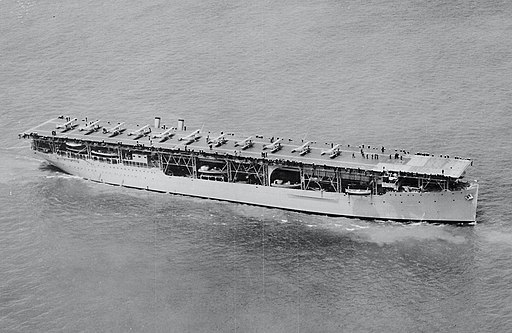
USS Langley CV-1
The USS Langley (CV-1) holds a significant place in naval history as the United States Navy’s first aircraft carrier. Originally commissioned as a collier in 1913, the USS Langley was converted into an aircraft carrier in 1920, marking the beginning of a new era in naval warfare. With a length of 542 feet and a displacement of around 11,500 tons, the Langley was a pioneering vessel that paved the way for the development of carrier aviation.
During its service, the USS Langley played a crucial role in advancing the capabilities of naval aviation. Its flight deck was used to launch and recover a variety of aircraft, including biplanes and seaplanes. While its capacity and capabilities were limited compared to later aircraft carriers, the Langley proved the concept of carrier-based aviation and demonstrated the potential for aircraft carriers to project power across vast distances.
Throughout its career, the USS Langley served as a testbed for new technologies and tactics, helping to refine the strategies and doctrines that would shape naval aviation in the years to come. Despite being converted from a collier and lacking the advanced features of later carriers, the Langley laid the foundation for the development of the formidable carrier strike groups that would become a cornerstone of modern naval warfare. Its legacy as the U.S. Navy’s first aircraft carrier remains a testament to the ingenuity, innovation, and adaptability of naval forces in the face of evolving threats and challenges.
Armament of USS Langley (CV-1)
As the United States Navy’s first aircraft carrier, the USS Langley (CV-1) had a modest armament primarily focused on self-defense. The armament of the USS Langley typically included:
- Anti-Aircraft Guns: The primary armament of the USS Langley consisted of anti-aircraft guns to defend against enemy aircraft attacks. This typically included a combination of 3-inch (76 mm) anti-aircraft guns and .50 caliber machine guns. These guns were positioned on the flight deck and around the island structure of the carrier to provide coverage against aerial threats.
- Machine Guns: In addition to the larger caliber anti-aircraft guns, the USS Langley was also armed with numerous .30 caliber and .50 caliber Browning machine guns for close-range defense and anti-personnel purposes. These machine guns were typically mounted in various locations around the ship to engage enemy aircraft and provide additional protection against strafing attacks.
Overall, the armament of the USS Langley (CV-1) was relatively light compared to later aircraft carriers, reflecting its role primarily as a platform for launching and recovering aircraft rather than engaging in direct combat. The carrier relied primarily on its aircraft for offensive operations, while its anti-aircraft guns and machine guns served to deter and defend against enemy threats encountered during its operations in the early years of naval aviation.
Dimensions of USS Langley (CV-1)
The USS Langley (CV-1), as the United States Navy’s first aircraft carrier, had the following approximate dimensions:
- Length: The overall length of the USS Langley was approximately 542 feet (165 meters). This measurement encompassed the entire length of the carrier’s hull from the bow to the stern.
- Beam: The width, or beam, of the USS Langley was approximately 65 feet (20 meters). This measurement represented the widest point of the carrier’s flight deck.
- Draft: The draft of the USS Langley, which refers to the vertical distance between the waterline and the bottom of the hull, varied depending on the ship’s load and displacement. However, the average draft during normal operating conditions was around 24 feet (7.3 meters).
- Displacement: The displacement of the USS Langley varied depending on factors such as fuel, ammunition, and aircraft onboard. However, the standard displacement was approximately 11,500 tons, while the full load displacement could exceed 14,000 tons.
These dimensions provided the USS Langley with the necessary size and stability to operate effectively as an aircraft carrier, launching and recovering aircraft from its flight deck. As the pioneering vessel that laid the groundwork for the development of carrier aviation, the Langley’s dimensions represented a significant leap forward in naval warfare capabilities and set the stage for the evolution of larger and more advanced aircraft carriers in the years to come.
_underway_in_June_1927_(cropped).jpg)