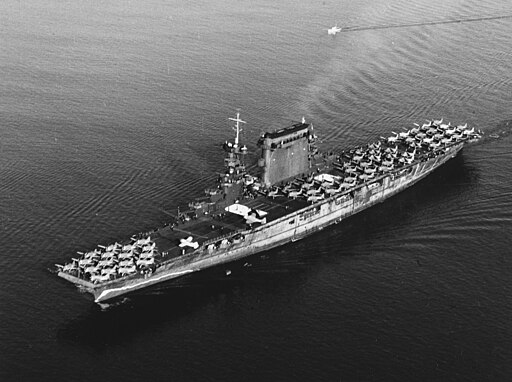
USS Lexington CV-2
The USS Lexington (CV-2) holds a revered place in the annals of American naval history as one of the U.S. Navy’s first aircraft carriers. Commissioned in 1927, the Lexington represented a significant leap forward in naval aviation capabilities, embodying the nation’s commitment to innovation and technological advancement. As the lead ship of its class, the Lexington played a pioneering role in the development of carrier-based aviation tactics and strategies, setting the stage for the future of naval warfare.
Throughout its distinguished career, the USS Lexington participated in numerous operations and campaigns, showcasing its versatility and effectiveness as a strategic asset. During the interwar years, the Lexington served as a symbol of American naval power projection, projecting strength and influence across the Pacific and Atlantic Oceans. With its formidable air wing and advanced aircraft handling capabilities, the Lexington played a key role in training and developing the skills of naval aviators, ensuring that the United States Navy remained at the forefront of aerial warfare.
Tragically, the USS Lexington met its end during the Battle of the Coral Sea in May 1942, where it was severely damaged by Japanese airstrikes. Despite valiant efforts to save the ship, the damage proved catastrophic, and the Lexington ultimately had to be scuttled by U.S. forces to prevent its capture by the enemy. While its service was cut short, the legacy of the USS Lexington endures as a testament to American naval ingenuity, resilience, and determination. The Lexington’s contributions to the advancement of carrier-based aviation and its role in shaping the course of World War II serve as a lasting tribute to its place in naval history, inspiring future generations of sailors and aviators to uphold its legacy of excellence.
Armament of USS Lexington (CV-2)
The armament of the USS Lexington (CV-2) included various weapons systems for self-defense and aircraft support. Here is a list of its main armament:
- Aircraft: The USS Lexington was capable of carrying a complement of aircraft, including fighters, bombers, torpedo bombers, and reconnaissance planes. These aircraft formed the primary offensive and defensive capability of the ship.
- Anti-Aircraft Guns: For self-defense against air attacks, the Lexington was equipped with a range of anti-aircraft guns, including 5-inch (127 mm) guns and 1.1-inch (28 mm) quad-mounted anti-aircraft guns. These guns were used to engage enemy aircraft that threatened the ship.
- Machine Guns: In addition to the larger anti-aircraft guns, the Lexington carried a number of 50-caliber machine guns for defense against air attacks and for engaging low-flying targets.
This armament provided the USS Lexington with the means to defend itself and provide protection to its aircraft during missions. Throughout its service, the Lexington played a crucial role in various operations and battles, contributing significantly to the Allied war effort in the Pacific Theater during World War II.
Dimensions of USS Lexington (CV-2)
The USS Lexington (CV-2) had the following approximate dimensions:
- Length: Approximately 888 feet (270.7 meters)
- Beam (Width): Approximately 106 feet (32.3 meters)
- Draft (Depth): Approximately 24 feet (7.3 meters)
These dimensions may vary slightly depending on specific configurations and modifications made over the course of the ship’s service. As one of the early aircraft carriers of the United States Navy, the Lexington played a significant role in shaping the evolution of naval aviation and the projection of American power in the Pacific Theater during World War II.
_leaving_San_Diego_on_14_October_1941_(80-G-416362).jpg)