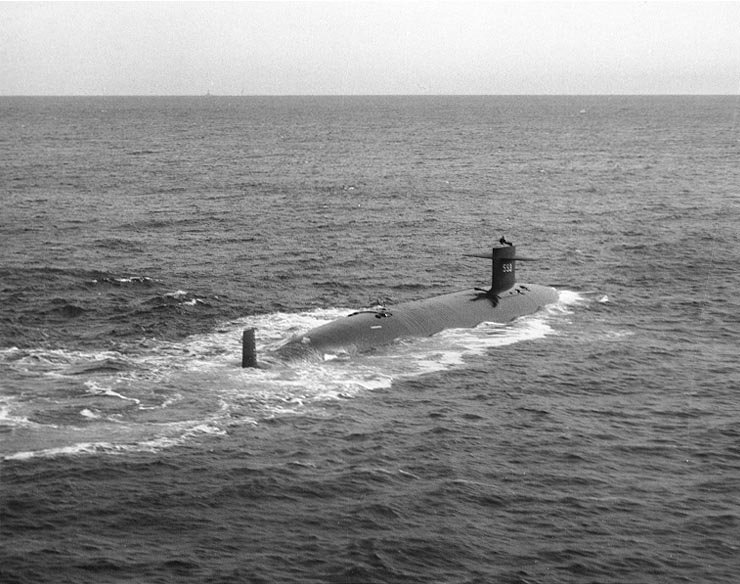
USS Thresher SSN-593
USS Thresher (SSN-593) was a nuclear-powered attack submarine that served in the United States Navy. Commissioned in 1961, Thresher was one of the first submarines of her class, designed to provide advanced capabilities in anti-submarine warfare and intelligence gathering. However, tragedy struck on April 10, 1963, when Thresher tragically sank during deep-diving tests off the coast of Massachusetts. The loss of Thresher was the deadliest submarine disaster in American history at that time, resulting in the deaths of all 129 crew members and civilians aboard.
The sinking of USS Thresher prompted a thorough investigation into its causes and the safety of nuclear submarines. It led to significant improvements in submarine design, construction, and safety protocols. The subsequent inquiry identified critical issues with the submarine’s construction and maintenance, particularly regarding its piping systems and welding techniques. These findings spurred the implementation of more stringent safety measures and the establishment of rigorous testing protocols for submarines, ensuring that such a tragedy would not occur again.
USS Thresher’s legacy extends beyond the tragedy of its sinking. The lessons learned from this disaster have contributed to enhancing the safety and reliability of subsequent generations of submarines. The memory of Thresher and her crew serves as a somber reminder of the risks inherent in naval operations and the ongoing commitment to ensuring the safety of those who serve beneath the waves.
Armament of USS Thresher (SSN-593)
USS Thresher (SSN-593) was equipped with a variety of armaments typical for a nuclear-powered attack submarine of its era. While the specific armament configurations may have varied during its service, here is a typical armament list for a submarine of the Thresher’s class:
- Torpedoes: Thresher would have been armed with a mix of Mark 37 torpedoes, which were electrically propelled and designed for anti-submarine warfare, and Mark 45 torpedoes, which were faster and had longer ranges. These torpedoes could be launched from the submarine’s torpedo tubes.
- Submarine-launched missiles: Depending on the era and upgrades, Thresher may have been equipped with submarine-launched ballistic missiles (SLBMs) or submarine-launched cruise missiles (SLCMs). These missiles would have provided Thresher with the capability to engage surface targets or land-based targets from long ranges while submerged.
- Anti-ship missiles: Some submarines of the Thresher’s class were also equipped with anti-ship missiles, such as the Harpoon missile system. These missiles would have enabled Thresher to engage surface vessels effectively.
- Mines: Submarines like Thresher could be equipped to lay mines in enemy waters, creating obstacles for enemy ships and submarines. These mines would have been stored internally and deployed through specialized mine tubes.
- Close-in weapon systems (CIWS): While primarily defensive in nature, CIWS such as the Phalanx or Goalkeeper systems could have been installed on Thresher to provide protection against incoming threats such as anti-ship missiles or aircraft.
It’s important to note that the specific armament of USS Thresher would have been subject to upgrades and changes throughout its service life, reflecting advancements in technology and changes in strategic priorities.
Dimensions of USS Thresher (SSN-593)
The USS Thresher (SSN-593) was a nuclear-powered attack submarine of the United States Navy. Here are the approximate dimensions of the Thresher:
- Length: The Thresher had a length of approximately 278 feet (about 85 meters). This length measurement includes the hull from the tip of the bow to the end of the stern.
- Beam: The beam, or width, of the Thresher was approximately 32 feet (about 9.8 meters). This measurement represents the widest point of the submarine’s hull.
- Draft: The draft of the Thresher, which refers to the depth of the submarine below the waterline, was approximately 28 feet (about 8.5 meters). This measurement indicates how deep the submarine sits in the water when fully submerged.
These dimensions provide an understanding of the size and scale of the USS Thresher, which was a significant vessel in the U.S. Navy’s submarine fleet during the early 1960s.
