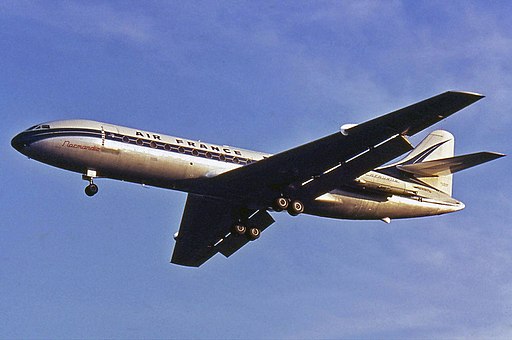
Sud Aviation Caravelle
The Sud Aviation Caravelle stands as one of the most iconic aircraft in the history of commercial aviation, symbolizing a transformative era when jet propulsion revolutionized air travel. Emerging from a period marked by rapid technological advancements and a growing demand for faster, more efficient airliners, the Caravelle was not merely an aircraft—it was a bold statement of innovation, design excellence, and the pioneering spirit of postwar Europe.
Origins and Development
The genesis of the Caravelle can be traced back to the mid-1950s, a time when the aviation industry was eager to leave behind the era of propeller-driven aircraft. In response to this demand, French aerospace engineers at Sud Aviation embarked on a project to create a jet-powered airliner that would set new standards for speed, efficiency, and passenger comfort. At a time when many nations were racing to harness the power of jet engines, the Caravelle emerged as a testament to French ingenuity and the collaborative efforts of engineers, designers, and visionaries.
From its earliest design stages, the Caravelle was envisioned as a short- to medium-range jet airliner that could serve the burgeoning network of postwar European routes. The design team focused on creating an aircraft that combined sleek aesthetics with practicality, ensuring that it could meet the operational requirements of airlines while delivering a superior flying experience. The result was a plane that featured a distinctive swept-wing design, a T-tail configuration, and engines mounted at the rear of the fuselage—innovations that would soon become hallmarks of modern jet airliners.
Innovative Design and Engineering
One of the most striking features of the Sud Aviation Caravelle is its unconventional engine layout. Unlike many of its contemporaries, which positioned engines beneath the wings, the Caravelle’s engines were mounted at the rear of the fuselage. This design choice brought multiple benefits. First, it significantly reduced cabin noise, creating a more comfortable environment for passengers. Second, the rear-mounted configuration improved aerodynamic efficiency and contributed to a cleaner wing design, allowing for better performance at higher speeds and altitudes.
The aircraft’s sleek, aerodynamic lines were not only visually appealing but also functional. The swept-wing design reduced drag at transonic speeds, making the Caravelle one of the faster jet airliners of its time. The T-tail provided enhanced stability and improved control, particularly during takeoff and landing—a critical factor in an era when airport infrastructures were still adapting to the demands of jet travel. These design elements combined to produce an airliner that was both innovative and highly practical, capable of serving a wide range of operational scenarios.
Technical Specifications and Performance
The performance of the Sud Aviation Caravelle set it apart from many of its competitors. With a cruising speed that allowed airlines to reduce travel times significantly, the aircraft was well-suited for the short- to medium-haul routes that defined the early jet era. Depending on the variant, the Caravelle could carry between 80 and 140 passengers, with cabin configurations designed to maximize comfort while maintaining operational efficiency.
Equipped with state-of-the-art jet engines of its time, the Caravelle was engineered for reliability and efficiency. Its robust performance, combined with an impressive range that enabled nonstop flights between key European destinations, made it a favorite among airlines seeking to modernize their fleets. The aircraft’s design also allowed for relatively low operating costs—a crucial factor for carriers in the competitive postwar aviation market.
Operational History and Global Impact
Entering service at the dawn of the jet age, the Sud Aviation Caravelle quickly captured the attention of airlines around the world. Its debut on the commercial scene marked a turning point, as it provided a glimpse into the future of air travel where speed, efficiency, and passenger comfort were paramount. European carriers, notably Air France and several Scandinavian airlines, were among the first to integrate the Caravelle into their fleets, using it to connect cities across the continent with unprecedented speed.
The Caravelle’s operational success was not confined to Europe alone. Its reliability and performance made it a popular choice in various international markets, including routes in Africa, Asia, and Latin America. As airlines around the globe sought to upgrade their fleets to meet the evolving demands of modern air travel, the Caravelle’s reputation for efficiency and durability played a key role in its widespread adoption.
In service, the Caravelle proved its mettle in a variety of roles. It was used not only as a passenger airliner but also for cargo transport and specialized missions, demonstrating its versatility in adapting to different operational needs. Over time, several improved variants of the Caravelle were introduced, each incorporating incremental technological advancements and refinements based on operational feedback. These upgrades ensured that the aircraft remained competitive even as newer models emerged, solidifying its legacy as a durable workhorse of the jet age.
Legacy of Innovation
The impact of the Sud Aviation Caravelle extends far beyond its immediate operational success. As one of the first successful jet airliners designed and produced in Europe, it played a critical role in establishing the region as a significant player in the aerospace industry. The design philosophies and engineering solutions implemented in the Caravelle influenced subsequent generations of aircraft, paving the way for future innovations in both European and global aviation.
The Caravelle’s rear-engine configuration, in particular, became a trendsetter. Later aircraft designs, including several models from other manufacturers, adopted similar engine placements to capitalize on the benefits of reduced noise and improved aerodynamics. This design legacy is a testament to the forward-thinking approach of the engineers at Sud Aviation, whose willingness to challenge conventional design norms contributed significantly to the evolution of modern airliners.
Moreover, the Caravelle holds a special place in the hearts of aviation enthusiasts and historians alike. Its distinctive design and historical significance have made it a popular subject in aviation museums and airshows around the world. Many retired Caravelle aircraft are preserved as a reminder of a pivotal moment in aviation history—a time when the boundaries of what was possible were being dramatically redefined by technological innovation and creative engineering.
Challenges and Adaptations
No pioneering aircraft is without its challenges, and the Sud Aviation Caravelle faced its share of hurdles as it entered service. The rapid pace of technological change in the aviation industry meant that the Caravelle had to continuously evolve to remain competitive. Early models, while innovative, eventually gave way to improved variants that addressed issues such as fuel efficiency, range, and passenger capacity.
The competitive landscape of the jet age also brought challenges from new entrants, particularly from American manufacturers who were rapidly developing their own jet airliners. Despite this intense competition, the Caravelle’s combination of design elegance and practical performance allowed it to maintain a strong presence in the market for many years. The continuous refinements and updates introduced by Sud Aviation ensured that the aircraft could meet the evolving demands of airlines and passengers alike.
A Symbol of French Engineering and International Cooperation
The story of the Sud Aviation Caravelle is also one of international collaboration and the sharing of technological expertise. While the aircraft was a product of French engineering, its success was intertwined with the global aviation market. Airlines from around the world embraced the Caravelle, integrating it into their fleets and contributing to a new era of international air travel. This cross-border adoption not only underscored the aircraft’s superior design but also highlighted the growing interconnectedness of the global aviation industry.
Furthermore, the Caravelle served as an important stepping stone for the European aerospace industry. Its success bolstered confidence in European manufacturing capabilities and set the stage for future collaborations that would eventually lead to the development of some of the world’s most successful commercial aircraft. In this way, the Caravelle is remembered not only as an outstanding aircraft in its own right but also as a catalyst for a broader transformation in global aviation.
Conclusion
Today, the legacy of the Sud Aviation Caravelle endures as a symbol of innovation and excellence during a pivotal era in aviation history. Its groundbreaking design, operational versatility, and significant contributions to the jet age have cemented its place among the great pioneers of modern air travel. As modern airliners continue to push the boundaries of technology and efficiency, the Caravelle’s spirit of innovation serves as a lasting reminder of what can be achieved through visionary engineering and creative problem-solving.
In reflecting on the Caravelle’s storied past, one cannot help but appreciate its enduring influence on both the aircraft that followed and the broader trajectory of commercial aviation. The aircraft’s ability to combine performance, safety, and comfort set a new standard for the industry—a standard that continues to inspire designers and engineers to this day. The Sud Aviation Caravelle is not just a chapter in the history of flight; it is a beacon of progress, illuminating the path toward the future of global air travel.
