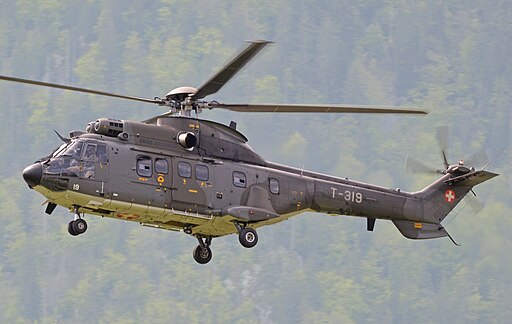
Eurocopter AS332 Super Puma
Eurocopter AS332 Super Puma: The Versatile Multi-Role Helicopter
The Eurocopter AS332 Super Puma is a twin-engine, medium-lift utility helicopter that has earned a reputation for reliability, power, and versatility in both civilian and military applications. Originally developed by Aérospatiale in the late 1970s and later manufactured by Eurocopter (now Airbus Helicopters), the Super Puma has been widely used for military transport, offshore operations, search and rescue (SAR), and disaster relief.
With a spacious cabin, powerful engines, and advanced avionics, the AS332 Super Puma continues to serve in demanding environments worldwide, including harsh maritime conditions, mountainous regions, and combat zones. Over the decades, it has evolved into an even more capable platform, leading to the development of the H225 (formerly EC225) Super Puma.
Development and History
Origins: From Puma to Super Puma
The AS332 Super Puma was developed as an improved and more powerful version of the Aérospatiale SA 330 Puma, a helicopter introduced in the 1960s. While the SA 330 was widely successful, the aviation industry demanded greater payload capacity, better range, and more powerful engines.
To meet these needs, Aérospatiale began working on an upgraded model, leading to the first flight of the AS332 Super Puma on September 13, 1978. The improvements included:
- More powerful engines for greater lifting capacity
- A stretched fuselage for more cargo space
- Enhanced avionics for improved navigation and safety
- A reinforced airframe for increased durability in tough conditions
Introduction and Production
The AS332 Super Puma entered service in the early 1980s, quickly gaining popularity among:
- Oil and gas companies for offshore transport
- Military forces for troop and cargo transport
- Emergency services for search and rescue operations
Following the merger of Aérospatiale and Daimler-Benz Aerospace in 1992, the helicopter became part of Eurocopter and later Airbus Helicopters. Over time, it has been modernized and replaced in some roles by the H225 Super Puma, though many AS332s remain in active service.
Technical Specifications of the AS332 Super Puma
Engine and Performance
The AS332 Super Puma is known for its twin-engine powerplant, allowing it to operate in high-altitude, maritime, and extreme weather conditions.
Engine Details:
- Engines: 2 × Turbomeca Makila 1A1 turboshaft engines
- Power Output: 1,577 shp (1,176 kW) per engine
- Maximum Speed: 277 km/h (172 mph)
- Cruising Speed: 252 km/h (157 mph)
- Range: 851 km (529 miles)
- Service Ceiling: 6,100 meters (20,000 feet)
- Rate of Climb: 7.4 m/s (1,450 ft/min)
- Maximum Takeoff Weight: 9,150 kg (20,172 lbs)
These performance specifications make the Super Puma ideal for long-range missions and heavy-lift operations, particularly in offshore and military roles.
Airframe and Design
The AS332 Super Puma’s design incorporates aerodynamic efficiency and structural strength, allowing it to operate in diverse environments.
Key Design Features:
- Four-blade main rotor with composite blades for durability
- Fixed landing gear (wheeled for smooth landings on various terrains)
- Large sliding doors for easy loading and unloading of cargo or personnel
- Crash-resistant fuel tanks to improve survivability in emergencies
The Super Puma’s sturdy build and safety features make it well-suited for military and civilian operations in extreme conditions.
Cockpit and Avionics
The Super Puma’s cockpit features modern avionics and flight controls, improving pilot situational awareness and mission effectiveness.
Key Avionics and Equipment:
- Glass cockpit (on newer variants) with digital displays
- Autopilot and stability augmentation systems
- Weather radar and night vision compatibility
- GPS and advanced navigation systems
- Self-defense systems (on military versions), including radar warning receivers and flare dispensers
These features allow the Super Puma to operate safely in low-visibility, night-time, and combat environments.
Roles and Applications
Military Operations
The AS332 Super Puma has been widely used by air forces, navies, and armies worldwide, performing various roles, including:
- Troop Transport – Moving soldiers efficiently across battlefields
- Cargo Transport – Carrying heavy supplies, weapons, and equipment
- Combat Search and Rescue (CSAR) – Extracting personnel from hostile areas
- Special Forces Deployment – Infiltrating and extracting elite military units
- Medical Evacuation (MEDEVAC) – Airlifting wounded soldiers to medical facilities
Many military variants of the Super Puma are equipped with:
✅ Ballistic armor protection
✅ Self-sealing fuel tanks
✅ Machine guns and countermeasures for self-defense
Offshore and Commercial Transport
One of the most common civilian applications of the AS332 Super Puma is transporting workers to and from offshore oil and gas platforms.
- Large passenger capacity (up to 19 people)
- Long-range endurance for extended offshore missions
- Ability to fly in harsh weather and over open water
Oil companies and helicopter operators like Bristow Helicopters and CHC Helicopter have relied on the Super Puma for decades.
Search and Rescue (SAR) and Disaster Relief
The AS332 Super Puma is a preferred helicopter for search and rescue (SAR) operations due to its:
- High endurance and range
- Ability to hover in extreme conditions
- Powerful winch for hoisting people from difficult locations
It has been used for natural disaster relief, including:
- Rescuing flood victims
- Delivering supplies after earthquakes
- Fighting wildfires (with water-carrying systems)
VIP Transport and Law Enforcement
Government agencies and VIP transport services use the Super Puma to transport:
- Heads of state
- Government officials
- Law enforcement teams for counter-terrorism operations
Notably, the French Air Force and Swiss Air Force use specially modified AS332s for presidential and governmental transport.
Operators and Legacy
Countries Using the AS332 Super Puma
The AS332 Super Puma is operated by more than 40 countries, including:
- France – French Air Force and Navy
- United Kingdom – Royal Air Force and private offshore operators
- Germany – German Air Force for military transport
- Norway – Offshore oil industry transport
- Brazil – Military and law enforcement roles
- Indonesia – Disaster relief and SAR missions
Evolution: The H225 Super Puma
The modern successor to the AS332 is the Airbus H225 Super Puma (formerly known as the EC225), featuring:
- More powerful engines
- Advanced avionics
- Better fuel efficiency
- Improved safety features
Despite these advancements, many original AS332 Super Pumas remain in service, proving their durability and lasting impact on aviation.
Conclusion: A True Workhorse of the Skies
The Eurocopter AS332 Super Puma has stood the test of time as one of the most versatile, reliable, and powerful helicopters ever built. Whether in military combat zones, offshore oil rigs, or life-saving rescue missions, the Super Puma continues to serve with distinction.
With its impressive lifting capacity, advanced avionics, and proven performance in extreme environments, the Super Puma remains a trusted helicopter for many organizations worldwide, solidifying its legacy as a true workhorse of the skies.
