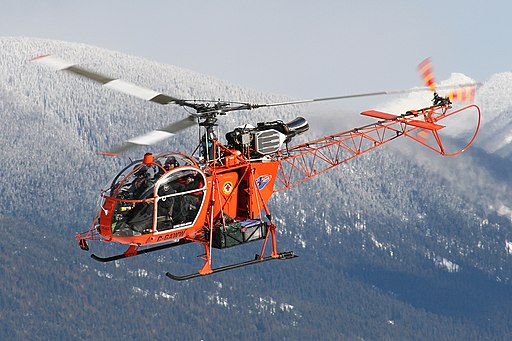
Aérospatiale SA 315B Lama
Aérospatiale SA 315B Lama: The Legendary High-Altitude Helicopter
The Aérospatiale SA 315B Lama is one of the most iconic light helicopters in history, designed specifically for high-altitude operations and extreme conditions. Developed in France in the late 1960s, the Lama combined elements of previous successful helicopters to create a powerful, agile, and highly capable aircraft that could operate where few other helicopters could.
Known for its exceptional lift capacity, rugged construction, and ability to fly in the world’s highest mountain ranges, the SA 315B Lama has seen extensive use in military, civilian, and rescue operations worldwide. Even decades after its introduction, it remains a respected workhorse in challenging environments.
Development and History
The Need for a High-Altitude Helicopter
In the 1960s, the Indian Air Force (IAF) required a helicopter that could perform high-altitude missions in the Himalayas, particularly for troop transport, supply drops, and rescue operations. The existing helicopters struggled in the thin air and extreme weather conditions of the region.
At the same time, Sud Aviation (which later became part of Aérospatiale) was looking to create a light helicopter with exceptional altitude performance. Instead of designing a completely new aircraft, engineers decided to combine:
- The fuselage of the Aérospatiale Alouette II
- The powerful engine of the Alouette III
This combination resulted in the SA 315B Lama, a helicopter specifically built to handle high-altitude missions with heavy loads.
First Flight and Production
- The first prototype of the SA 315B Lama flew on March 17, 1969.
- After extensive testing, the helicopter entered production in 1971.
- The Indian Air Force quickly adopted the Lama, which was produced under license by Hindustan Aeronautics Limited (HAL) as the HAL Cheetah.
- Over the next few decades, hundreds of Lamas were produced, serving in Europe, Asia, South America, and beyond.
Technical Specifications of the SA 315B Lama
Engine and Performance
The Lama is powered by a single turboshaft engine, giving it the power needed for extreme high-altitude operations.
Engine Details:
- Model: Turbomeca Artouste IIIB
- Power Output: 870 horsepower (650 kW)
- Main Rotor Diameter: 11.02 meters (36 feet 2 inches)
- Tail Rotor Diameter: 1.91 meters (6 feet 3 inches)
- Maximum Speed: 192 km/h (119 mph)
- Cruising Speed: 171 km/h (106 mph)
- Range: 515 km (320 miles)
- Service Ceiling: 7,000 meters (23,000 feet)
- Maximum Takeoff Weight: 2,300 kg (5,070 lbs)
With this engine and lightweight design, the SA 315B Lama was capable of flying at altitudes far beyond most helicopters of its time.
Airframe and Design
The Lama’s airframe was built to be light, yet strong, allowing it to perform heavy-lift operations while withstanding extreme weather.
Key Features of the Airframe:
- Open-frame tail boom for weight reduction and better cooling
- Bubble canopy cockpit for maximum visibility
- Skid-type landing gear for rough terrain operations
- Compact fuselage for maneuverability in tight spaces
This design made the Lama an ideal choice for mountain operations, remote supply missions, and high-risk rescue flights.
Cockpit and Avionics
The cockpit of the SA 315B Lama is designed for maximum visibility and efficiency, ensuring pilots can operate effectively in extreme environments.
Cockpit Features:
- Seating for a pilot and one or two passengers (depending on configuration)
- Basic flight instruments for VFR (Visual Flight Rules) operations
- Upgraded avionics available for IFR (Instrument Flight Rules) operations
- Optional cargo hook controls for sling load operations
Despite being a relatively simple and lightweight helicopter, the Lama could be equipped with modern avionics to improve safety and versatility.
Operational Capabilities and Uses
High-Altitude Performance and World Records
One of the SA 315B Lama’s greatest achievements is its unmatched high-altitude performance.
- On June 21, 1972, French test pilot Jean Boulet set a world record by flying a Lama to 12,442 meters (40,820 feet)—the highest altitude ever reached by a helicopter at that time.
- The aircraft still holds records for high-altitude operations and heavy lifting in extreme conditions.
Military Applications
The Lama was widely adopted by military forces around the world for various roles, including:
- Troop transport and insertion in remote areas
- Cargo and supply transport via sling-load operations
- Search and rescue (SAR) missions in mountainous terrain
- Reconnaissance and observation
- Light attack and armed escort (when equipped with machine guns and rockets)
Civilian and Rescue Operations
In the civilian sector, the SA 315B Lama became a favorite among helicopter operators in rugged regions, especially for:
- Mountain rescue operations in the Alps, Himalayas, and Andes
- Aerial construction and powerline maintenance in remote areas
- Logging and forestry operations
- Oil and gas exploration in harsh environments
Its ability to lift heavy loads in extreme conditions made it invaluable for emergency services, construction teams, and scientific expeditions.
Operators and Legacy
Key Operators
The SA 315B Lama has been used by many countries worldwide, including:
- France – French Army and Gendarmerie
- India – Indian Air Force (as HAL Cheetah)
- Nepal – Nepalese Army Air Service for mountain rescue and transport
- Switzerland – Used extensively for high-altitude rescue operations in the Alps
- South America – Used in Peru, Argentina, and Chile for Andean missions
Successor and Modern Replacements
Although the Lama is still in use today, many air forces and civilian operators have begun replacing it with modern helicopters like:
- HAL Cheetal – An upgraded version of the Lama with a new engine
- Eurocopter AS350 Écureuil – A more modern and efficient alternative
- Bell 407 – A popular replacement in high-altitude operations
Despite these replacements, the Lama remains one of the most respected helicopters ever built, with many aircraft still flying in remote and extreme environments.
Conclusion: A Timeless Legend in Aviation
The Aérospatiale SA 315B Lama is more than just a helicopter—it is a symbol of high-altitude aviation excellence. Designed to operate in the most demanding conditions, it has served military forces, rescue teams, and civilian operators for over 50 years.
With its record-breaking altitude performance, rugged reliability, and unmatched lifting power, the Lama continues to prove its worth, even as modern helicopters take its place. Few aircraft have left such a lasting impact on aviation history, making the SA 315B Lama a true legend of the skies.
.jpg)