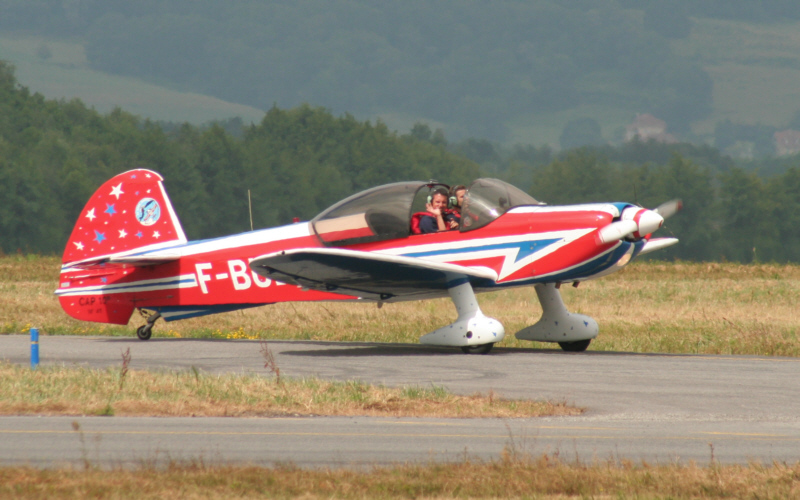
Mudry CAP 10
The Mudry CAP 10 is a two-seat aerobatic monoplane celebrated for its precision, agility, and robust design. Originating in France in the 1970s, it has become a global standard for basic and advanced aerobatic training. Pilots praise its responsive controls, forgiving stall characteristics, and impressive g-load tolerance. Whether teaching loop, roll, or spin entry and recovery, the CAP 10 delivers safety and performance in equal measure.
Design and Development
Origins and Collaborative Engineering
The CAP 10 emerged from a collaboration between Pierre and Étienne Mudry and the French company Avions Mudry. Building on the lineage of the earlier CAP 20, designers simplified the structure and optimized weight distribution to enhance low-speed handling and stall recovery. The resulting airframe combined a welded steel-tube fuselage with wooden wings, offering a lightweight yet sturdy platform suited to repeated aerobatic stress cycles.
Airframe Structure
The fuselage consists of a chromoly steel-tube framework, welded into a truss that resists bending and torsional loads. Over this frame, a lightweight composite shell provides aerodynamic smoothness. Wings are constructed using spruce spars and plywood ribs, covered by doped fabric and reinforced at high-stress zones. The horizontal and vertical stabilizers share this wooden construction, ensuring consistent stiffness and predictable control response.
Aerodynamic Features
A symmetrical airfoil profile ensures identical lift behavior in upright and inverted flight. Full-span ailerons deliver crisp roll authority, while 45 cm-deep elevators provide aggressive pitch rates. The wing’s aspect ratio and modest dihedral angle strike a balance between maneuverability and stability, enabling sustained sustained energy through complex sequences.
Cockpit and Avionics
Ergonomics and Visibility
Two tandem seats accommodate instructor and student, each with a five-point harness and energy-absorbing foam cushions. The raised rear seat offers a clear view over the instructor’s headrest, enhancing safety during training flights. A large canopy with minimal framing grants panoramic visibility, critical for spatial orientation in aerobatic maneuvers.
Instrumentation Suite
The CAP 10’s panel focuses on essential flight and engine data:
- Airspeed indicator graduated to 400 km/h
- Attitude indicator with 360° pitch vision
- Turn-and-slip indicator calibrated for 1 g
- Tachometer and manifold pressure gauge
- Cylinder head and oil temperature sensors
- Optional G-meter for recording positive and negative g-loads
Electrical power is supplied by a 14 V alternator and 12 V battery, driving essential lighting, radios, and instrumentation. A standby magnetic compass provides backup navigation reference.
Variants and Modifications
CAP 10B and CAP 10B/K
Early CAP 10B models featured a 180 hp Lycoming O-360 engine and basic aerobatic equipment. The later CAP 10B/K upgrades introduced inverted fuel and oil systems, allowing unlimited negative g-maneuvers and extended inverted flight.
CAP 10C
The CAP 10C variant incorporated a reinforced airframe certified for ±6 g, auto-fuelling valves, and improved control linkage for sharper responsiveness. Many CAP 10B/K airframes have since been retrofitted to C standard.
Modernized Retrofits
Operators often install:
- Digital engine monitors with EGT and CHT cylinders
- Glass-panel EFIS units replacing analog gauges
- Lightweight composite cowling and wingtips
- Ballistic recovery parachute systems in the center fuselage
Technical Specifications
Dimensions and Weights
| Parameter | Value |
|---|---|
| Wingspan | 8.43 m |
| Length | 6.30 m |
| Height | 2.50 m |
| Wing Area | 11.0 m² |
| Empty Weight | 530 kg |
| Maximum Takeoff Weight | 820 kg |
| Useful Load | 290 kg |
Performance
| Parameter | Value |
|---|---|
| Maximum Speed | 350 km/h |
| Cruise Speed | 260 km/h |
| Stall Speed (Flaps Down) | 90 km/h |
| Rate of Climb | 10 m/s |
| Service Ceiling | 5,500 m |
| Range (Standard Fuel) | 650 km |
| G-Load Limit (CAP 10C) | +6 g / –4 g |
| Takeoff Distance (Ground Roll) | 150 m |
| Landing Distance (Ground Roll) | 170 m |
Powerplant
| Parameter | Value |
|---|---|
| Engine | Lycoming O-360-A3A |
| Power Output | 134 kW (180 hp) at 2,700 rpm |
| Propeller | 2-blade constant-speed |
| Fuel Capacity | 120 L |
| Fuel Consumption (Cruise) | 35 L/h |
Aerobatic Capabilities
The CAP 10 excels in standard aerobatic figures:
- Loop, roll, and immelman
- Hammerhead stall turn
- Inverted flight and snap roll
- Cuban eight and four-point roll
- Spin entry and recovery from upright and inverted attitudes
Its inverted fuel and oil system on B/K and C models allow continuous negative-g lines without engine interruption. Rapid roll rates of 180°/s and pitch accelerations of 7 m/s² grant precise energy management throughout a sequence.
Operational History
Introduced in 1973, over 300 CAP 10s have trained generations of aerobatic pilots. National teams from France, Spain, and Brazil used fleet-wide CAP 10s in display roles. Flying schools value its low operating costs, straightforward maintenance, and predictable behavior in both gentle stalls and advanced maneuvers.
Maintenance and Support
Airframe inspections occur every 50 flight hours, focusing on wing spar bolts, fuselage welds, and control hinge bearings. Wooden wings require moisture checks and fabric integrity inspections annually. Engine overhauls follow a 2,000-hour TBO, with regular compression and magneto checks at 100-hour intervals. Composite cowling repairs are straightforward, while steel-tube fuselage sections have demonstrated 30-year fatigue lives under typical training usage.
Conclusion
The Mudry CAP 10 endures as a benchmark in primary and advanced aerobatic training. Its marriage of a lightweight yet robust structure with responsive flight controls delivers safety, precision, and pilot confidence. Modern avionics upgrades and airframe reinforcements continue to extend its service life, ensuring that the CAP 10 remains the go-to choice for educators and competitors seeking a proven aerobatic platform.
