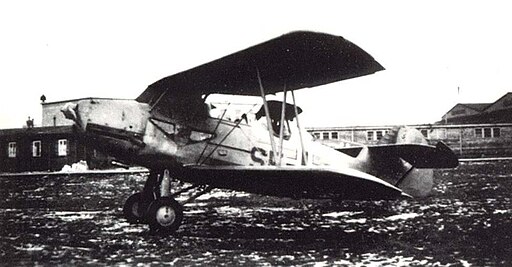
Arado Ar 66
The Arado Ar 66 emerged in the early 1930s as Germany’s primary two-seat training biplane, blending rugged simplicity with the aerodynamic refinements of a modern military design. First flown in 1932 and entering Luftwaffe service in 1933, it would train thousands of pilots, navigators and machine-gun operators before and during World War II. Beyond its role as a trainer, the Ar 66 proved adaptable to night ground-attack missions on the Eastern Front, demonstrating its structural resilience and ease of maintenance under austere conditions.
Development and Design
Origins and Requirements
In 1930, the Reichswehr sought a reliable aircraft to replace aging civil-derived trainers and prepare crews for increasingly complex frontline machines. Arado’s design bureau, led initially by Walter Rethel and later overseen by Walter Blume, leveraged experience from earlier biplanes to meet strict criteria for stability, low-speed handling and straightforward upkeep. Prototype work was self-funded, reflecting Arado’s confidence in securing an eventual Luftwaffe contract.
Prototyping and Evaluation
The first prototype, Ar 66a, flew in mid-1932 powered by an Argus As 10A inverted V8. A second prototype set, Ar 66b, tested twin-float undercarriage configurations for maritime training. After extensive flight trials, structural tweaks to wing stagger, landing-gear geometry and cockpit ergonomics led to the definitive Ar 66c production standard.
Airframe and Structure
Fuselage
The fuselage comprised a welded steel-tube frame faired with wooden longerons and fabric covering. Reinforced bulkheads at the engine mount absorbed vibration and torque, while quick-release panels provided rapid access for routine inspections. Dual tandem cockpits featured simple instrumentation for primary flight and weapons training.
Wing Assembly
A single-bay biplane layout with slight positive stagger delivered balanced lift distribution and excellent low-speed behavior. Upper and lower wings used duralumin spars, wooden ribs and doped fabric skin. Streamlined interplane struts and faired bracing wires minimized drag, and ailerons on both planes enhanced roll control.
Empennage
The tail section paired a steel-tube fin and rudder with a fabric-covered tailplane. Adjustable-incidence stabilizers allowed pilots to trim for solo or dual-control flights. Generous control-surface areas ensured crisp elevator and rudder response, essential for practicing aerobatics and formation work.
Powerplant and Performance
Engine Installation
The production Ar 66c standardized on the Argus As 10C air-cooled inverted V8, rated at 179 kW (240 hp) at 1,900 rpm. Mounted on vibration-absorbing saddles, it drove a two-bladed wooden propeller through a reduction gearbox. A large spinner and cowling flaps optimized cooling, while a gravity-fed fuel system simplified operations.
Flight and Climb Characteristics
The combination of 240 hp and a 1,330 kg maximum takeoff weight yielded a respectable power-to-weight ratio for a trainer. Maximum speed reached 210 km/h at sea level, with a cruise speed of 175 km/h. Pilots could climb to 1,000 m in roughly six minutes and attain a service ceiling near 5,200 m, ample for advanced instrument and aerobatic training.
Armament and Mission Equipment
Defensive Armament
For weapons instruction, the rear cockpit could mount a single 7.92 mm Parabellum MG 14 machine gun on a Zurüstgerät ring, complete with 300 rounds of ammunition. This setup enabled gunnery trainees to practice deflection shooting and air-to-air gunnery drills.
Light-Attack Capability
On night ground-attack missions, field modifications added two 50 kg light bombs under the lower wing center section. The sturdy undercarriage and simple bomb-release fittings allowed rapid conversion between training and combat roles.
Variants
Ar 66a and Ar 66b Prototypes
- Ar 66a: Landplane prototypes fitted with Argus As 10A engines and open-frame fuselage fairings.
- Ar 66b: Floatplane trials featuring twin wooden floats, enlarged rudder surface and reinforced wing roots.
Ar 66c Production Trainer
- Main production model with Argus As 10C engine, refined cowling, standardized cockpit layout and wheeled undercarriage.
Field-Modified Attack Versions
- Night ground-attack conversions added bomb racks and simplified sighting gear in the forward cockpit to support night operations on the Eastern Front.
Operational History
Upon its induction in 1933, the Ar 66 equipped Luftwaffe flight schools across Germany, ascending as the workhorse for elementary, advanced and specialized crew training. Its benign stall characteristics, combined with forgiving landing behavior, made it ideal for novices. In the winter of 1941–42, several units improvised Ar 66 night-attack flights against Soviet supply columns, exploiting the aircraft’s low-speed stability and ease of maintenance in frozen conditions.
Technical Specifications
| Parameter | Value |
|---|---|
| Crew | 2 |
| Length | 8.30 m |
| Wingspan | 10.00 m |
| Height | 2.90 m |
| Wing area | 29.6 m² |
| Empty weight | 937 kg |
| Maximum takeoff weight | 1 330 kg |
| Powerplant | 1 × Argus As 10C inverted V8, 179 kW (240 hp) |
| Maximum speed | 210 km/h at sea level |
| Cruise speed | 175 km/h |
| Range | 720 km |
| Service ceiling | 5 200 m |
| Time to 1 000 m | ~6 minutes |
| Armament | 1 × 7.92 mm MG 14 rear-cockpit machine gun; up to 100 kg light bombs |
Legacy and Impact
Although eventually superseded by monoplane trainers, the Arado Ar 66’s decades-long service forged core Luftwaffe aircrews and validated key structural and aerodynamic solutions. Its blend of straightforward maintenance, stable flight characteristics and multi-role adaptability influenced subsequent German trainer and ground-attack designs. Today, surviving Ar 66 airframes in museums stand as testament to its pivotal role in 1930s and 1940s military aviation.
