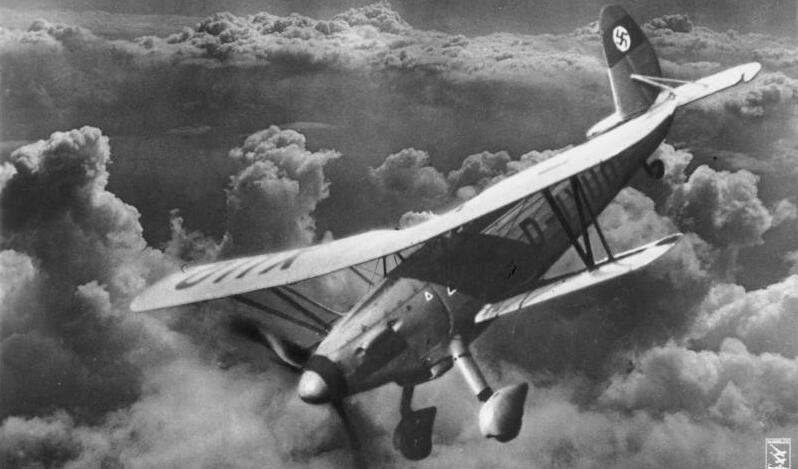
Arado Ar 68
The Arado Ar 68 emerged as one of Germany’s primary single-seat biplane fighters in the mid-1930s, developed and produced by Arado Flugzeugwerke. It first flew in early 1934 and entered Luftwaffe service in the summer of 1936, equipping frontline units and later seeing action with the Condor Legion during the Spanish Civil War. Despite being outclassed by newer monoplane designs like the Messerschmitt Bf 109, the Ar 68 continued serving as an advanced trainer until its retirement around 1944.
Development and Design
Origins and Prototyping
Arado initiated the Ar 68 program in 1932 to replace the earlier Ar 65 fighter. The first three prototypes—Ar 68a, Ar 68b and Ar 68c—tested various engines (BMW VI and Junkers Jumo 210 variants) and structural refinements to wing stagger, fuselage decking and cooling arrangements. Flight trials validated its handling qualities and led to the standardized Ar 68E production version by 1936.
Airframe and Structure
The Ar 68 utilized a single-bay biplane configuration with slight positive stagger, duralumin wing spars, wooden ribs and doped fabric covering. Streamlined interplane struts and bracing wires reduced drag, while the welded steel-tube fuselage frame, faired with wood longerons and fabric, provided robust strength. Generous control surfaces on both wings and the tail delivered crisp aileron, elevator and rudder response essential for dogfighting maneuvers.
Engine and Propulsion
Early Ar 68 production (series F) employed the BMW VI 7.3Z liquid-cooled V-12 engine rated at 750 PS, which increased weight and fuel consumption. The most numerous Ar 68E variant standardized on the Junkers Jumo 210Ea inverted V-12, delivering 507 kW (690 PS) through a two-bladed wooden propeller and offering superior high-altitude performance. Both installations featured dual ignition, full-pressure lubrication and optimized cowling flaps for effective cooling during climbs and extended missions.
Armament
The fighter’s primary armament comprised two synchronized 7.92 mm MG 17 machine guns mounted in the upper fuselage, each fed with 500 rounds of ammunition. Underwing hardpoints allowed carriage of up to six SC 10 light bombs (10 kg each), enabling occasional ground-attack tasks or training in bomb-release procedures. Production subtypes removed bomb racks to save weight once frontline fighter roles gave way to training duties.
Variants
Prototype Series
- Ar 68a: Initial prototype powered by license-built BMW Jupiter radial engine.
- Ar 68b: Inline-engine trials with BMW VI and structural tweaks.
- Ar 68c: Added dorsal fin and refined cooling ducts before standardization.
Production Models
- Ar 68E: Main production variant using Jumo 210Ea engine, fixed armament and fabric-covered airframe. Roughly 350 units built.
- Ar 68F: Short-run adaptation to BMW VI powerplant; production ceased in late 1936.
- Ar 68G: Minor modification for improved cockpit layout; limited numbers before transition to trainers.
Operational History
Following its 1936 introduction, the Ar 68 equipped early Luftwaffe fighter wings but was progressively replaced by monoplanes beginning in 1938. Its excellent low-speed handling and sturdy airframe found a second life as an advanced trainer through World War II. Twelve Ar 68s also served with Bulgaria’s air force for pilot instruction before being phased out in the late 1930s.
Technical Specifications
| Parameter | Value |
|---|---|
| Crew | 1 |
| Length | 9.67 m |
| Wingspan | 11.00 m |
| Height | 3.30 m |
| Wing area | 27.3 m² |
| Empty weight | 1 600 kg |
| Maximum takeoff weight | 2 020 kg |
| Powerplant | 1 × Junkers Jumo 210Ea, 507 kW (690 PS) |
| Propeller | 2-blade wooden, fixed-pitch |
| Maximum speed | 335 km/h at 2 650 m |
| Cruise speed | 280 km/h |
| Range | 415 km |
| Service ceiling | 8 100 m |
| Rate of climb | 12.6 m/s (0–6 000 m in 16 min) |
| Armament | 2 × 7.92 mm MG 17 (500 rpg); up to 6 × SC 10 bombs (10 kg each) |
All figures as per standard Ar 68E production specifications.
Legacy
Although quickly outpaced by monoplane contemporaries, the Arado Ar 68 played a formative role in rebuilding Germany’s fighter capabilities, bridging early biplane design with emerging inline-engine technology. Its robust construction and handling traits informed later Luftwaffe trainers and light attack aircraft, leaving a lasting imprint on 1930s German military aviation.
