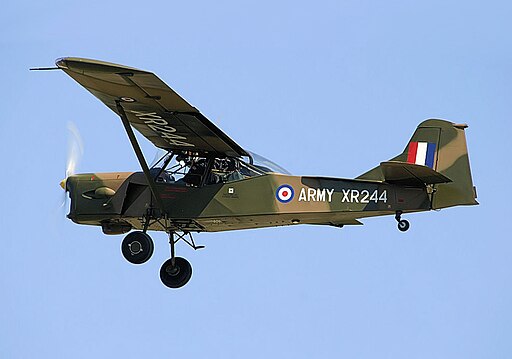
The Auster AOP.9: Britain’s Last Purpose-Built Army Observation Post Aircraft
The Auster AOP.9 was a British military observation aircraft designed in the 1950s as the ultimate development of the Auster air observation post lineage. It was built specifically for artillery spotting, reconnaissance, and liaison duties, representing the culmination of more than a decade of experience with earlier Auster designs used extensively during the Second World War and the immediate post-war years.
The AOP.9 marked the end of an era for fixed-wing observation aircraft in British service, as helicopters soon took over the role of artillery spotting and battlefield observation. Nevertheless, it played an important part in the transition period of the 1950s and 1960s.
Development Background
The Auster Aircraft Company had produced a series of light liaison and observation aircraft since the early 1940s, starting with the Taylorcraft-based Auster AOP.1. By the mid-1950s, advances in artillery and battlefield tactics created a need for a more capable observation aircraft with better visibility, greater payload, and improved performance.
The Auster AOP.9 was designed in response, incorporating lessons from earlier models such as the AOP.6. Its first flight took place in 1954, and it entered service shortly afterward with the British Army. A total of over 150 examples were built.
Design Characteristics
The AOP.9 was a high-wing monoplane with a fixed tailwheel undercarriage, optimized for short takeoff and landing from rough fields. Its structure was largely metal with fabric covering in some areas, designed for durability and ease of maintenance.
A key feature of the aircraft was its large glazed cockpit with expansive downward and side visibility, essential for the artillery observation role. The tandem seating arrangement placed the pilot in front and the observer in the rear, with both positions having excellent views of the ground.
The aircraft was powered by the Blackburn Cirrus Bombardier 203, a six-cylinder inline piston engine that provided significantly more power than the de Havilland Gipsy engines used in earlier Austers. This allowed the AOP.9 to carry more equipment and operate more effectively in varied environments.
It was equipped with modern radios and navigation gear for coordinating artillery fire, making it a much more capable platform than its predecessors.
Operational Use
The Auster AOP.9 entered service in the mid-1950s with Royal Artillery Air Observation Post Flights of the British Army. Its main role was to direct artillery fire and conduct low-level reconnaissance.
The aircraft was deployed in several theaters, including Malaya during counter-insurgency operations, and later in Cyprus and other overseas postings. Its short-field capability allowed it to operate from improvised strips close to the battlefield.
Despite its improvements, the AOP.9 entered service at a time when helicopters such as the Westland Scout and later the Westland Gazelle were beginning to prove their superiority in observation and liaison roles. By the late 1960s, helicopters had largely replaced the AOP.9, though some aircraft remained in secondary roles or in foreign service for a number of years.
Technical Parameters of the Auster AOP.9
-
Role: Air Observation Post and artillery spotting aircraft
-
Crew: 2 (pilot and observer in tandem)
Dimensions
-
Length: 25 ft 6 in (7.77 m)
-
Wingspan: 36 ft 6 in (11.13 m)
-
Height: 9 ft 3 in (2.82 m)
-
Wing area: ~200 sq ft (18.6 m²)
Weights
-
Empty weight: ~1,900 lb (862 kg)
-
Maximum takeoff weight (MTOW): ~3,000 lb (1,361 kg)
Powerplant
-
1 × Blackburn Cirrus Bombardier 203, six-cylinder inverted inline piston engine
-
Power output: 295 hp (220 kW)
-
Propeller: Two-bladed fixed-pitch wooden propeller
Performance
-
Maximum speed: ~150 mph (240 km/h, 130 knots)
-
Cruise speed: ~120 mph (193 km/h, 104 knots)
-
Stall speed: ~47 mph (76 km/h, 41 knots)
-
Range: ~380 miles (610 km)
-
Service ceiling: ~16,000 ft (4,875 m)
-
Rate of climb: ~1,200 ft/min (6.1 m/s)
Other Features
-
Excellent glazed cockpit for downward visibility
-
Tandem seating for pilot and observer
-
Fixed, rugged tailwheel undercarriage for field operations
-
Equipped with military radios and artillery-spotting equipment
Legacy
The Auster AOP.9 was the final dedicated fixed-wing artillery observation aircraft to serve with the British Army. Although it represented the peak of Auster’s development of light liaison aircraft, it was introduced at a time when helicopters were rapidly proving to be more flexible and effective platforms for observation and liaison.
While its service career was relatively short compared to earlier Austers, the AOP.9 remains historically significant as the last of the Auster AOP lineage. Today, several examples survive in museums and with private collectors, reflecting its importance in the evolution of military aviation during the post-war period.
.jpg)