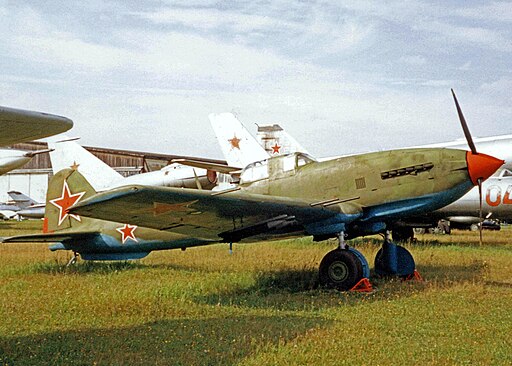
The Ilyushin Il-10 was a Soviet ground-attack aircraft developed during the final phase of World War II as an improved successor to the renowned Il-2 Shturmovik. Combining enhanced armor protection, upgraded firepower, and better flight performance, the Il-10 was designed to provide close air support to advancing ground forces. It entered service in 1944 and remained active with multiple air forces into the 1950s. Rugged, lethal at low altitudes, and highly maneuverable for its role, the Il-10 was a key player in late-war Soviet tactics and postwar military aviation.
Development and Design Evolution
The Il-10 originated from design efforts to address limitations of the Il-2, particularly in survivability, pilot visibility, handling, and power. Soviet engineers under Sergei Ilyushin reengineered the airframe with stronger structure, improved aerodynamics, and better crew protection. A major change was the repositioning of the engine and refinement of the armored “bathtub” that protected vital systems and crew members.
While retaining the general configuration of the Il-2, the Il-10 incorporated a more refined fuselage shape, a redesigned tail assembly, and revised wing contours to improve handling at low altitude attack profiles. The cockpit layout provided better visibility and ergonomics for both the pilot and rear gunner. The armor layout surrounded the cockpit, engine, and fuel tanks with hardened steel plating.
Powerplant and Performance
The Ilyushin Il-10 was powered by a Mikulin AM-42 liquid-cooled V-12 piston engine delivering about 2,000 horsepower. This engine was an upgraded variant of the AM-38 used in the Il-2, offering greater output and reliability despite the increased takeoff weight.
With the AM-42, the Il-10 achieved a maximum speed of approximately 507 kilometers per hour at optimal altitude. Cruise speed averaged 430–450 kilometers per hour. The aircraft could climb to 3,000 meters in around six minutes, with a service ceiling of approximately 7,500 meters. Its combat range was roughly 800 kilometers depending on payload and mission profile.
Armament and Payload
The Il-10 featured an armament configuration designed for maximum impact against ground targets. In its most common version, the aircraft carried:
-
Two 23 mm VYa-23 cannons in the wing roots
-
Two 7.62 mm ShKAS or 12.7 mm UBS machine guns in forward-firing positions (depending on variant)
-
One 20 mm or 12.7 mm rear defensive machine gun for the gunner (such as the Berezin UBK)
The bomb load reached up to 600 kilograms. Typical ordnance included high-explosive bombs, fragmentation bombs, anti-armor bomblets, and occasionally unguided rockets such as RS-82 or RS-132. The internal bomb bay and underwing hardpoints allowed mission-specific loadouts.
Airframe and Structure
The Il-10 used a low-wing monoplane configuration with a robust metal airframe. The wings were constructed with a combination of aluminum alloy and steel, featuring a strong single-spar design. The tail section was fully metal and redesigned to improve stability in high-speed dives and tight turns at low altitude.
Critical components, including the engine block, oil cooler, fuel tanks, pilot seat, and control systems, were enclosed in an armored shell up to 15 millimeters thick in some areas. This armor concept was integral rather than applied, forming part of the load-bearing structure.
Crew Protection and Layout
The Il-10 was a two-seat aircraft with the pilot in the forward cockpit and a rear gunner seated behind under a separate canopy. Both positions were surrounded by armor plating and bullet-resistant glass panels. The pilot had improved forward and lateral visibility over the Il-2 due to the repositioned cockpit and refined canopy design.
The gunner operated a flexible dorsal gun mount for defense against enemy fighters. In many variants, an armored shield surrounded the gunner’s station to provide protection without obstructing field of fire.
Landing Gear and Ground Handling
The Il-10 featured retractable conventional landing gear in a taildragger arrangement. The main landing gear retracted into the wings, and the tailwheel was fixed or semi-retractable in some production models. The reinforced gear allowed operations from semi-prepared airfields, which were common near front-line regions.
Shock absorbers and wide-track gear improved stability during takeoff, landing, and taxiing. The rugged construction enabled the aircraft to operate in harsh weather and uneven terrain.
Operational Roles and Combat Use
The Il-10 was introduced into service during the closing stages of World War II and saw limited combat on the Eastern Front in 1945. After the war, it became a front-line attack aircraft in the Soviet Air Forces and Warsaw Pact countries. It also served in Asia, including with North Korean forces during the Korean War.
Its primary mission profile included low-level strafing, tank-busting, close air support, and anti-infantry strikes. The armored airframe and heavy weaponry allowed the Il-10 to sustain ground fire while delivering precise attacks.
Variants and Upgrades
Several variants of the Il-10 were developed:
-
Il-10 (initial production model)
-
Il-10M (postwar modernization with improved aerodynamics and avionics)
-
Avia B-33 (Czechoslovak license-built version)
-
Il-10K (command variant with enhanced navigation)
-
Training variants with dual controls
Each successive version focused on refining performance, increasing reliability, and modernizing onboard systems.
Dimensions and Technical Parameters
-
Length: 11.12 meters
-
Wingspan: 13.4 meters
-
Height: 4.0 meters
-
Wing area: 30.0 square meters
-
Empty weight: approximately 4,350 kilograms
-
Maximum takeoff weight: approximately 6,500 kilograms
-
Powerplant: 1 × Mikulin AM-42, around 2,000 hp
-
Maximum speed: 507 km/h
-
Cruise speed: 430–450 km/h
-
Range: up to 800 km
-
Service ceiling: 7,500 meters
-
Rate of climb: around 10 meters/second
-
Crew: 2 (pilot and rear gunner)
-
Armament: 23 mm cannons, machine guns, up to 600 kg of bombs or rockets
Maintenance and Survivability
The Il-10 was designed for field maintenance. Engine components, control linkages, and armament were accessible for quick servicing. The aircraft’s steel armor and redundant control systems enhanced survivability against small-arms fire and flak.
Routine inspections focused on engine health, fuel systems, hydraulic lines, and armament mechanisms. The robust construction allowed the aircraft to remain operational in demanding conditions where infrastructure was limited.
Legacy and Significance
The Ilyushin Il-10 marked the culmination of Soviet piston-engined ground-attack design before the transition to jet-powered aircraft. It combined the proven lessons of the Il-2 with improved performance, making it one of the most formidable assault aircraft of its era.
Although eventually replaced by jet aircraft like the Il-40 and Sukhoi Su-7, the Il-10 served in several countries into the 1950s and early 1960s. Its influence remained evident in later Soviet concepts of armored close-support aviation.
Conclusion
The Il-10 represented a strategic evolution in ground-attack aviation with its blend of armor, firepower, and durability. It fulfilled critical roles in late WWII and postwar conflicts, reinforcing the Soviet doctrine of close air support. Today, surviving examples in museums and historical collections stand as reminders of the era’s engineering priorities and battlefield demands.
