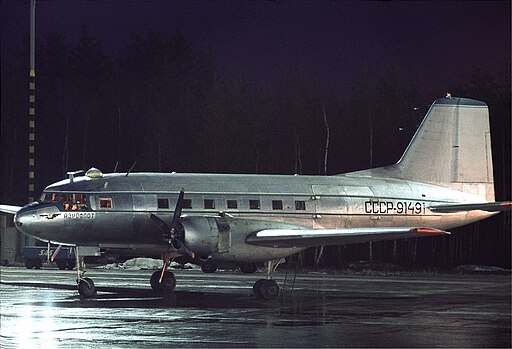
The Ilyushin Il-14 is a Soviet twin-engine transport aircraft developed in the early 1950s as an improvement over the earlier Il-12. Designed for both civilian and military applications, the Il-14 became one of the most widely used aircraft in Eastern Europe and other allied countries during the Cold War. It was known for its rugged design, reliability under harsh operating conditions, and adaptability to a variety of roles including passenger transport, cargo hauling, medical evacuation, and maritime patrol.
Development and Design
The development of the Il-14 was initiated to address performance and safety limitations of the Il-12. Ilyushin focused on improving aerodynamic efficiency, structural integrity, and engine reliability. The resulting design featured a low-wing monoplane configuration with a conventional tail and retractable tricycle landing gear. The aircraft’s all-metal construction with stressed-skin design allowed for both durability and ease of maintenance.
The fuselage was pressurized in later variants for improved passenger comfort, while the cockpit and passenger cabin were designed for ergonomic efficiency. The cabin could accommodate up to 24 passengers in the standard civilian configuration, with flexibility to carry cargo, stretchers, or additional fuel tanks for extended range operations.
Powerplant and Performance
The Ilyushin Il-14 was typically powered by two Shvetsov ASh-82T radial engines, each delivering approximately 1,850 horsepower. These air-cooled, 14-cylinder, two-row radial engines provided dependable performance and were coupled with three-blade variable-pitch propellers.
The Il-14’s maximum speed reached approximately 330 kilometers per hour, with a typical cruising speed of 285 kilometers per hour. It had a service ceiling of 6,500 meters and a maximum range of around 2,200 kilometers when fully loaded. Takeoff and landing distances were relatively short for an aircraft of its size, with fully loaded takeoff requiring roughly 1,100 meters and landing around 900 meters, making it suitable for operation from moderately prepared airstrips.
Airframe and Aerodynamics
The Il-14 features a low-wing cantilever design with dihedral wings, providing stability and predictable handling characteristics. The wings incorporated slotted flaps and ailerons for efficient lift management during takeoff, landing, and low-speed operations. The conventional tail unit, consisting of a vertical stabilizer and horizontal stabilizers, contributed to stable flight and precise control during adverse conditions.
The fuselage was streamlined to reduce aerodynamic drag, with a rounded nose housing navigation and weather radar equipment in some military variants. The all-metal construction with semi-monocoque techniques offered both strength and weight efficiency, ensuring safe operation in extreme temperatures and rough-field conditions.
Avionics and Instrumentation
Civilian Il-14 variants were equipped with basic flight instrumentation including airspeed indicator, altimeter, vertical speed indicator, directional gyro, turn and bank indicator, and engine monitoring gauges. Later military and upgraded models included additional avionics such as radio navigation aids, weather radar, and communication systems to enhance operational flexibility. The cockpit was designed to accommodate two pilots with dual controls, enabling effective crew coordination during long flights.
Landing Gear and Ground Handling
The Il-14 employed a retractable tricycle landing gear system. The main landing gear retracted into nacelles under the wings, while the nose wheel retracted forward into the fuselage. This configuration provided stable ground handling and allowed operations from paved and semi-prepared airstrips. The landing gear was equipped with oleo-pneumatic shock absorbers to withstand rough terrain and reduce impact loads during landing.
Operational Roles and Uses
The Il-14 served in a variety of roles across civilian and military aviation sectors. Civil operators used it primarily for short to medium-haul passenger transport and cargo operations, while military forces employed it for troop transport, paratroop drops, medical evacuation, reconnaissance, and maritime patrol. Its adaptability and reliability allowed the aircraft to operate in extreme climates, from Siberian cold to tropical heat, and on unpaved or austere airfields.
Many countries outside the Soviet Union also operated the Il-14 under license or through direct purchase, making it a globally recognized workhorse of the 1950s and 1960s. Its combination of simplicity, robustness, and moderate operating costs ensured its longevity in service, with some examples remaining operational well into the 1980s and 1990s.
Dimensions and Technical Specifications
-
Length: 22.6 meters
-
Wingspan: 31.4 meters
-
Height: 7.7 meters
-
Wing area: 110 square meters
-
Empty weight: 10,200 kilograms
-
Maximum takeoff weight: 15,500 kilograms
-
Powerplant: 2 × Shvetsov ASh-82T radial engines, 1,850 hp each
-
Propellers: Two three-blade variable-pitch
-
Maximum speed: 330 km/h
-
Cruise speed: 285 km/h
-
Stall speed: 140 km/h
-
Range: 2,200 kilometers
-
Service ceiling: 6,500 meters
-
Takeoff distance (MTOW): 1,100 meters
-
Landing distance (MTOW): 900 meters
-
Crew: 2–3
-
Passenger capacity: 18–24 depending on configuration
-
Cargo capacity: 3,000 kilograms
Safety and Maintenance
The Il-14 was known for its ruggedness and reliability. Maintenance was simplified by the use of robust radial engines, easily accessible components, and standardized parts. The aircraft’s strong airframe allowed it to tolerate hard landings and operations on less-than-ideal airstrips. Routine inspections included engine monitoring, control surface checks, landing gear maintenance, and structural integrity assessments. Its predictable flight characteristics and redundancy in systems contributed to a high level of operational safety.
Legacy and Conclusion
The Ilyushin Il-14 remains a historically significant aircraft, symbolizing the evolution of Soviet postwar aviation. Its versatility, rugged design, and long-range capabilities allowed it to serve multiple generations of pilots and passengers in both civilian and military roles. As a workhorse of the Eastern Bloc, the Il-14 left a lasting legacy in regional aviation, influencing the design of subsequent Soviet transports and providing reliable service across challenging operating environments. The aircraft’s enduring reputation for reliability and adaptability ensures its recognition as one of the key transport aircraft of the 20th century.
