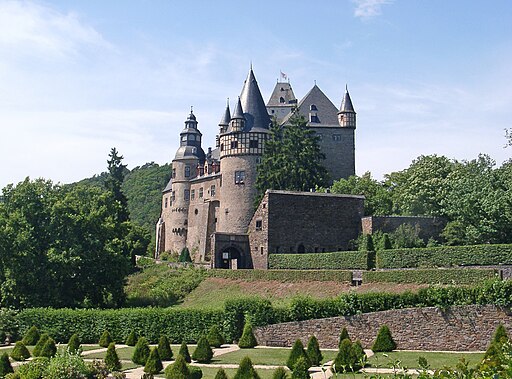
Nestled in the picturesque Eifel region of Rhineland-Palatinate, Germany, Schloss Bürresheim stands as one of the few medieval castles in the Rhineland that has never been destroyed. Overlooking the scenic Nette Valley near Mayen, this beautifully preserved fortress offers an authentic glimpse into Germany’s architectural evolution, noble heritage, and medieval defensive strategies. With its distinctive towers, romantic courtyards, and well-kept interiors, Schloss Bürresheim is not only a monument of historical importance but also a beloved cultural landmark that draws visitors seeking both beauty and history.
Historical Background
Schloss Bürresheim dates back to the 12th century, when it was first constructed as a fortified residence. Originally, the castle was part of a triad of strongholds that guarded the surrounding region, alongside Schloss Eltz and Schloss Lissingen. While many castles in the Rhineland were destroyed during wars or revolutions, Bürresheim miraculously escaped such a fate. It remained intact through the Thirty Years’ War, the French invasions, and the turmoil of the Napoleonic era.
For centuries, the castle was divided into two separate sections, each belonging to different noble families. The first section was held by the Bürresheim family, who gave the castle its name. The second section came under the control of the Cologne cathedral chapter, which used it as a residence for clerical nobility. Over time, these two sections were united under the ownership of the Waldbott von Bassenheim family, who transformed the fortress into a more comfortable residence without stripping it of its medieval character.
Architectural Features
Schloss Bürresheim’s architecture is a fascinating mixture of Romanesque, Gothic, and Renaissance styles, reflecting centuries of continuous use and adaptation. The complex consists of an outer bailey, an inner courtyard, and several residential and defensive buildings that have been remarkably well preserved.
The castle’s most striking features include its asymmetrical towers and turrets, which rise above the lush greenery of the surrounding valley. The main residential buildings feature steep gabled roofs, ornate dormer windows, and richly decorated facades. Inside, visitors can find period furniture, wall tapestries, portraits, and household items that vividly illustrate the daily life of the aristocracy from the Middle Ages to the 19th century.
The chapel of St. Nicholas, built in the late Gothic style, stands as one of the most significant architectural highlights. It contains original frescoes and intricate woodwork that testify to the artistic craftsmanship of the era. The combination of defensive structures, residential comfort, and religious elements makes Schloss Bürresheim an exceptional example of a medieval noble residence that successfully evolved into a stately home.
Survival and Preservation
Unlike many castles in the Rhineland, Schloss Bürresheim was never taken by force or damaged in battle. This extraordinary preservation is partly due to its remote location in the Eifel hills, which made it less accessible to invading armies. It also owes its survival to the continuous care of its owners, who maintained and adapted the castle rather than abandoning it.
In the early 20th century, the last private owner, Maria von Waldbott-Bassenheim, sold the castle to the Prussian state. Since then, Schloss Bürresheim has been managed by the General Directorate for Cultural Heritage Rhineland-Palatinate (Generaldirektion Kulturelles Erbe Rheinland-Pfalz). Extensive restoration projects have been undertaken to stabilize the structure and preserve its interiors, ensuring that the castle remains an authentic historical site rather than a reconstructed monument.
The Castle’s Interior and Collections
The interior of Schloss Bürresheim offers visitors an immersive experience into the lifestyle of the nobility across several centuries. The rooms are decorated with furniture and artifacts from the Renaissance, Baroque, and Rococo periods, all carefully curated to reflect historical accuracy.
The Great Hall serves as the centerpiece of the residence, showcasing carved wooden ceilings, massive fireplaces, and portraits of the castle’s former inhabitants. The castle’s library, filled with centuries-old books and manuscripts, reflects the intellectual pursuits of the noble families who once lived there. Other rooms include a knight’s hall, a drawing room, a dining hall, and private chambers adorned with ornate furniture and fine art.
One particularly notable feature is the kitchen, which has been preserved with original utensils and furnishings. This room provides insight into the practical aspects of life in a medieval and early modern noble household, showing how food was prepared, stored, and served before modern conveniences.
Schloss Bürresheim in Popular Culture
Schloss Bürresheim’s fairy-tale appearance has made it a popular filming location for movies and television. It was famously used as a backdrop in the 1989 film Indiana Jones and the Last Crusade, where it served as “Castle Brunwald,” the fictional Austrian castle where Indiana rescues his father. Its cinematic charm continues to attract film producers and photographers seeking authentic medieval architecture.
Visiting Schloss Bürresheim Today
Today, Schloss Bürresheim is open to the public as a museum and cultural site. Guided tours allow visitors to explore the castle’s history, architecture, and interior furnishings. The surrounding landscape offers scenic hiking trails and panoramic views of the Nette Valley, making it an ideal destination for both history enthusiasts and nature lovers.
Special exhibitions, concerts, and cultural events are regularly held on the castle grounds, adding a vibrant contemporary dimension to this historic site. The combination of preserved medieval architecture, peaceful rural surroundings, and educational programming makes Schloss Bürresheim one of the most rewarding heritage destinations in western Germany.
Conclusion
Schloss Bürresheim stands as a rare example of a medieval castle that has survived untouched by war or destruction. Its blend of defensive and residential architecture, its centuries-old furnishings, and its idyllic setting give it a unique place among German castles. Beyond its architectural and historical importance, the castle represents a living bridge between the Middle Ages and modern times—a monument that continues to inspire awe, curiosity, and appreciation for the enduring legacy of Europe’s cultural heritage.
