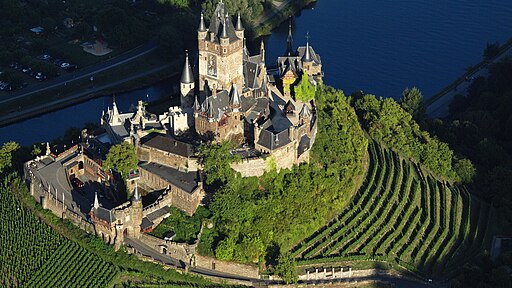
Perched dramatically atop a hill overlooking the Moselle River, Reichsburg Cochem is one of Germany’s most iconic and picturesque castles. Rising majestically above the charming town of Cochem in Rhineland-Palatinate, the castle embodies the romantic spirit of the Middle Ages, blending history, legend, and stunning architecture. With its commanding towers, intricate spires, and sweeping views of the Moselle Valley, Reichsburg Cochem stands as both a symbol of the region’s medieval heritage and a masterpiece of 19th-century restoration.
Early History and Origins
The origins of Reichsburg Cochem date back to the early 12th century. It was likely built around the year 1000 and was first mentioned in historical records in 1130, during the reign of King Konrad III. The castle served as a defensive stronghold and administrative center for the local rulers who controlled trade and travel along the Moselle River.
In its earliest form, the castle was constructed in the Romanesque style, featuring a massive keep surrounded by fortified walls and towers. It was strategically positioned to oversee the river valley, allowing its occupants to collect tolls from merchants and travelers navigating the Moselle — a vital economic artery in the region. For centuries, the castle was a key fortification in the Holy Roman Empire’s defensive network along the western frontier.
Destruction and Decline
Reichsburg Cochem’s early prominence came to a tragic end in the late 17th century. During the Nine Years’ War (1688–1697), French troops under King Louis XIV invaded the Rhineland. In 1689, the castle was captured and subsequently destroyed by French forces. Its walls were left in ruins, and for nearly two centuries, the once-proud fortress lay in decay, a silent witness to the turbulent history of Europe.
For generations, the ruins of Reichsburg Cochem were a reminder of lost grandeur. Local residents occasionally scavenged stones for building materials, and the structure gradually became overgrown with vegetation. By the 19th century, the site had transformed into a romantic ruin, admired by travelers, poets, and painters who were captivated by its melancholy beauty.
The 19th-Century Reconstruction
The castle’s revival began in 1868 when the Berlin businessman Louis Fréderic Jacques Ravené purchased the ruins. Ravené, a wealthy industrialist and passionate art collector, sought to restore the fortress in the spirit of the 19th-century Romantic movement, which idealized the medieval past.
Between 1868 and 1877, Ravené commissioned the reconstruction of Reichsburg Cochem in the Neo-Gothic style. Architects and craftsmen worked meticulously to create a structure that combined historical authenticity with artistic imagination. The new design incorporated elements from different periods of medieval architecture, resulting in a castle that was not an exact replica of the original, but rather a romantic reinterpretation of what a medieval castle ought to look like.
Towers were rebuilt with slender spires and battlements, grand halls were decorated with intricate wood carvings, and elegant chambers were furnished with tapestries, armor, and antiques. The result was a striking blend of Gothic revival aesthetics and medieval charm — a perfect reflection of 19th-century romantic ideals.
Architectural Highlights
Reichsburg Cochem is a textbook example of Neo-Gothic castle architecture. Its layout centers around a towering keep, surrounded by an irregular polygon of defensive walls and turrets. The steep, conical roofs and ornate gables lend the castle a fairy-tale appearance that has made it one of the most photographed landmarks in the Moselle Valley.
The castle’s entrance is guarded by a massive gatehouse, reached by a winding road that ascends the hill. Inside, visitors find lavishly decorated rooms such as the Knight’s Hall, the Dining Room, and the Trophy Room. Each room is adorned with period furnishings, stained glass, and elaborate wooden ceilings that reflect the taste and wealth of the Ravené family.
One of the most beautiful spaces is the Knight’s Hall, which features large Gothic windows, a carved fireplace, and coats of arms of noble families. The Dining Room is decorated with Renaissance-style furniture and portraits, while the Trophy Room displays hunting memorabilia, a popular motif among 19th-century nobility. The castle chapel, with its pointed arches and delicate stained glass, offers a peaceful contrast to the grandeur of the public rooms.
Legends and Folklore
Like many medieval castles, Reichsburg Cochem is surrounded by local legends. One popular tale tells of the “Knight of Cochem,” a nobleman who defended the castle valiantly against invaders and whose spirit is said to still watch over the valley. Another legend speaks of a hidden treasure buried somewhere within the castle walls — a story that continues to capture the imagination of visitors.
These legends, while largely mythical, reflect the deep connection between the people of Cochem and their castle. The fortress has long been seen not only as a seat of power but also as a guardian of local identity and tradition.
The Castle in the Modern Era
After World War II, the Ravené family lost ownership of the castle. In 1942, it was confiscated by the Nazi regime, and later, it came under the administration of the German government. Today, Reichsburg Cochem is owned by the town of Cochem and operates as a museum and cultural venue.
The castle has become one of the most popular tourist attractions in the Moselle region. Guided tours take visitors through its furnished halls, where they can learn about both the medieval and 19th-century histories of the site. The panoramic views from the castle terrace are breathtaking, offering a sweeping vista of the river, vineyards, and town below.
Beyond its role as a museum, the castle also hosts medieval banquets, concerts, and seasonal events. These celebrations bring the castle to life, allowing visitors to experience its atmosphere much as its medieval inhabitants might have.
The Castle and the Town of Cochem
Reichsburg Cochem’s relationship with the town below it is integral to its identity. Cochem itself is a charming riverside settlement filled with half-timbered houses, cobblestone streets, and vibrant markets. The castle dominates the skyline, its towers visible from nearly every point in the town.
Visitors often combine a castle tour with a stroll through Cochem’s old town, a boat cruise along the Moselle, or a tasting at one of the region’s many wineries. The surrounding hills are covered in vineyards that produce the famous Moselle Riesling, making the area a perfect blend of history, culture, and natural beauty.
Conclusion
Reichsburg Cochem stands as a magnificent testament to Germany’s layered history — from its medieval beginnings through its destruction and romantic rebirth. Its towering spires and lush surroundings encapsulate the essence of the Moselle Valley, a region where time seems to slow down and history feels tangible.
