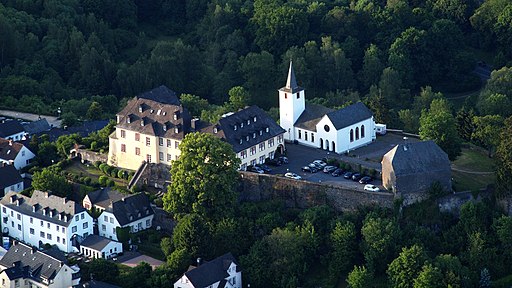
Burg Daun, also known as Daun Castle, is a historic fortress that stands in the heart of the Vulkaneifel region in Rhineland-Palatinate, Germany. Overlooking the modern spa town of Daun, the castle’s elevated position provides sweeping views of the surrounding volcanic hills and lakes that give the region its unique character. Although much of the medieval fortress has not survived in its original form, Burg Daun remains a site of considerable historical and cultural significance. Its long history — from medieval stronghold to noble residence and finally to an administrative center — reflects the evolving landscape of German feudalism and local governance.
Historical Origins
The origins of Burg Daun date back to the early Middle Ages. Historians believe that the first fortifications were built in the 11th or 12th century as a defensive structure to protect the surrounding lands and trade routes. Like many castles in the Eifel region, Burg Daun occupied a strategic hilltop position that allowed its occupants to monitor movement through the valleys below and defend against potential invaders.
The castle was the ancestral seat of the noble family of Daun, one of the oldest and most influential dynasties in the region. The Lords of Daun are first mentioned in historical documents in the 12th century. They held significant power and influence, both locally and in the broader context of the Holy Roman Empire. Members of the family served as knights, ecclesiastical dignitaries, and high-ranking military officers, establishing connections with major noble houses across Germany.
The Lords and Counts of Daun
The Daun family played a prominent role in regional and imperial politics. Over the centuries, their influence grew, and several branches of the family rose to considerable prominence. The best-known line, the Counts and later Princes of Daun-Falkenstein, extended their power far beyond the Eifel.
During the Middle Ages, the Lords of Daun were vassals of the Electors of Trier, who controlled much of the Rhineland. The castle served as a feudal seat and administrative hub, where taxes and tithes were collected from surrounding villages. The family maintained Burg Daun as both a residence and a symbol of their authority. Its fortified towers and curtain walls demonstrated their status and their ability to defend their domain.
In the early modern period, the Daun family became particularly prominent in Austrian service. Count Wirich Philipp von Daun (1669–1741) and his son Leopold Josef von Daun (1705–1766) distinguished themselves as field marshals in the Habsburg army. Leopold Josef achieved fame for his military victories during the Seven Years’ War, particularly against Frederick the Great of Prussia. Though by that time the family’s political center had shifted to Vienna, their ancestral roots remained tied to Burg Daun.
Architectural Development
While no detailed plans of the original medieval fortress survive, historical records and archaeological findings suggest that Burg Daun followed the typical hilltop castle design of the Eifel region. The core of the castle likely consisted of a central keep surrounded by defensive walls, towers, and residential buildings.
In later centuries, as military functions became less essential, Burg Daun was gradually transformed into a more comfortable noble residence. During the Renaissance and Baroque periods, elements of comfort and aesthetics were introduced — larger windows, decorative facades, and formal gardens. However, these renovations were limited, as the Daun family increasingly resided elsewhere.
By the 18th century, the castle’s importance as a military and residential seat had diminished. Portions of the structure fell into disrepair, and some sections were repurposed for administrative and civic use.
Burg Daun in the Modern Era
In the 19th century, the remnants of Burg Daun entered a new chapter of use. As local governance modernized, the site was adapted to serve as a district administrative center. The former noble residence was renovated and expanded to accommodate government offices.
Today, the main building of Burg Daun houses the district administration (Kreisverwaltung) of Vulkaneifel. While little remains of the medieval fortress, the location still carries a strong historical presence. The outlines of the old castle walls can still be discerned in the foundations, and parts of the later constructions preserve architectural elements that hint at the site’s medieval past.
The adaptation of Burg Daun into a functional civic building ensured its survival, even if the original fortress has largely vanished. Unlike many ruined castles in the Eifel, which stand as romantic relics of a bygone era, Burg Daun continues to serve an active purpose within the community.
The Town of Daun and Its Surroundings
The town of Daun itself developed around the castle, benefiting from its protection and administrative influence. Over time, Daun evolved from a small settlement into a prosperous regional center. Its location in the Vulkaneifel — a landscape shaped by volcanic activity — has made it a popular destination for nature enthusiasts and spa visitors.
The nearby volcanic lakes, known as the Dauner Maare, are among the most famous geological features in Germany. These crater lakes, formed by ancient eruptions, provide a dramatic backdrop to the castle hill. The juxtaposition of medieval architecture and volcanic natural beauty creates a striking image that defines the region’s identity.
Daun also features a charming town center with a mixture of Baroque, Renaissance, and modern buildings. Visitors often explore the local history museum, hike through the volcanic hills, or visit the wildlife park near the town. The presence of Burg Daun atop its commanding hill continues to link the town’s modern life with its deep historical roots.
Cultural Significance
Although Burg Daun does not enjoy the same level of fame as larger castles such as Burg Eltz or Reichsburg Cochem, it holds a unique cultural and historical significance for the Eifel region. It represents the enduring continuity of governance — a site that has evolved from medieval feudal power to modern democratic administration.
The castle’s association with the distinguished Daun family also gives it broader historical importance. Through their military and political achievements, the Daun lineage bridged regional and European history, making the name “Daun” known far beyond the Rhineland.
Furthermore, Burg Daun serves as a reminder of how historical buildings can adapt to new purposes without losing their identity. Its transformation from fortress to administrative seat illustrates the flexibility of heritage architecture and the potential for historical continuity through modern use.
Visiting Burg Daun
While Burg Daun is not a museum in the traditional sense, its location and historical atmosphere attract visitors interested in regional history and architecture. The site can be viewed from the town center, and its grounds occasionally host cultural events, exhibitions, and local celebrations.
For those exploring the Vulkaneifel, Burg Daun provides a worthwhile stop on a broader tour that includes the nearby maars, the Eifel Volcano Museum, and the picturesque countryside. The castle hill offers scenic views of Daun and its surroundings, particularly beautiful at sunrise or sunset.
Conclusion
Burg Daun stands as a quiet yet enduring symbol of the Vulkaneifel’s long and layered history. From its origins as a medieval stronghold of the Lords of Daun to its current role as a center of local administration, the castle reflects the passage of centuries and the changing face of power, architecture, and community life.
