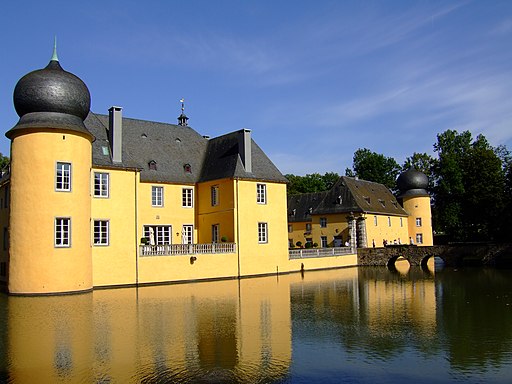
Tucked away in a picturesque valley at the confluence of two small streams in the municipality of Wachtberg (near Bonn, Germany), stands the stunning moated castle known as Burg Gudenau. The castle combines a rich historical lineage, striking architectural elements from different periods, and one of the more refined surviving private Baroque gardens in the Rhineland. Though the main building remains in private ownership, the castle’s park is open for visitors under certain conditions. In this article, we will explore its history, architecture, landscaping, current status and visitor information in detail.
Location and Setting
Burg Gudenau is situated in the district of Villip within Wachtberg, in the Rhein-Sieg district of North Rhine-Westphalia, Germany. Its geographical position is fairly unique: the castle lies in a low-lying valley (a talbett) at the point where the Godesberger Bach and the Arzdorfer Bach join. Because of the water-rich terrain, the castle was established as a water castle (Wasserburg) — meaning surrounded by or set in relation to water for defensive and aesthetic reasons. The location provides not only natural protection in older times but also lends the castle a highly scenic setting: reflections of towers, moats, and lush surroundings create a magical atmosphere.
Historical Development
Early Origins (13th Century)
The origins of Burg Gudenau date back to the early 13th century. It was originally conceived as a medieval water castle, serving both defensive and administrative roles in the region under the influence of the Electorate of Cologne. Over time, various noble families held the castle as a fief, which shaped its fortunes and architectural changes.
Renaissance & Expansion (c. 1560)
Around 1560 the main four-winged structure of the castle was significantly expanded. At this time, Renaissance architectural details were added: bay windows (Erker), curly gables or “geschweifte Hauben” (curved hoods) on towers, and more elaborate decorative elements. This period marked the castle’s transformation from purely a fortified residence to a more comfortable and stately home fitting for noble families.
Baroque Garden & Later Additions (17th–18th Century)
In the 17th century, under Italianate influences, the park and garden behind the castle were laid out with great care. This garden is special: it is recognised as the only preserved private Baroque garden in the Rhineland. The castle’s architecture also features a mix of styles from prior eras: the main castle retains a Gothic bay and corner tower with pointed slate roof, while other towers carry Baroque cupolas.
Ownership and Modern Era
Over the centuries the castle changed hands through marriage, inheritance, purchase, and political events. Notably, the castle was under the ownership of the Freiherr von Felten-Guilleaume family up until the mid-20th century. Today the property is in private ownership — for many years it has belonged to the family of Gräfin von Strasoldo. The castle, though not fully open to the public for interior tours, remains carefully maintained and preserves its historic character.
Architectural Features
Burg Gudenau presents a harmonious yet varied ensemble of architectural styles, each layer adding character:
-
The fore-castle (Vorburg) faces the viewer and includes a massive five-storey gate tower with a slate hipped roof and an octagonal clock turret.
-
The main castle (Hauptburg) is built in a four-winged plan, surrounded by water and featuring multiple corner towers. One tower retains a pointed slate roof from its older Gothic phase; the remaining three corner towers carry Baroque domes.
-
Several towers and wings display decorative “geschweifte Hauben” (curved roofs) which were typical of later Renaissance/Baroque styles in the region. These elements provide a distinct silhouette.
-
The castle’s interior is less documented publicly (as it is private), but the exterior detailing, moats, water reflections, and the park design reflect high craftsmanship and stylistic ambition spanning centuries.
The Baroque Garden
One of the most remarkable features of Burg Gudenau is its garden. Situated at the rear of the main castle, the garden was laid out in the 17th century in terraces with strong Italian influences: symmetry, axial views, statuary, water features.
The garden fulfills several functions:
-
Aesthetic and recreational: It served as a display of taste and wealth, and as a setting for leisurely walks and contemplation.
-
Symbolic: The garden reflects the noble status of the owners, and the blending of architecture and nature.
-
Historical rarity: Not many private Baroque gardens in the Rhineland survive intact; this one stands out for that reason.
Visitors report seeing terraces, grottos (an 18th-century grotto is noted in guided tours), statues, ponds, formal plantings, and the integration of nature with the castle’s built form.
Visiting Today & Practical Information
Although Burg Gudenau is privately owned, its park and grounds are accessible to the public under specific conditions:
-
The park area is open Monday to Friday, from March until 20 December, from 8:00–12:00 and 13:00–17:00. It is closed on Saturdays, Sundays and public holidays.
-
An entrance fee is charged (for example approximately 8 € for adults) for guided visits and special events.
-
The castle and garden are accessible by car but parking is typically arranged in the village (Villip) near the church; the castle lies along the Wasserburgen-Route (Water Castles Route) and cycling is also recommended.
-
Special events (“Burgen öffnen Ihre Tore”) allow guided external visits of the castle with the garden/grotto included — advance registration is often required.
When planning a visit, it is wise to check the local tourist information website (e.g., via the regional Rhein-Voreifel Touristik) for any changes in opening times, guided tour slots or special event days.
Cultural Significance and Preservation
Burg Gudenau holds cultural, architectural and historical significance:
-
It is one of the most prominent water castles in the Wachtberg region and the largest castle within that municipality.
-
The garden represents a unique survival of private Baroque garden design in the Rhineland, making it of interest to historians of landscape architecture.
-
The layering of architectural styles—medieval defensive water castle, Renaissance residential expansion, Baroque refinement—provides a tangible record of the changing roles of castles from fortress to stately home.
-
The careful preservation and restoration works (especially in the modern era) illustrate the commitment of its owners and the local community to heritage conservation. For instance, records indicate that the owners undertook restoration after storm / flood damage.
Challenges and Considerations
Despite its well-maintained appearance, Burg Gudenau faces the common challenges of historic properties:
-
Private ownership means that full public access is limited; only the grounds or selected areas may be visited.
-
Maintenance costs are high for such structures (water management, historic fabric, garden upkeep).
-
Environmental threats: Being in a valley with water courses, the site is vulnerable to flooding — indeed, the region suffered major damage during an intense storm in June 2016.
-
Balancing conservation and use: Ensuring that events, tourism and public access do not compromise the historic fabric or the tranquility of the site.
Why Visit Burg Gudenau?
For the visitor, Burg Gudenau offers several compelling reasons:
-
Scenic beauty: the moat, the water reflections, the lush garden terraces, and the wooded valley setting make for a peaceful outing.
-
Architectural interest: one sees medieval, Renaissance and Baroque features in one ensemble.
-
Historical depth: the castle encapsulates centuries of local noble history, regional politics, and changing lifestyles.
-
Tranquility: off the beaten path compared to major tourist sites, allowing a more contemplative experience.
-
Garden fascination: for anyone interested in historic gardens, the Baroque layout is a special treat.
Summary
Burg Gudenau is a fascinating and somewhat hidden gem within the Rhineland’s landscape of castles. Its origins as a water castle in the early 13th century, its Renaissance expansion in the mid-16th century, and its grand Baroque garden in the 17th century all combine to create a site of multi-layered historical, architectural and landscape significance. Though privately owned and with limited public access, the castle grounds offer a captivating visit for those interested in heritage, nature and serenity. For anyone exploring the Bonn region or seeking castles off the mainstream, Burg Gudenau is well worth the detour.
