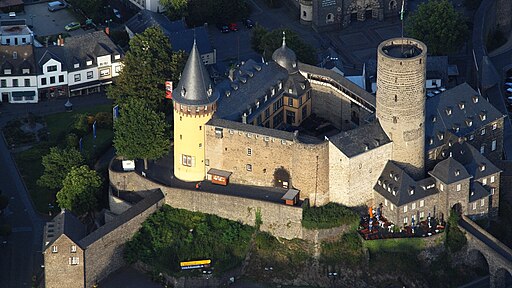
Genovevaburg, majestically overlooking the town of Mayen in the Rhineland-Palatinate region of Germany, is one of the most striking castles in the Eifel area. Perched on a rocky hill in the heart of Mayen, this impressive fortress combines centuries of regional history, legend, and architectural evolution. Although it has been destroyed and rebuilt multiple times, Genovevaburg continues to stand as a proud symbol of Mayen and the surrounding Eifel region. Its combination of medieval charm, romantic myth, and historical significance make it one of the most culturally rich landmarks in western Germany.
The Legendary Origins
The name Genovevaburg is closely tied to one of Germany’s most enduring medieval legends: the tale of Saint Genoveva of Brabant. According to legend, Genoveva was the virtuous wife of Count Siegfried of the Palatinate. During her husband’s absence on a crusade, she was falsely accused of infidelity by his steward, Golo, and condemned to death. However, Genoveva was spared by her executioner and lived for years in a forest cave with her child, sustained by a deer that brought her milk. When Count Siegfried returned and discovered the truth, he was overcome with remorse and reunited with her.
Though the story is largely mythical, it became deeply rooted in regional folklore during the Middle Ages. Over time, the castle in Mayen became associated with this legend, and from the 17th century onward, it began to be called Genovevaburg — literally, the Castle of Genoveva.
Early History and Construction
The origins of Genovevaburg trace back to the 13th century, when the Electors of Trier, powerful princes of the Holy Roman Empire, sought to strengthen their control over the Eifel region. The site was strategically chosen due to its elevated position above Mayen, offering both a defensive advantage and symbolic dominance over the surrounding lands.
The castle was likely built around 1280, serving as both a fortress and an administrative center. Constructed from the local basalt stone, its design was typical of the era — featuring thick walls, a central keep, and a protective outer ring of fortifications. The castle quickly became the seat of the Electorate’s bailiff (Vogt) in Mayen and remained under ecclesiastical authority for several centuries.
Throughout the Middle Ages, the fortress was expanded and strengthened. Its central Bergfried (keep), a tall defensive tower that still dominates the skyline today, became both the castle’s stronghold and its emblem.
Destruction and Reconstruction
Genovevaburg suffered extensive damage during the Thirty Years’ War (1618–1648), a conflict that ravaged much of central Europe. The castle was besieged and partially destroyed during the warfare that swept across the Rhineland. Further destruction came in 1689, when French troops under Louis XIV devastated many Rhineland fortresses during the War of the Palatine Succession. The castle was left in ruins for many years after these attacks.
However, the people of Mayen held the castle in deep affection, both for its symbolic importance and its connection to local legend. In the 19th century, during the Romantic movement — a period marked by renewed interest in medieval ruins and national heritage — Genovevaburg was gradually rebuilt.
Reconstruction began around 1832, guided by the desire to restore the castle’s medieval appearance while adapting it for new uses. Architects and local craftsmen combined authentic medieval remains with 19th-century Romantic style elements, giving the castle the picturesque form it retains today. The rebuilt Genovevaburg became not just a monument of history, but a living symbol of regional pride and identity.
Architectural Description
The architecture of Genovevaburg reflects its layered history, with medieval foundations complemented by 19th-century Romantic reconstruction.
At the heart of the complex stands the Bergfried, a tall, cylindrical keep that dominates both the castle and the town below. Rising over 30 meters high, it was originally built as a defensive lookout and refuge. From its summit, one can enjoy panoramic views of Mayen, the volcanic Eifel landscape, and the distant Rhine valley.
The inner courtyard is surrounded by thick walls and reconstructed residential wings, featuring Gothic-style windows, arched passageways, and half-timbered upper floors. The blend of stone and timber adds to the castle’s visual charm, while the irregular layout preserves its medieval authenticity.
A deep well, essential for survival during sieges, can still be seen within the courtyard. The outer fortifications include a gatehouse, towers, and sections of the old curtain wall that once protected the castle’s inhabitants.
The architectural ensemble is a fascinating combination of medieval military design and 19th-century romantic revivalism, reflecting both the castle’s defensive past and its later transformation into a cultural monument.
The Castle and the Town of Mayen
Genovevaburg is inseparable from the history of Mayen itself. The town, known since Roman times for its basalt and slate quarries, flourished as a regional market center under the protection of the castle. The fortress not only served as a defensive stronghold but also as a symbol of feudal authority, ensuring the town’s loyalty to the Electorate of Trier.
After the secularization of church properties in the early 19th century, Mayen became part of Prussia, and Genovevaburg transitioned from a decaying ruin to a civic landmark. The town took responsibility for maintaining the site, eventually transforming it into a museum and cultural venue.
Today, the castle and town form a unified historical landscape where medieval architecture, industrial heritage, and regional folklore coexist harmoniously.
The Museums of Genovevaburg
One of the most distinctive aspects of Genovevaburg today is its role as a museum complex that preserves and interprets the cultural heritage of the Eifel region.
The Eifelmuseum, located within the castle, explores the geology, archaeology, and cultural development of the Eifel region. Exhibits cover topics such as volcanic activity, medieval crafts, local folklore, and the daily lives of past inhabitants.
Another highlight is the German Slate Mining Museum (Deutsches Schieferbergwerk), located beneath the castle in a series of reconstructed tunnels. This museum offers visitors a realistic and educational experience of traditional slate mining, an industry that shaped Mayen’s economy for centuries. Visitors descend into the underground exhibits to see tools, mining techniques, and multimedia presentations illustrating the life of miners.
These museums make Genovevaburg not only a historical monument but also a vibrant educational center dedicated to preserving the legacy of the Eifel region.
The Genoveva Festival and Cultural Events
Each year, Genovevaburg comes alive with cultural festivities, the most famous of which is the Genoveva Festival (Genovevafest). This annual event celebrates the legend of Saint Genoveva through theater, music, and medieval reenactments. Local actors perform the story of Genoveva and Siegfried within the castle courtyard, transforming the ancient walls into a dramatic stage.
The festival attracts visitors from across the Rhineland and beyond, celebrating both faith and folklore while fostering community spirit. The event also includes markets, concerts, and exhibitions, ensuring that the castle remains a living part of Mayen’s cultural identity.
In addition to the festival, Genovevaburg hosts art exhibitions, historical lectures, and seasonal events throughout the year, further cementing its reputation as a cultural hub.
Preservation and Restoration
Maintaining a castle with such a long and turbulent history presents constant challenges. Since the 20th century, Genovevaburg has undergone several phases of restoration, each aimed at preserving its structural stability and historical character.
Significant repairs were carried out after World War II, when the castle sustained minor damage during air raids. Later restoration campaigns focused on preventing erosion of the basalt stonework, reinforcing the foundations, and updating the museum facilities to modern standards.
The restoration efforts emphasize authenticity and sustainability, ensuring that the castle remains both historically accurate and accessible to the public. Today, it stands as one of the best-preserved and most thoughtfully maintained castles in the Eifel.
Cultural and Historical Significance
Genovevaburg represents far more than just a medieval fortress; it is a cultural emblem of the Eifel region. Its story embodies themes of endurance, transformation, and community. The castle’s architectural evolution mirrors the broader history of Germany itself — from feudal fragmentation and ecclesiastical power to Romantic revival and modern preservation.
Its association with the legend of Saint Genoveva adds a spiritual and moral dimension that has captivated generations. The blending of myth and history at Genovevaburg illustrates how folklore can become a defining element of a place’s identity.
Visiting Genovevaburg
Today, Genovevaburg is open to visitors throughout most of the year. Tourists can explore the museum exhibits, climb the Bergfried for sweeping views of Mayen, and wander the castle courtyard and ramparts. Guided tours offer insight into both the historical architecture and the local legends that shaped the site.
The castle’s central location in Mayen makes it easily accessible for day trips, and its proximity to the volcanic landscapes of the Eifel National Park makes it a popular stop for travelers exploring the region.
Conclusion
Genovevaburg stands as a timeless monument to the intertwined forces of legend, history, and human resilience. From its medieval foundations to its Romantic reconstruction and modern cultural role, the castle has remained a beacon of the Eifel’s identity for over seven centuries.
