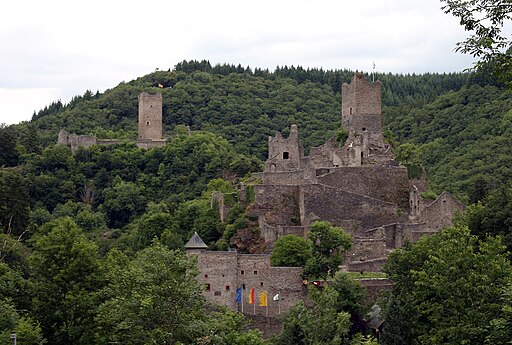
The Manderscheider Burgen—often referred to simply as the Manderscheid Castles—form one of the most dramatic and historically rich castle ensembles in the Eifel region of Germany. Perched above the Lieser Valley, the twin fortresses known as the Oberburg (Upper Castle) and Niederburg (Lower Castle) face each other across a narrow ravine, embodying centuries of territorial rivalry, medieval power struggles, and architectural evolution. Today, these ruins attract history enthusiasts, hikers, and photographers drawn to their rugged silhouettes and captivating stories.
Geographic Setting and Strategic Importance
Situated in the Volcanic Eifel, a landscape shaped by ancient eruptions and lush river valleys, the Manderscheider Burgen occupy a naturally strategic position. The Lieser River cuts sharply through the terrain, creating steep slopes ideal for defensive construction. Medieval rulers recognized this vantage point, using the castles to monitor trade routes and assert authority over the contested border region.
The closeness of the two fortresses—visible to one another at all times—symbolizes the tension that once defined Manderscheid’s political landscape. Their positions were not accidental; each castle represented competing regional powers vying for dominance.
Origins and Medieval Rivalries
The earliest documented references to the Manderscheid Castles date to the Middle Ages, when the region was embroiled in disputes between the Electorate of Trier and the Duchy of Luxembourg. The Niederburg, believed to be the older of the two, likely originated in the 12th century as a Luxembourg stronghold. The Oberburg, set higher on the opposite slope, was developed under the authority of Trier in the centuries that followed.
This geographical duality turned Manderscheid into a frontier zone. Skirmishes, sieges, and political maneuverings became part of daily life, and the two castles symbolized an enduring rivalry. Control of the region shifted several times, reflecting broader power struggles across the Holy Roman Empire.
Architectural Layout and Fortification Features
Each castle boasts unique architectural characteristics shaped by its purpose and topography.
Niederburg (Lower Castle)
The Niederburg occupies a broader hill spur, with enough space to support a sizable medieval community. Key features of its layout include:
-
A tall residential keep, which provided living quarters and a final defensive refuge
-
Extensive curtain walls, forming multiple defensive rings
-
A large outer bailey, which housed stables, workshops, and storage facilities
-
A commanding gate tower, which once controlled entry along the steep approach path
Even in ruin, the scale of the Niederburg hints at its former importance as a fortified administrative seat.
Oberburg (Upper Castle)
In contrast, the Oberburg sits on a narrower ridge, emphasizing verticality and strategic elevation. Its defining elements include:
-
A slender tower keep, visible across the landscape
-
Compact inner courtyards, adapted to the limited terrain
-
Defensive bastions, taking advantage of sheer cliffs for natural protection
The Oberburg’s height granted it superior views over the valley, enabling watchers to track movements between the castles and throughout the surrounding territory.
Life in the Medieval Castles
Daily life at the Manderscheider Burgen would have been shaped by both its frontier nature and its rural environment. Soldiers, servants, craftsmen, and clerics formed the core community. Activities likely included weapon maintenance, food storage, horse care, and administrative duties related to taxes and land management.
The surrounding villages supplied agricultural goods, while forests and rivers provided wood, game, and freshwater. The constant threat of conflict meant that castles served not only as residences but also as protective havens for local populations during turbulent periods.
Decline, Destruction, and Ruin
By the early modern era, many medieval castles lost their strategic value. Advances in artillery diminished the usefulness of hilltop fortifications, and political landscapes shifted as territorial conflicts waned.
The Manderscheider Burgen suffered extensive damage during the wars of the 17th century, most notably during the Thirty Years’ War and later conflicts involving French forces. Fires, neglect, and depopulation accelerated their deterioration. By the 18th century, both castles were abandoned, gradually collapsing into the romantic ruins seen today.
Restoration Efforts and Modern Preservation
Interest in preserving the Manderscheid Castles grew in the 19th and 20th centuries, fueled by Romanticism and the rising appreciation for medieval architecture. Archaeological studies, stabilization projects, and tourism development have helped protect the structures from further decay.
Today, paths connect the castles, allowing visitors to explore both sites on foot. Restoration focuses on maintaining safety while preserving the authenticity of the ruins. Interpretive signs and guided tours provide historical context without altering the castles’ characteristic wildness.
Festivals and Cultural Events
One of the highlights of Manderscheid’s cultural calendar is the annual Medieval Festival, held typically in late summer. This event transforms the Niederburg into a lively scene of historical reenactments, traditional music, costumed performers, and artisan markets. Jousting displays, battle demonstrations, and medieval cuisine bring history to life and celebrate the region’s heritage.
These festivities not only entertain but also deepen public understanding of the Manderscheider Burgen’s role in shaping local identity.
Hiking, Scenic Views, and Natural Surroundings
The landscapes surrounding the Manderscheider Burgen are as compelling as the castles themselves. The Lieser Valley offers:
-
Panoramic viewpoints, particularly from the Oberburg’s ridge
-
Dense forest trails, part of the renowned Eifelsteig hiking network
-
River overlooks, showcasing meandering bends and rich biodiversity
-
Volcanic formations, a reminder of the region’s geological origins
For nature lovers and photographers, the interplay between rugged stone ruins and verdant hills creates a striking visual experience throughout the seasons.
Significance in Regional History
The Manderscheider Burgen represent more than architectural relics; they embody the political tensions that shaped the medieval history of the Eifel. Their twin configuration is a rare and vivid example of how geography and rivalry intersected to produce lasting cultural landmarks. Their preservation ensures that future generations can explore both the physical remnants and the stories embedded in the landscape.
Conclusion
The Manderscheider Burgen stand as enduring witnesses to centuries of conflict, governance, and human resilience in the Eifel region. With their dramatic placement, distinctive structures, and richly layered past, the twin castles invite visitors to step into a living tapestry of medieval Europe. Whether approached through history, architecture, or natural beauty, the Manderscheider Burgen offer a profound and memorable connection to the region’s heritage.
