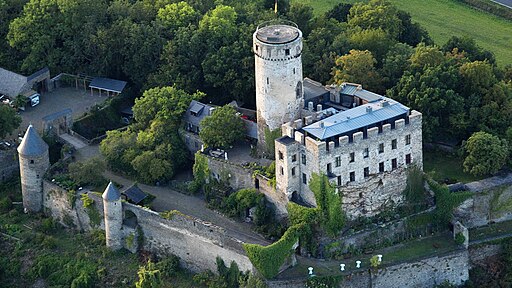
Pyrmont Castle, also known as Burg Pyrmont, is a striking medieval hilltop fortress located in the Eifel region of Rhineland-Palatinate. Positioned on a narrow spur above the Elzbach stream, the castle commands a dramatic landscape of forested ravines, winding valleys, and volcanic hills typical of the Eifel’s rugged terrain. Its impressive tower, conserved defensive walls, and picturesque setting make it one of the region’s most atmospheric and visually captivating fortifications. Today, Pyrmont Castle stands as a carefully restored private estate, welcoming visitors who wish to experience both the architectural legacy of the Middle Ages and the tranquility of the surrounding nature.
Early Origins and Founding
The origins of Pyrmont Castle can be traced back to the High Middle Ages, with its earliest construction generally attributed to the twelfth century. It was likely founded by a local noble lineage seeking to solidify control over the surrounding territory and protect a key route through the Elzbach valley. Like many early hill castles, its initial structure would have focused on basic defensive necessities, such as a sturdy keep, a protective ring wall, and strategically placed watchpoints. These early defensive elements formed the nucleus around which later generations expanded the castle, reflecting the gradual evolution of military architecture throughout the medieval period.
Architectural Development and Expansion
Over the centuries, Pyrmont Castle underwent numerous phases of construction and renovation, each leaving behind architectural features that reveal the changing priorities of its inhabitants. With the growth of noble families and the increasing complexity of regional politics, the castle expanded to include additional living quarters, a chapel, fortified gateways, and more elaborate defensive systems. Its thick stone walls, narrow arrow slits, and commanding tower illustrate the fortress’s long-standing military role, while the later construction of more comfortable residential spaces reveals the desire to combine defense with domestic life. The castle’s architecture thus tells a story of adaptation, resilience, and the shifting balance between security and comfort.
Strategic Importance in Regional History
Given its prominent position overlooking a crucial valley passage, Pyrmont Castle held strategic significance for much of its active history. It served not only as a military stronghold but also as an administrative center for the surrounding lands. Control of the castle often translated into influence over trade routes, agricultural estates, and local settlements. Throughout the late medieval and early modern periods, the castle saw periods of conflict, negotiation, and alliance-building as competing noble families and regional powers vied for influence. Although not the site of major battles, Pyrmont’s defensive features and commanding height made it a valuable asset during times of political instability.
Decline and Rediscovery
Like many medieval castles in the region, Pyrmont Castle faced decline as the military and economic landscape shifted in the early modern era. Changing warfare technologies, reduced strategic relevance, and political transitions contributed to its gradual abandonment. Sections of the castle fell into disrepair as nature reclaimed the surrounding spur and stones weathered under centuries of wind and rain. Yet despite its deteriorating condition, the castle remained a romantic landmark, attracting the attention of travelers, artists, and architects drawn to its dramatic silhouette. By the nineteenth century, the ruined fortress had become a symbol of medieval nostalgia and a subject of cultural fascination.
Restoration and Modern Preservation
In the twentieth century, Pyrmont Castle underwent a series of ambitious restoration projects led by private owners dedicated to preserving its historical character. These efforts focused on stabilizing the remaining structures, rebuilding portions of the tower, and securing the defensive walls while maintaining authenticity. The restoration work also introduced careful improvements that allow visitors to explore the castle safely, such as reinforced stairways, interpretive signage, and revitalized paths. Today, Pyrmont Castle stands as a rare example of a medieval fortress restored with respect for both historical integrity and the natural environment that surrounds it.
The Castle Grounds and Natural Setting
One of Pyrmont Castle’s most distinctive features is its integration with the surrounding landscape. The steep cliffs and deep ravines around the Elzbach stream form a natural defensive barrier that enhances the fortress’s dramatic appearance. Dense forests, rocky outcrops, and secluded footpaths surround the site, creating an atmosphere that feels both ancient and untouched. Scenic hiking trails lead to the castle, offering visitors views of waterfalls, wildlife habitats, and the lush vegetation characteristic of the Eifel. This harmony between the built structure and the natural world adds to the castle’s enduring appeal, making it a favored destination for hikers, photographers, and history enthusiasts.
Cultural and Touristic Importance
Today, Pyrmont Castle plays an important role in the cultural identity of the Eifel region. Its distinctive tower rising above the treetops has become a recognizable landmark, and the site is included in many regional tourism routes and historical tours. The castle hosts guided visits, seasonal events, small exhibitions, and private functions that bring life to its ancient walls. Its preservation demonstrates the value placed on heritage in the Eifel, where castles, monasteries, and volcanic landscapes form a cohesive cultural tapestry. Visitors often remark on the castle’s tranquil atmosphere and the sense of stepping directly into the medieval past.
Visiting Pyrmont Castle Today
A visit to Pyrmont Castle offers an immersive historical experience complemented by the beauty of its natural setting. Visitors can explore the tower for panoramic views, walk through restored interior sections, and trace the outlines of the defensive structures that once protected the valley below. The surrounding trails provide opportunities for extended excursions into the Elzbach gorge and beyond, making the castle an ideal destination for both cultural and outdoor activities. Whether approached as a historical monument, a scenic viewpoint, or a peaceful retreat, Pyrmont Castle leaves a lasting impression through its combination of heritage, restoration, and landscape.
