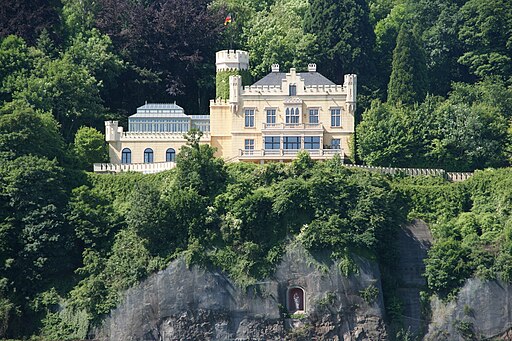
Schloss Marienfels is an elegant hillside villa and small palace located above the Rhine River in Remagen, Rhineland-Palatinate. Known for its commanding position overlooking the river valley, the property exemplifies the romantic spirit of nineteenth-century Rhine architecture. Surrounded by terraced gardens, forested slopes, and winding paths, the estate radiates the atmosphere of a secluded retreat while remaining closely connected to the cultural landscape of the Middle Rhine. Its unique blend of architectural refinement and picturesque scenery has long contributed to its reputation as one of the region’s most enchanting private residences.
Origins and Nineteenth-Century Construction
Schloss Marienfels was constructed in the mid-nineteenth century, during a period when the Rhine region attracted wealthy patrons, artists, and aristocrats inspired by its romantic vistas. Built as a stately villa rather than a defensive castle, the estate embraced contemporary tastes that favored ornate façades, decorative towers, and richly detailed interiors. Its creators sought to design a residence that celebrated the beauty of its surroundings while offering modern comfort and a sense of aristocratic grandeur. The villa soon became a symbol of cultivated leisure, reflecting the era’s fascination with refined country living and scenic landscapes.
Architectural Characteristics
The architectural style of Schloss Marienfels harmonizes historicist influences with the elegance typical of Rhine villas of the period. A distinctive tower and asymmetrical façade provide the building with a dynamic silhouette, while large windows and balconies ensure that the interiors are closely connected to the outdoors. Stonework, sculptural elements, and decorative gables contribute to the visual richness of the structure, helping it stand out against the wooded hillsides that embrace it. Inside, the layout favors generous rooms, high ceilings, and ornamental detailing, mirroring the expectations of affluent nineteenth-century society for refined hosting spaces and an atmosphere of cultured domesticity.
Ownership and Changing Uses
Throughout its history, Schloss Marienfels has passed through the hands of several notable owners, each leaving a mark on the evolution of the property. Some used the residence as a seasonal retreat, while others invested in modernization, restoration, or expansion. In more recent decades, the villa has drawn public attention due to its association with well-known contemporary figures who temporarily made it their home. These transitions contributed to renewed interest in the estate’s architectural and cultural significance, encouraging efforts to preserve its historic character while adapting it to modern standards of comfort.
Restoration and Preservation
Periodically, Schloss Marienfels has undergone restoration to counter the wear of time and maintain the structural and aesthetic integrity of the building. Preservation efforts often focus on refurbishing façades, reinforcing historical masonry, restoring interior woodwork, and revitalizing the landscaped gardens that form an integral part of the estate’s identity. Balancing historical authenticity with modern use requires careful attention, especially in a property that includes delicate ornamentation and architectural features crafted in the traditions of the nineteenth century. These restorative projects ensure that the villa continues to stand as an example of the cultural and artistic heritage of the Middle Rhine.
Gardens and Surrounding Landscape
The grounds of Schloss Marienfels are a defining feature of the estate, designed to complement its architecture and enhance the experience of its hillside setting. Terraced pathways lead through areas planted with ornamental shrubs, mature trees, and seasonal flowers, creating a series of viewpoints that emphasize the sweeping vistas of the Rhine valley below. The interplay of natural terrain and arranged gardens reflects the romantic landscape ideals of the nineteenth century, where nature was shaped to evoke beauty, tranquility, and contemplative charm. These outdoor spaces also serve as a natural buffer, conferring privacy and seclusion despite the villa’s prominent position above the town.
Cultural Significance
Beyond its architectural and scenic value, Schloss Marienfels holds a place in the cultural narrative of the Rhine region. It represents the era in which the Middle Rhine became synonymous with art, literature, and the aesthetic exploration of nature. Many villas and manors were constructed during this period, but Schloss Marienfels stands out due to its distinctive design, its well-preserved state, and its visibility from both river and town. As such, it contributes to the romantic image that continues to define the cultural identity of the Rhine, resonating with the legacy of travelers, poets, and architects who celebrated the landscape’s beauty.
Visiting and Public Perception
While Schloss Marienfels is primarily known as a private residence and is not regularly open to the public, its exterior and setting remain points of interest for visitors exploring the Rhine region. The villa’s picturesque appearance from afar, often glimpsed from riverboats or trails along the opposite shore, draws the attention of those who appreciate historical architecture and atmospheric landscapes. Its presence enriches the visual rhythm of Remagen’s riverfront skyline, adding depth to the region’s mix of medieval ruins, historic villas, and natural scenery. For many, Schloss Marienfels stands as a reminder of the Rhine’s enduring ability to inspire admiration across generations.
