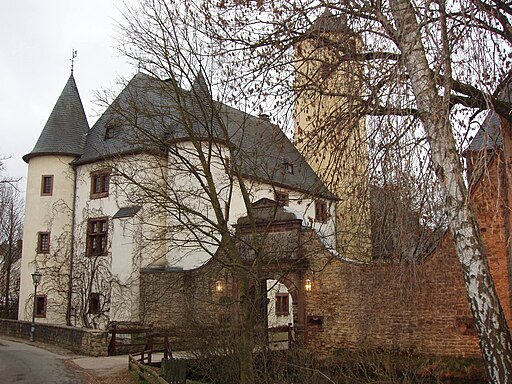
Rittersdorf Castle is a commanding medieval fortress situated near the village of Rittersdorf in western Germany, overlooking the Kyll Valley in the Eifel region. Rising from a rocky ridge, the castle occupies a landscape shaped by steep slopes, forests, and narrow valleys that once defined both trade and conflict in this borderland area. Although parts of the castle were altered in later centuries, its medieval core remains clearly visible, offering insight into the architectural, political, and social forces that shaped fortified residences in the Middle Ages.
Geographic Context and Strategic Importance
The position of Rittersdorf Castle was carefully chosen to maximize control over the surrounding terrain. The elevated ridge provided excellent visibility across the Kyll Valley, an important route for travel and commerce connecting the Moselle region with northern territories. Natural slopes protected the castle on several sides, limiting access and strengthening its defenses without the need for excessive artificial fortification. This strategic setting allowed the castle’s lords to monitor movement, collect tolls, and assert authority over the surrounding countryside, reinforcing their influence within the feudal system.
Origins and Early Construction
Rittersdorf Castle originated in the High Middle Ages, a period marked by the consolidation of noble power and the widespread construction of stone fortresses. The earliest phase likely consisted of a simple fortified complex designed to secure territory and provide a defensible residence for its lord. As the importance of the site grew, the castle was expanded with stronger walls, additional towers, and improved residential structures. These developments reflect the growing wealth and ambitions of its owners, as well as the increasing need for durable defenses in a politically fragmented region.
Architectural Features and Defensive Design
The architecture of Rittersdorf Castle illustrates a careful balance between military strength and residential comfort. Thick stone walls, narrow entrances, and elevated towers formed the backbone of its defensive system, while inner courtyards organized daily activity within the complex. The keep served as the most secure structure, offering refuge during attacks and symbolizing the lord’s authority. Over time, residential buildings were enhanced with larger windows, fireplaces, and more refined interior spaces, indicating a gradual shift toward greater comfort as security conditions improved.
Life Within the Castle
Life at Rittersdorf Castle revolved around both defense and administration. The castle functioned as a local center of governance, where legal matters were addressed, land was managed, and feudal obligations were enforced. A diverse population lived within or around its walls, including soldiers, servants, craftsmen, and members of the noble household. Food storage, water supply, and workshops were essential components of daily survival, particularly during periods of isolation or unrest. Religious observance also played a role, shaping routines and reinforcing social order within the castle community.
Later Modifications and Changing Functions
As medieval warfare evolved and political structures became more centralized, Rittersdorf Castle underwent changes that reflected new priorities. Some defensive elements lost their original military function and were adapted for residential or administrative use. Later modifications introduced features associated with more comfortable living, transforming parts of the castle into a manor-like residence. These changes illustrate how castles adapted to shifting social and political realities, gradually transitioning from purely defensive strongholds to symbols of status and heritage.
Decline and Preservation
The decline of Rittersdorf Castle was influenced by broader historical developments, including advances in artillery and the reduced strategic value of hilltop fortresses. As maintenance costs increased and the need for strong defenses diminished, parts of the castle fell into disuse. However, unlike many medieval fortifications, Rittersdorf Castle was not completely abandoned. Continued occupation and later restoration efforts helped preserve significant portions of the structure, allowing it to survive as an important historical monument.
Cultural Significance and Modern Legacy
Today, Rittersdorf Castle stands as a testament to the layered history of the Eifel region. Its surviving walls and towers reflect centuries of adaptation, conflict, and continuity. The castle serves as a cultural landmark, connecting modern visitors with the medieval past and illustrating how architecture can embody both power and practicality. Through preservation and interpretation, Rittersdorf Castle continues to contribute to regional identity, offering a tangible link to the social and political foundations of the Middle Ages.
