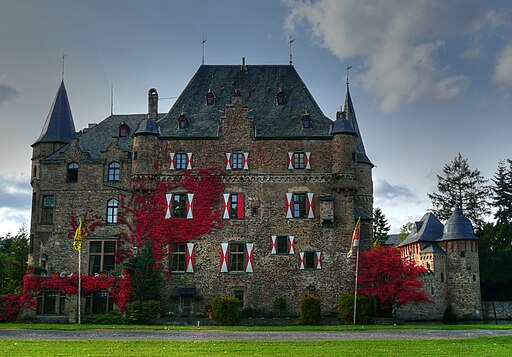
Burg Satzvey is one of the best-preserved moated castles in the Rhineland, located near the village of Satzvey in western Germany. Unlike many hilltop fortresses built primarily for military dominance, Burg Satzvey developed as a water castle, using its surrounding moats and wetlands as its principal defensive features. Its enduring structure and continued use over the centuries make it a rare example of a medieval castle that has remained largely intact, offering a vivid impression of noble life, architectural evolution, and regional history from the Middle Ages to the present day.
Landscape, Water Defenses, and Strategic Setting
The castle’s setting in a low-lying area shaped both its appearance and its defensive strategy. Instead of relying on steep terrain, Burg Satzvey was protected by broad moats fed by nearby streams, creating a natural barrier that discouraged attackers and limited access points. The surrounding flat landscape allowed for controlled approaches, making any hostile movement clearly visible from the castle walls. This type of water-based defense was particularly effective in regions where natural elevations were scarce, demonstrating how medieval builders adapted their designs to local geography.
Origins and Early Noble Ownership
Burg Satzvey was established in the 14th century during a period of consolidation among regional noble families. Its early owners constructed the castle as both a fortified residence and a symbol of their growing authority. The complex initially included essential defensive elements such as a gatehouse, curtain walls, and a central residential tower. Over time, as the family’s status increased, the castle was expanded and refined, reflecting both rising wealth and the desire to display prestige through architecture.
Architectural Layout and Structural Features
The architectural layout of Burg Satzvey reveals a carefully planned ensemble centered around an inner courtyard. Thick stone walls, corner towers, and fortified gateways provided security, while residential buildings offered comfort and functionality. The castle’s towers not only served defensive purposes but also housed living quarters and storage spaces. Timber-framed upper stories, stone foundations, and decorative elements added in later centuries illustrate how the castle evolved from a purely defensive structure into a refined noble residence without losing its medieval character.
Domestic Life and Social Organization
Life within Burg Satzvey was shaped by its dual role as a defensive stronghold and a family home. The noble household occupied the main residential buildings, while servants, guards, and craftsmen supported daily operations. Kitchens, storerooms, and workshops ensured self-sufficiency, particularly during times of unrest. Social life centered around the great hall, where meals, celebrations, and administrative duties took place. The castle was not an isolated military outpost but a lively social center embedded in the surrounding rural community.
Survival Through Conflict and Change
Burg Satzvey’s remarkable preservation is partly due to its ability to adapt to changing historical circumstances. While many castles were destroyed or abandoned during wars and political upheavals, Satzvey remained in continuous use. Its water defenses proved resilient, and successive owners invested in maintenance and modernization rather than abandonment. Even as artillery and new military tactics reduced the effectiveness of medieval fortifications, the castle’s role as a residence ensured its survival through periods that saw the destruction of many similar structures.
Restoration and Modern Use
In more recent centuries, Burg Satzvey has undergone careful restoration aimed at preserving its historical integrity while allowing for modern use. Restoration efforts have focused on maintaining original materials and architectural forms, ensuring that changes respect the castle’s medieval origins. Today, the castle functions as a cultural and event venue, hosting historical reenactments, festivals, and educational programs that bring its past to life. These activities allow visitors to experience the castle as a living space rather than a static monument.
Cultural Importance and Enduring Legacy
Burg Satzvey holds a special place in the cultural landscape of the Rhineland as a rare example of a medieval water castle that has endured with its structure and spirit largely intact. It embodies the adaptability of noble residences and the close relationship between architecture and environment. Through preservation, continued use, and public engagement, Burg Satzvey remains a powerful link to the medieval world, illustrating how history can be sustained through thoughtful stewardship and community involvement.
