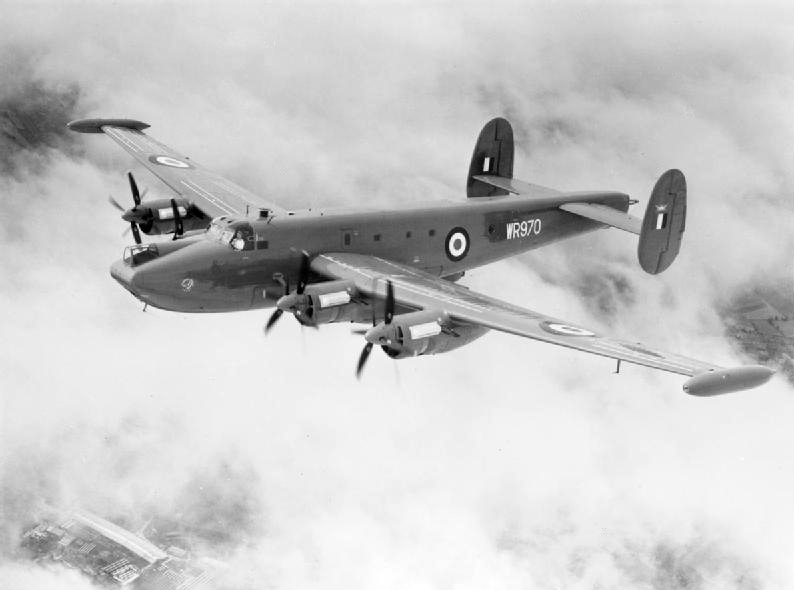
The Avro Shackleton was one of the most enduring and technically distinctive military aircraft to serve with the Royal Air Force during the Cold War. Designed primarily as a long-range maritime patrol and anti-submarine warfare aircraft, it represented a major evolution of piston-engined aviation at a time when jet propulsion was rapidly becoming dominant. Despite this, the Shackleton proved that range, endurance, and reliability were often more valuable than speed for certain strategic roles, allowing it to remain operational for decades.
Design Origins and Strategic Requirement
The Shackleton was developed in response to an urgent postwar requirement to protect Britain’s maritime approaches from the growing threat of Soviet submarines. Existing wartime aircraft, such as the Avro Lancaster and Lincoln, lacked the specialized equipment, endurance, and low-altitude handling needed for prolonged maritime patrols. Avro was tasked with adapting the Lincoln airframe into a purpose-built patrol aircraft capable of remaining on station for many hours while carrying sophisticated detection systems and weapons.
Rather than designing an entirely new aircraft, Avro engineers extensively reworked the Lincoln’s structure, creating an airframe optimized for low-level flight, long endurance, and heavy sensor loads. The result was an aircraft that shared visual similarities with its bomber ancestors but differed substantially in internal layout, systems integration, and mission philosophy. The Shackleton first flew in March 1949, entering service in the early 1950s as the RAF’s primary maritime patrol platform.
Airframe Structure and Aerodynamics
The Shackleton’s airframe was large and robust, designed to withstand the stresses of long-duration flights over open ocean in harsh weather conditions. The fuselage was lengthened and deepened compared to the Lincoln, providing space for extensive electronic equipment, operator stations, and increased fuel capacity. Structural reinforcement was applied throughout the airframe to support the weight of radar systems, weapons, and additional crew accommodations.
The wings retained a long span of approximately 120 feet, contributing to excellent lift and fuel efficiency at patrol speeds. These wings were optimized for stable, low-altitude flight rather than high-speed performance. Large control surfaces enhanced handling during slow-speed maneuvers, such as when tracking submarines or conducting search patterns close to the sea surface. The tailplane was also enlarged to improve stability, particularly during asymmetric engine operation, which was a critical safety consideration for long overwater flights.
Powerplant and Propulsion System
One of the Shackleton’s most distinctive features was its engine configuration. It was powered by four Rolls-Royce Griffon piston engines, each producing approximately 2,450 horsepower. These engines were significantly more powerful than the Merlin engines used on earlier Avro bombers and were chosen to provide the reliability and torque needed for extended patrol missions.
The Griffon engines drove large contra-rotating propellers, a feature that reduced torque effects and improved efficiency, particularly during low-speed flight. This configuration enhanced directional stability and reduced pilot workload, which was especially important during long missions that could exceed 12 hours. While the engines were noisy and maintenance-intensive, they were renowned for their durability and ability to operate for long periods without failure.
Performance Characteristics and Endurance
The Shackleton was not designed for speed, but for endurance and persistence. Its maximum speed was approximately 300 mph, while typical patrol speeds were much lower, often in the range of 200 to 230 mph. This allowed the aircraft to loiter efficiently over patrol areas for extended periods.
Operational range exceeded 4,000 miles, and endurance could reach 15 hours or more depending on mission profile and payload. The service ceiling was around 30,000 feet, though most missions were flown at much lower altitudes to maximize the effectiveness of sensors and weapons. The aircraft’s ability to remain airborne for prolonged periods made it exceptionally well suited to maritime surveillance and anti-submarine warfare.
Avionics and Sensor Systems
The Shackleton was among the most heavily instrumented piston-engined aircraft ever built. Its avionics suite evolved significantly over time, reflecting advances in detection technology and changing operational requirements. Central to its mission was a large maritime search radar housed in a ventral radome, capable of detecting surface vessels and submarine periscopes over considerable distances.
In addition to radar, the Shackleton was equipped with magnetic anomaly detection equipment, which allowed it to identify submerged submarines by detecting disturbances in the Earth’s magnetic field. Sonobuoy systems enabled the aircraft to deploy and monitor acoustic sensors in the ocean, greatly enhancing its anti-submarine capabilities. Electronic support measures were also integrated, allowing crews to detect and classify enemy radar and communication emissions.
Armament and Weapons Capability
The Shackleton carried a diverse array of weapons tailored to maritime operations. Its internal bomb bay and underwing hardpoints could accommodate depth charges, naval mines, conventional bombs, and later, homing torpedoes. This flexibility allowed the aircraft to engage both submerged submarines and surface targets.
Defensive armament was initially retained from its bomber heritage, including gun turrets mounted in the nose and tail. These turrets housed 20 mm cannon or machine guns, depending on the variant. Over time, as the threat from fighter interception diminished and weight savings became more important, defensive armament was reduced or removed on later versions to improve endurance and payload capacity.
Crew Complement and Internal Layout
The Shackleton required a large and highly specialized crew, typically consisting of 10 to 12 personnel. In addition to pilots and flight engineers, the aircraft carried navigators, radar operators, acoustic specialists, electronic warfare operators, and weapons officers. The internal layout was designed to support continuous operations, with multiple workstations arranged along the length of the fuselage.
Crew comfort was a critical design consideration due to the extreme duration of missions. The aircraft included rest areas, basic food preparation facilities, and improved heating and insulation compared to wartime designs. While still noisy and physically demanding, the Shackleton offered better habitability than earlier long-range patrol aircraft.
Operational Service and Global Deployment
The Avro Shackleton served with the Royal Air Force from the early 1950s until the early 1990s, an exceptionally long service life for a piston-engined aircraft. It operated from bases across the United Kingdom and overseas, including Iceland, Gibraltar, South Africa, and the Far East. These deployments placed the aircraft on the front line of Cold War maritime surveillance, monitoring key sea lanes and tracking potential submarine threats.
Beyond anti-submarine warfare, the Shackleton was employed in search and rescue, overland surveillance, and electronic intelligence gathering. Its long endurance and spacious interior made it adaptable to a wide range of secondary roles, extending its usefulness well beyond its original design intent.
Evolution and Variants
Several major variants of the Shackleton were produced, each incorporating improvements based on operational experience. Early versions emphasized traditional patrol and defensive capabilities, while later models focused on advanced sensors, improved crew facilities, and extended range. Structural reinforcements and system upgrades allowed the aircraft to remain relevant despite rapid technological change.
The final variants featured upgraded avionics and reduced armament, reflecting a shift toward surveillance and reconnaissance rather than direct combat. These incremental improvements demonstrated the flexibility of the original design and Avro’s ability to adapt a piston-engined platform to modern operational requirements.
Legacy and Historical Importance
The Avro Shackleton stands as one of the last great piston-engined military aircraft and a symbol of Britain’s Cold War maritime defense strategy. Its longevity was a testament to its robust design, exceptional endurance, and the critical nature of the missions it performed. While eventually replaced by turboprop and jet-powered aircraft, the Shackleton filled a vital role during a period of intense geopolitical tension.
Technically, it represented the ultimate refinement of long-range propeller-driven patrol aircraft, combining powerful engines, extensive sensor suites, and a durable airframe. Historically, it ensured the security of maritime approaches for decades, making it one of the most important yet often overlooked aircraft in postwar British aviation history.
