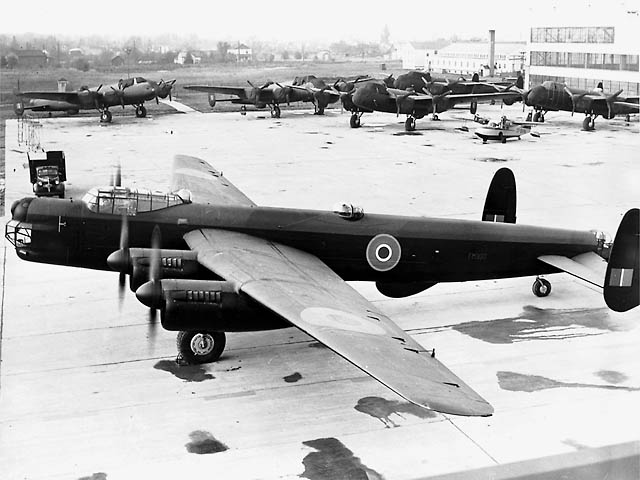
The Avro Lincoln was one of the most significant British long-range bombers to emerge in the immediate post–Second World War period. Although outwardly similar to the famous Avro Lancaster, the Lincoln was a substantially redesigned aircraft, created to meet new strategic requirements that demanded greater range, payload flexibility, and high-altitude performance. It represented the peak of piston-engined heavy bomber development in Britain before the rapid transition to jet-powered designs.
Origins and Development
The Avro Lincoln originated from a late-war requirement for a bomber capable of reaching targets far beyond the range of the Lancaster, particularly in the Pacific theater. While the Lancaster had proven extremely effective over Europe, its operational radius and cruising altitude were limiting factors for global operations. Avro responded by evolving the basic Lancaster concept into a much larger and more capable airframe, initially known during development as the Lancaster IV and Lancaster V before receiving the distinct name Lincoln.
The design process involved extensive structural changes rather than a simple stretch. The wings were lengthened and strengthened, the fuselage was extended, and the overall airframe was optimized for sustained high-altitude flight. Although the Lincoln first flew in June 1944, the war ended before it could see combat, placing it instead into a crucial transitional role during the late 1940s and early 1950s.
Airframe and Structural Design
The Lincoln featured a significantly larger airframe than its predecessor, with an emphasis on aerodynamic efficiency and endurance. The wingspan was increased to approximately 120 feet, compared to the Lancaster’s 102 feet, providing improved lift at high altitudes and allowing greater fuel capacity. The wing structure incorporated a higher aspect ratio, reducing drag during long-range cruise and improving overall fuel efficiency.
The fuselage was lengthened to accommodate additional fuel tanks, crew comfort improvements, and enhanced equipment. The bomb bay was extended and reinforced, enabling the aircraft to carry heavier and more varied payloads. The tailplane was also enlarged, with greater span and area, improving longitudinal stability, particularly during long cruises and when operating at maximum takeoff weight.
The Lincoln retained an all-metal stressed-skin construction, primarily using aluminum alloys. This construction method provided a strong yet relatively lightweight structure capable of withstanding prolonged operations and high operational loads.
Powerplant and Propulsion
The Avro Lincoln was powered by four Rolls-Royce Merlin engines, typically the Merlin 85, 87, or later variants depending on production batch and operator. These engines were among the most advanced piston engines of their time, optimized for high-altitude performance through the use of two-stage, two-speed superchargers.
Each engine produced approximately 1,750 horsepower, driving four-bladed constant-speed propellers. The propellers were designed to maintain efficiency across a wide range of speeds and altitudes, which was essential for a bomber expected to cruise at high altitude for extended periods. Engine cooling and reliability were critical design considerations, as the Lincoln was intended for missions lasting well over ten hours.
The increased fuel capacity, combined with efficient cruise settings, gave the Lincoln an operational range exceeding 4,000 miles, making it one of the longest-ranged piston-engined bombers ever to serve with the Royal Air Force.
Performance Characteristics
The Lincoln offered markedly improved performance over the Lancaster. Its maximum speed was approximately 315 mph at altitude, while cruising speeds were optimized around 275 mph to balance fuel consumption and mission endurance. Service ceiling was significantly higher, reaching around 35,000 feet, placing it beyond the effective reach of many wartime anti-aircraft systems.
Maximum takeoff weight exceeded 82,000 pounds, reflecting the aircraft’s ability to carry substantial fuel loads alongside heavy bomb payloads. Rate of climb was modest compared to later jet bombers, but adequate for its intended operational profile. The aircraft was designed to spend most of its mission at altitude rather than relying on speed for survivability.
Armament and Defensive Systems
Defensive armament on the Avro Lincoln followed established British bomber doctrine but benefited from refinements in turret design and fire control. The aircraft typically carried four remotely powered turrets: nose, dorsal, ventral, and tail. These turrets mounted a total of up to eight 0.50-inch machine guns, a notable upgrade from the .303-inch guns used on earlier bombers.
The tail turret was particularly important, as experience from wartime operations had shown rear attacks to be the most common threat. Improved gun mounting, better sighting systems, and increased ammunition capacity enhanced the Lincoln’s defensive capability. Despite these improvements, the rapid post-war development of jet fighters soon rendered heavy defensive armament less effective, highlighting the transitional nature of the aircraft.
Bomb Load and Mission Flexibility
The Avro Lincoln’s bomb bay was designed to accommodate a wide range of ordnance configurations. Maximum bomb load was approximately 14,000 pounds, although this varied depending on mission range and fuel requirements. The extended bomb bay allowed the carriage of large high-capacity bombs, including weapons exceeding those typically carried by the Lancaster.
The aircraft was also capable of deploying mines and specialized munitions, making it suitable for maritime interdiction and area denial roles. This flexibility allowed the Lincoln to serve not only as a strategic bomber but also as a general-purpose platform for a variety of post-war missions.
Crew and Avionics
The standard crew complement consisted of seven personnel: pilot, flight engineer, navigator, bomb aimer, wireless operator, and two gunners. Crew positions were arranged to improve efficiency and communication, with better heating, oxygen systems, and soundproofing compared to wartime bombers.
Avionics represented a significant step forward. The Lincoln was equipped with advanced navigation aids, including radio navigation systems and radar for bombing and navigation. These systems enhanced accuracy during long-range operations and in poor weather, reflecting lessons learned during the Second World War.
Operational Service and Roles
The Avro Lincoln entered Royal Air Force service in 1945 and quickly became the backbone of Britain’s long-range bomber force during the late 1940s. It served in several overseas theaters, including the Middle East, Africa, and the Far East, where its endurance and payload made it well suited to patrol and strike missions.
One of its most notable operational uses was during the Malayan Emergency, where Lincolns conducted bombing missions against insurgent targets. These operations highlighted both the aircraft’s reliability and its adaptability to counter-insurgency warfare, a role quite different from its original strategic bombing purpose.
The Lincoln was also exported to several countries, including Australia and Argentina, where it served in various roles such as maritime patrol, reconnaissance, and training. In Australia, locally built versions featured minor modifications tailored to regional requirements.
Legacy and Historical Significance
The Avro Lincoln occupies an important place in aviation history as the final evolution of the classic British heavy bomber lineage. It bridged the gap between the massed bomber formations of the Second World War and the emerging era of jet-powered strategic aviation. While it was soon eclipsed by aircraft such as the English Electric Canberra and the V-bombers, the Lincoln demonstrated how far piston-engine technology could be pushed.
