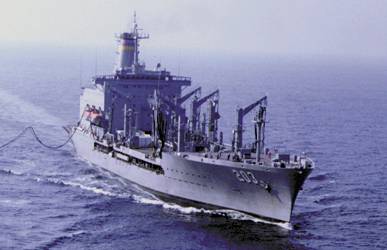
USNS Laramie (T-AO-203) was a fleet replenishment oiler built to meet the expanding logistical demands of the United States Navy during the Cold War. As part of the Cimarron-class oilers, she represented a continuation and refinement of wartime tanker concepts adapted for sustained peacetime and contingency operations. The strategic premise behind Laramie’s construction was simple but critical: modern naval forces, particularly carrier strike groups, required a reliable, mobile source of fuel and limited supplies to remain forward-deployed without dependence on fixed bases.
Named after the Laramie River, the ship entered service under the Military Sea Transportation Service, later known as the Military Sealift Command. Unlike commissioned combatants, Laramie operated primarily with a civilian mariner crew, reflecting a logistical philosophy that emphasized efficiency, endurance, and cost-effective operation. Throughout her career, the ship functioned as an indispensable enabler of naval power rather than a visible instrument of force.
Hull Design and Structural Characteristics
USNS Laramie was built with a welded steel hull optimized for stability, cargo volume, and long-term structural durability. The hull form featured a full-bodied design with a pronounced beam, allowing the ship to carry large quantities of liquid cargo while maintaining sufficient stability during underway replenishment. A deep draft contributed to predictable handling in open-ocean conditions and reduced the effects of roll during fueling operations.
Internal subdivision was extensive, with multiple cargo tanks separated by longitudinal and transverse bulkheads. This configuration improved survivability in the event of hull damage and allowed for the segregation of different fuel types. Structural reinforcement around replenishment stations and machinery spaces reflected the high stresses encountered during connected replenishment, particularly when operating alongside larger combatants in variable sea states.
Dimensions and Displacement Parameters
USNS Laramie measured approximately 553 feet in overall length, with a beam of about 75 feet and a full-load draft approaching 32 feet. Her standard displacement was in the range of 17,000 tons, increasing to over 25,000 tons when fully loaded with fuel and stores. These dimensions placed Laramie among the larger auxiliary vessels of her time, providing the cargo capacity necessary to support sustained fleet operations.
The ship’s size allowed for generous internal tankage while preserving deck space for replenishment equipment and cargo handling systems. The balance between length and beam was carefully chosen to ensure acceptable maneuverability during close-quarters operations without sacrificing cargo volume or seakeeping performance.
Propulsion Plant and Performance
Laramie was powered by a steam propulsion system consisting of oil-fired boilers supplying steam to a single reduction-geared turbine. This machinery arrangement delivered approximately 16,000 shaft horsepower to a single propeller shaft. While not designed for high speed, the propulsion plant provided reliable and economical performance suitable for long-range operations.
The ship’s maximum speed was approximately 16 knots, enabling her to operate effectively with carrier task groups during replenishment evolutions. Endurance was a defining feature, with fuel and freshwater capacity sufficient to support extended deployments without frequent port visits. Auxiliary machinery included turbo-generators for electrical power, supporting cargo pumps, navigation systems, and onboard habitability.
Fuel Cargo Capacity and Tank Arrangement
The primary mission of USNS Laramie was the transportation and delivery of petroleum products. She carried a variety of fuel grades, including naval distillate fuel oil and aviation fuels for carrier air wings. Total liquid cargo capacity exceeded 180,000 barrels, distributed across multiple tanks designed to minimize contamination and allow flexible load planning.
Tank arrangements incorporated heating coils where necessary to maintain fuel viscosity in colder climates. Pumping systems were capable of high-volume transfer rates, ensuring rapid refueling of receiving ships. Redundant piping and valve systems enhanced operational reliability and reduced the risk of mission interruption due to mechanical failure.
Underway Replenishment Systems
Laramie was equipped with multiple underway replenishment stations along both port and starboard sides. These stations featured standardized fueling rigs with span wires, tensioning winches, and reinforced hose saddles. The ship could refuel multiple vessels simultaneously, a capability that significantly increased fleet logistics efficiency during high-tempo operations.
The replenishment systems were designed to accommodate a wide range of receiving ships, from destroyers to aircraft carriers. Careful placement of kingposts and fairleads minimized interference between rigs and improved crew safety. The deck layout emphasized clear working zones and direct access to cargo control stations, enabling precise coordination during complex replenishment evolutions.
Cargo Handling and Auxiliary Support Capabilities
In addition to liquid fuel, USNS Laramie could carry limited quantities of dry cargo, including packaged supplies, spare parts, and provisions. Deck-mounted cranes and winches supported vertical replenishment and pier-side cargo handling. While not a primary dry cargo ship, this capability allowed Laramie to supplement dedicated supply vessels and respond flexibly to operational needs.
The ship also carried basic support equipment for minor maintenance and emergency assistance to other vessels. Workshops and storage areas were integrated into the design, reflecting the expectation that fleet oilers would often operate far from major logistics hubs.
Navigation, Communications, and Control Systems
Laramie was fitted with navigation systems appropriate for global operations, including surface search radar, gyrocompasses, and traditional magnetic compasses. The bridge was designed for sustained watchstanding and precise shiphandling, particularly during replenishment maneuvers that demanded fine speed and course control.
Communications systems included high-frequency and very-high-frequency radios, allowing coordination with task force commanders, receiving ships, and shore-based logistics commands. While the ship did not carry advanced combat sensors, her systems ensured safe integration into fleet operations and compliance with naval command and control requirements.
Defensive Features and Damage Control
As a non-combatant auxiliary, USNS Laramie carried only minimal defensive armament, typically limited to small-caliber machine guns for self-defense against minor threats. Protection against serious attack relied on escorting warships and operational planning rather than organic weaponry.
Damage control was a central design consideration due to the hazards associated with carrying large volumes of fuel. The ship was equipped with extensive firefighting systems, including fixed foam installations, fire mains, and portable equipment. Crew training emphasized rapid response to fires, spills, and flooding, recognizing that survivability depended more on prevention and control than on armor or weapons.
Crew Organization and Habitability Standards
USNS Laramie was operated by a civilian mariner crew under the Military Sea Transportation Service, supported by a small Navy detachment responsible for communications, supply coordination, and mission oversight. This arrangement combined professional maritime expertise with naval operational integration.
Habitability was designed for long deployments, with air-conditioned berthing spaces, a well-equipped galley, and recreational facilities. Compared to combatants of similar vintage, living conditions were relatively spacious, reflecting the expectation of extended voyages and the need to maintain crew efficiency over time.
Operational Role and Strategic Contribution
Throughout her service life, USNS Laramie supported carrier strike groups, amphibious forces, and independent surface units across multiple theaters. By enabling sustained at-sea operations, she directly contributed to the Navy’s ability to project power, deter adversaries, and respond rapidly to crises.
Her operational value lay not in visibility but in reliability. Every sortie flown from a carrier and every mile steamed by a destroyer depended on the uninterrupted flow of fuel delivered by ships like Laramie. This quiet but essential role made her a cornerstone of Cold War naval strategy.
Decommissioning and Legacy
USNS Laramie represented the mature expression of mid-20th-century fleet oiler design. While later classes introduced greater automation, higher speeds, and expanded dry cargo capacity, the fundamental principles demonstrated by Laramie remained valid for decades.
