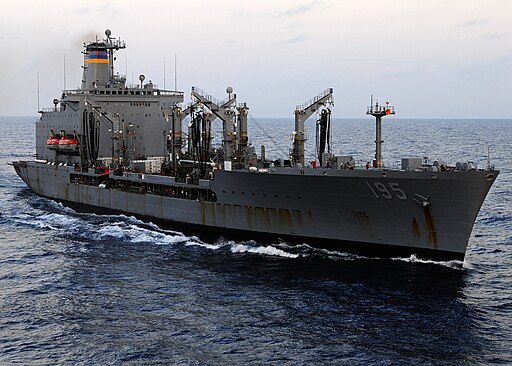
USNS Leroy Grumman (T-AO-195) was a fleet replenishment oiler constructed to support the operational tempo of the United States Navy during the latter decades of the Cold War. As a unit of the Maumee-class oilers, she was designed to provide sustained fuel support to carrier strike groups, amphibious forces, and independent surface combatants operating far from fixed bases. The ship was named in honor of Leroy Randle Grumman, the founder of the Grumman Aircraft Engineering Corporation, reflecting the Navy’s tradition of commemorating individuals who made lasting contributions to American naval and aerospace power.
Placed in service with the Military Sea Transportation Service, later redesignated the Military Sealift Command, Leroy Grumman operated as a non-commissioned auxiliary. This status emphasized her logistical mission rather than combat capability, with a civilian mariner crew forming the core of her complement. Throughout her service life, the ship functioned as a critical enabler of naval operations, ensuring that frontline units could remain deployed for extended periods without interruption.
Hull Form and Structural Design
The hull of USNS Leroy Grumman was engineered to maximize fuel carriage while ensuring stability during demanding underway replenishment operations. Built with a fully welded steel structure, the hull featured a broad beam and deep draft that contributed to a high degree of transverse stability. This was particularly important when operating alongside large carriers, where maintaining steady relative motion was essential for safe fuel transfer.
Internal subdivision was extensive, with numerous longitudinal and transverse bulkheads dividing the hull into cargo tanks, machinery spaces, and service compartments. This arrangement improved damage tolerance and allowed for the segregation of multiple fuel types. Structural reinforcement around replenishment stations, kingposts, and deck fittings addressed the significant loads imposed during connected replenishment in open-ocean conditions.
Principal Dimensions and Displacement
USNS Leroy Grumman had an overall length of approximately 563 feet and a beam of about 77 feet. Her full-load draft approached 32 feet, reflecting the substantial weight of fuel carried when fully loaded. Displacement ranged from roughly 18,000 tons light to over 25,000 tons at full load, placing her among the larger auxiliary vessels in the Navy’s logistics fleet at the time.
These dimensions were carefully selected to balance cargo capacity, seakeeping, and maneuverability. The hull proportions allowed the ship to maintain adequate speed and handling while providing sufficient internal volume for fuel tanks, machinery, and crew accommodations. The size also ensured compatibility with existing naval infrastructure, including piers and replenishment equipment.
Propulsion System and Engineering Layout
Leroy Grumman was powered by a steam propulsion plant consisting of oil-fired boilers feeding a single reduction-geared steam turbine. This machinery produced approximately 16,000 shaft horsepower delivered to a single propeller shaft. The propulsion system emphasized reliability and ease of maintenance over high speed, a logical choice for a vessel expected to operate continuously over long distances.
The ship’s maximum sustained speed was approximately 16 knots, enabling her to keep pace with carrier strike groups during replenishment operations. Auxiliary machinery included ship service turbo-generators that supplied electrical power for cargo pumps, deck equipment, navigation systems, and hotel services. Redundancy in key systems ensured continued operation even in the event of partial machinery failure.
Fuel Capacity and Cargo Tank Configuration
The primary function of USNS Leroy Grumman was the transportation and delivery of petroleum products. She carried multiple grades of fuel, including naval distillate fuel oil and aviation fuels used by carrier-based aircraft. Total liquid cargo capacity exceeded 180,000 barrels, distributed across a complex network of segregated tanks designed to prevent cross-contamination.
Cargo tanks were equipped with heating coils where necessary to maintain fuel flow characteristics in cold environments. The pumping system featured high-capacity centrifugal pumps capable of transferring fuel at rates sufficient to support rapid replenishment of multiple ships. The layout of piping and valves allowed flexible cargo management, enabling the ship to adapt to varying operational requirements.
Underway Replenishment Capabilities
USNS Leroy Grumman was fitted with a comprehensive suite of underway replenishment equipment. Multiple fueling stations were installed along both port and starboard sides, each equipped with span wires, tensioning winches, and standardized hose connections. This configuration allowed the ship to conduct simultaneous fueling operations to two or more receiving vessels.
The replenishment systems were designed to support a wide range of ship types, from destroyers to aircraft carriers. Deck arrangements emphasized clear working spaces and safe crew movement, reducing the risk of accidents during complex evolutions. The ship’s ability to sustain high-tempo replenishment operations made her an indispensable asset during major fleet exercises and deployments.
Dry Cargo and Auxiliary Support Functions
While primarily a fuel carrier, Leroy Grumman also possessed limited dry cargo capabilities. She could transport packaged supplies, spare parts, and provisions to supplement dedicated supply ships. Deck-mounted cranes and winches enabled vertical replenishment and pier-side cargo handling, enhancing the ship’s flexibility.
Additional support facilities included workshops and storage areas for minor repairs and maintenance tasks. These capabilities allowed the ship to provide limited assistance to other vessels and to sustain her own operations during prolonged deployments away from major logistics hubs.
Navigation, Command, and Communications Systems
The ship was equipped with navigation systems appropriate for global operations, including surface search radar, gyrocompasses, and conventional magnetic compasses. The bridge layout supported precise shiphandling, particularly during close-quarters replenishment maneuvers that required fine control of speed and heading.
Communications systems included high-frequency and very-high-frequency radios, enabling coordination with task group commanders, receiving ships, and shore-based logistics authorities. Although not fitted with combat sensors, Leroy Grumman’s communications suite ensured effective integration into fleet command and control networks.
Defensive Measures and Damage Control
As a non-combatant auxiliary, USNS Leroy Grumman carried minimal defensive armament, typically limited to small-caliber machine guns intended for self-defense against minor threats. The ship relied primarily on escorting combatants for protection in hostile environments.
Damage control was a critical aspect of the design, given the risks associated with transporting large volumes of flammable fuel. The ship was equipped with extensive firefighting systems, including fixed foam installations, fire mains, and portable extinguishing equipment. Crew training emphasized rapid detection and response to fires, spills, and flooding, underscoring the importance of prevention and containment.
Crew Composition and Habitability
Leroy Grumman was operated by a civilian mariner crew under the Military Sea Transportation Service, supplemented by a small Navy detachment responsible for communications, supply coordination, and mission liaison. This blended crewing model combined commercial maritime expertise with naval operational oversight.
Habitability standards were designed for long deployments, with air-conditioned berthing spaces, a capable galley, and recreational areas to support crew morale. Compared to many combatants of similar age, living conditions were relatively spacious, reflecting the ship’s role as an endurance-oriented logistics platform.
Operational Service and Strategic Value
Throughout her service life, USNS Leroy Grumman supported naval operations across multiple theaters, enabling sustained at-sea presence for carrier strike groups and other forces. By providing reliable fuel delivery under a wide range of conditions, she directly contributed to the Navy’s ability to project power and maintain readiness during periods of global tension.
Her strategic value lay in consistency and dependability rather than visibility. Every extended deployment and high-tempo exercise relied on ships like Leroy Grumman to function as the logistical backbone of the fleet, making her contributions fundamental to overall naval effectiveness.
Deactivation and Enduring Legacy
USNS Leroy Grumman represented a mature and effective design within the Maumee-class oiler lineage. While later logistics ships introduced greater automation and expanded mission profiles, the core principles embodied by Leroy Grumman remained central to naval logistics planning.
.jpg)